

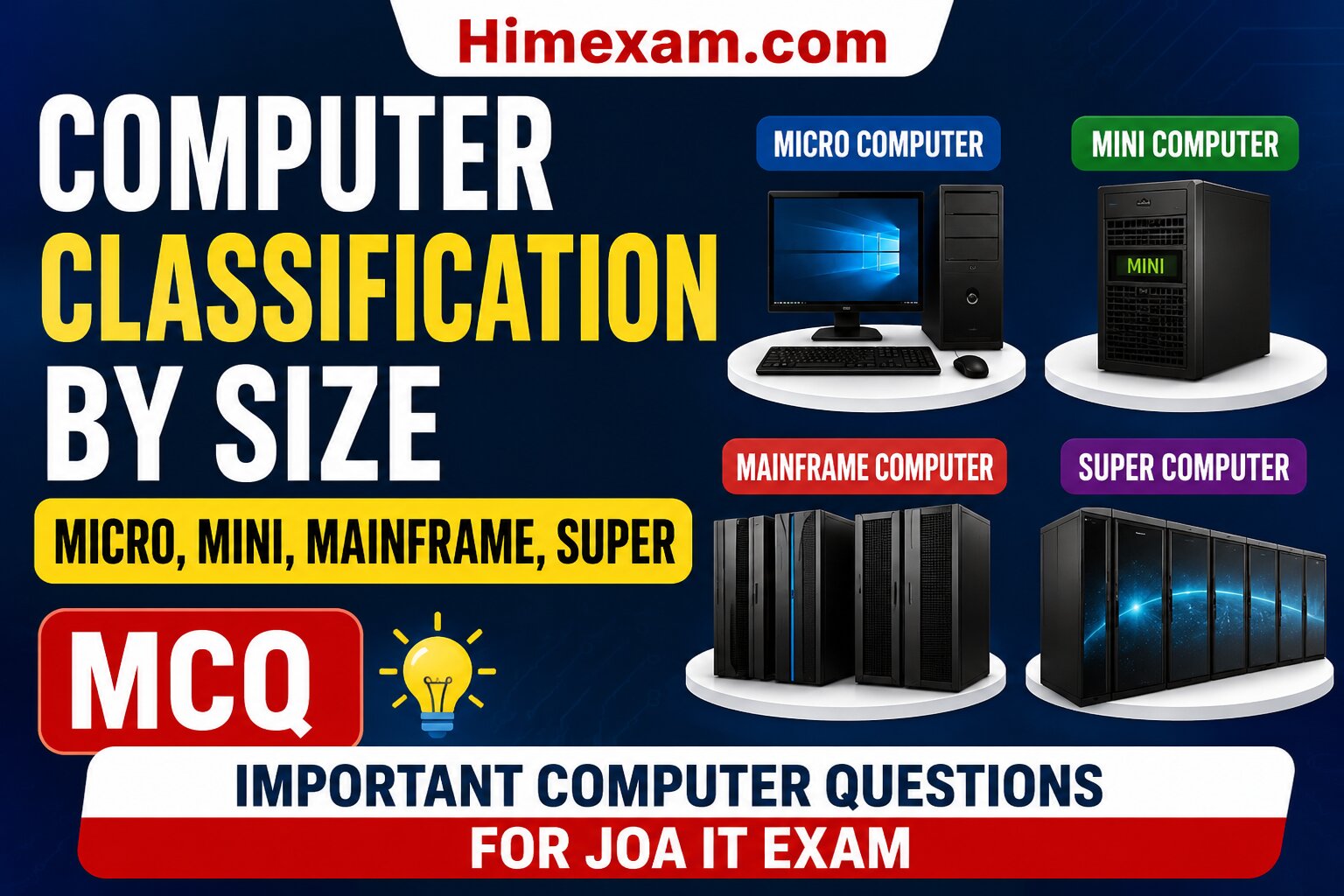


Computer Classification by Size (Micro, Mini, Mainframe, Super) MCQ for JOA IT Exam | Important Computer Questions
Prepare for the Himachal Pradesh JOA IT Exam with these important MCQs on “Definition & Characteristics of Computer.” This quiz covers basic computer fundamentals including speed, accuracy, storage capacity, automation, diligence, versatility, reliability, and other essential features of computers frequently asked in competitive exams like HPSSC JOA IT, SSC, Banking, Railway, Police, and State Exams.


These multiple choice questions are specially designed for beginners and aspirants preparing for computer awareness sections. Practice these latest and exam-oriented MCQs to improve your score in the JOA IT examination.
Computer Classification by Size (Micro, Mini, Mainframe, Super) MCQ for JOA IT Exam | Important Computer Questions
1. Which type of computer is primarily designed to handle massive data processing workloads for thousands of simultaneous users in an enterprise environment?
A) Microcomputer
B) Minicomputer
C) Mainframe Computer
D) Supercomputer
Answer: C
2. The processing speed of modern supercomputers is universally measured in which of the following units?
A) MIPS (Million Instructions Per Second)
B) FLOPS (Floating-Point Operations Per Second)
C) MHz (Megahertz)
D) Gbps (Gigabits per second)
Answer: B
HPRCA JOA IT CBT TEST SERIES:- CLICK HERE
3. What is the fundamental difference between a Mainframe computer and a Supercomputer?
A) Supercomputers are smaller than mainframes.
B) Mainframes focus on high-throughput transaction processing, while supercomputers focus on ultra-fast complex scientific calculations.
C) Supercomputers use serial processing, while mainframes use parallel processing.
D) Mainframes execute a single program at a time, whereas supercomputers execute millions.
Answer: B
4. Which category of computers includes devices like desktop PCs, laptops, tablets, and smartphones?
A) Minicomputers
B) Mainframes
C) Microcomputers
D) Workstations
Answer: C
5. What type of computer is typically configured as a mid-range server to support medium-sized business networks, manufacturing processes, or departmental tasks?
A) Supercomputer
B) Minicomputer
C) Microcomputer
D) Embedded Computer
Answer: B
6. Microcomputers are also widely known as “Computers on a Chip” because their entire Central Processing Unit (CPU) is contained on a single chip called a:
A) Microcontroller
B) Microprocessor
C) Motherboard
D) Integrated Circuit
Answer: B
HPRCA JOA IT CBT TEST SERIES:- CLICK HERE
7. In the context of supercomputing, what does the term “Massively Parallel Processing” (MPP) mean?
A) Using a single CPU to handle multiple files.
B) Linking thousands of processors to work together on parts of a single large task simultaneously.
C) Processing data sequentially using multiple hard drives.
D) Running micro, mini, and mainframe systems on the same network.
Answer: B
8. Which of the following is considered the world’s first commercially successful minicomputer, launched by Digital Equipment Corporation (DEC) in 1965?
A) ENIAC
B) PDP-8
C) IBM 360
D) Cray-1
Answer: B
9. Mainframe computers utilize specialized, highly secure, and isolated virtual partitions within a single physical system. These partitions are known as:
A) Nodes
B) Clusters
C) LPARs (Logical Partitions)
D) Micro-kernels
Answer: C
10. A standard programmable smart watch, washing machine controller, or car braking system uses which specialized type of microcomputer?
A) Handheld computer
B) Laptop
C) Embedded computer
D) Workstation
Answer: C
11. Which architectural series introduced by IBM in 1964 is widely credited with establishing the standard design and market dominance of Mainframe computers?
A) IBM System/360
B) IBM PC-XT
C) IBM ThinkPad
D) IBM Roadrunner
Answer: A
12. Which of the following ranks among the fastest and most advanced supercomputing platforms built by India?
A) PARAM Siddhi-AI
B) Anurag-PC
C) Siddhartha-1
D) Sagar-20
Answer: A
13. High-end microcomputers designed for intensive architectural rendering, 3D animation, or complex engineering design (CAD) that require more processing power than a standard PC are classified as:
A) Minicomputers
B) Workstations
C) Mainframes
D) Super-micros
Answer: B
14. What specific feature allows Mainframe computers to achieve “five-nines” (99.999%) availability and run for decades without unexpected shutdowns?
A) High-speed liquid cooling systems
B) Extensive hardware redundancy and hot-swappable components
C) Use of consumer-grade Intel Core i9 processors
D) Small physical footprint
Answer: B
15. Which system is universally recognized as the world’s first successful dedicated supercomputer, designed by Seymour Cray and installed at Los Alamos in 1976?
A) CDC 6600
B) Cray-1
C) Deep Blue
D) UNIVAC I
Answer: B
16. Minicomputers are technically positioned between which two computer classes in terms of size, cost, and processing capacity?
A) Microcomputers and Mainframes
B) Mainframes and Supercomputers
C) Embedded systems and Microcomputers
D) Workstations and Laptops
Answer: A
17. What type of operating system environment is most commonly found running on modern corporate Mainframe systems like IBM z/OS?
A) Single-user, single-tasking OS
B) Highly secure, high-volume batch and online transaction processing OS
C) Standard desktop Windows OS
D) Real-time embedded OS
Answer: B
18. The overall computational performance of a Mainframe computer is traditionally characterized and measured in:
A) FLOPS
B) MIPS or Millions of Millions of Instructions Per Second
C) Kilobytes per minute
D) Clock speed in KHz
Answer: B
19. Which of the following is an example of an application that strictly requires the processing power of a Supercomputer?
A) Managing a local school’s student attendance database
B) Running an e-commerce website with 500 active users
C) Advanced molecular modeling and global climate forecasting
D) Processing monthly payroll for a small retail store
Answer: C
20. Which term describes a collection of independent microcomputers connected via a high-speed local network to act as a single, cost-effective supercomputer?
A) Mainframe Grid
B) Computer Cluster (or Beowulf Cluster)
C) Time-sharing system
D) Minicomputer matrix
Answer: B
21. What historical shift led to the rapid decline of traditional mid-range minicomputers in the late 1980s and 1990s?
A) Mainframes became significantly cheaper.
B) Microcomputers (PCs) became highly powerful, cheap, and networked via Client-Server architecture.
C) Supercomputers replaced all business desktop operations.
D) Minicomputers were banned due to high power consumption.
Answer: B
HPRCA JOA IT CBT TEST SERIES:- CLICK HERE
22. Which component serves as the absolute defining core of any Microcomputer system?
A) Vacuum tubes
B) Magnetic drum memory
C) Microprocessor
D) Punch card reader
Answer: C
23. Large airline reservation systems (like Sabre) and global credit card processing networks (like Visa) rely heavily on which class of computers for transaction handling?
A) Supercomputers
B) Mainframes
C) Minicomputers
D) High-end Desktop Microcomputers
Answer: B
24. The legendary “Cray-1” supercomputer featured a distinctive design layout to keep wire lengths as short as possible. What was its physical shape?
A) A giant solid cube
B) A C-shaped cylindrical tower
=C) A long flat rectangular table
D) Multiple separate vertical panels spread across three rooms
Answer: B
25. In the classification of computers by size, where does a Tablet PC or a Netbook strictly fit?
A) Minicomputer category
B) Microcomputer category
C) Workstation category
D) Hybrid Embedded category
Answer: B
26. Which type of memory architecture is heavily emphasized in supercomputers to ensure processors are never starved of data during complex calculations?
A) Massively distributed, high-bandwidth parallel memory architectures
B) Standard single-channel DDR2 RAM
C) Virtual memory stored exclusively on mechanical hard drives
D) Read-Only Memory (ROM) chips
Answer: A
27. What makes a minicomputer different from a microcomputer regarding multi-user capability?
A) Microcomputers naturally support hundreds of users simultaneously via dummy terminals.
B) Minicomputers were designed from the ground up to support multiple users (multi-user OS) via time-sharing terminals.
C) Minicomputers can only support one user at a time.
D) Microcomputers do not have keyboards or displays.
Answer: B
28. What is the name of India’s first indigenous supercomputer series developed by the Centre for Development of Advanced Computing (C-DAC)?
A) AGNI
B) PARAM
C) PRITHVI
D) TRISHUL
Answer: B
29. Mainframe systems feature dedicated secondary processors tasked exclusively with managing Input/Output operations to free up the primary CPU. These are called:
A) Coprocessors
B) I/O Channels (or Channel Subsystems)
C) Front-side buses
D) Network interface cards
Answer: B
30. Which of the following is a classic example of a mid-range enterprise server that evolved out of the minicomputer lineage?
A) IBM AS/400 (later IBM iSeries)
B) Apple Macintosh Plus
C) Commodore 64
D) Intel 8086 Kit
Answer: A
31. What primary cooling mechanism is required by most modern, massive-scale supercomputers to dissipate the immense heat generated by thousands of processors?
A) Passive aluminum heat sinks
B) Standard desktop chassis fans
C) Liquid cooling loops (using water or specialized refrigerants)
D) Open-air window ventilation
Answer: C
HPRCA JOA IT CBT TEST SERIES:- CLICK HERE
32. The term “Personal Computer” (PC) is a direct synonym for which size-based classification?
A) Minicomputer
B) Mainframe
C) Microcomputer
D) Supercomputer
Answer: C
33. Which computing tier is engineered with an emphasis on “Fault Tolerance” so that if a memory module or CPU fails, the system switches to a backup component instantly without interrupting user transactions?
A) Basic Microcomputers
B) Mainframe Computers
C) Early Minicomputers
D) Entry-level Laptops
Answer: B
34. Who is universally regarded as the “Father of Supercomputing”?
A) Charles Babbage
B) Seymour Cray
C) Alan Turing
D) John von Neumann
Answer: B
35. A “Handheld PC” or Personal Digital Assistant (PDA) falls under which broad category of computer sizes?
A) Microcomputer
B) Minicomputer
C) Mainframe
D) Nanocomputer
Answer: A
36. In a mid-range minicomputer system environment, how did standard users traditionally interact with the central machine?
A) Through individual connected graphics workstations
B) Through “Dumb Terminals” consisting only of a keyboard and a monitor with no local processing power
C) By inserting individual floppy disks directly into the server
D) Via wireless smartphone applications
Answer: B
37. Which system developed by C-DAC in 1991 is recognized as India’s very first indigenous supercomputer?
A) PARAM 10000
B) PARAM 8000
C) PARAM Yuva
D) PARAM Brahma
Answer: B
38. Which type of computer system has its hardware components embedded directly into an automobile dashboard to control air conditioning, navigation, and airbags?
A) Mainframe
B) Minicomputer
C) Embedded Microcomputer
D) Super-station
Answer: C
39. When an enterprise processes millions of overnight bank account updates or insurance premium calculations in huge non-interactive blocks, it is utilizing the mainframe’s strength in:
A) Real-time 3D vector rendering
B) Batch Processing
C) Computational fluid dynamics
D) Interactive gaming simulation
Answer: B
40. What is the technical name given to each individual, independent computer system connected together within a larger Supercomputer cluster network?
A) Terminal
B) Element
C) Node
D) Unit
Answer: C
41. Which of the following accurately lists computer classifications by size in ascending order (from smallest to largest processing capability and scale)?
A) Supercomputer -> Mainframe -> Minicomputer -> Microcomputer
B) Microcomputer -> Minicomputer -> Mainframe -> Supercomputer
C) Minicomputer -> Microcomputer -> Mainframe -> Supercomputer
D) Microcomputer -> Mainframe -> Minicomputer -> Supercomputer
Answer: B
42. Which architectural element became obsolete because modern microprocessors can now execute more instructions per second than a 1970s room-sized minicomputer?
A) Cache memory
B) The standalone multi-cabinet Minicomputer
C) Hard drives
D) Operating Systems
Answer: B
43. The “Altair 8800,” released in 1974 based on the Intel 8080 chip, is historically celebrated as the first commercially viable:
A) Supercomputer
B) Mainframe
C) Minicomputer
D) Microcomputer
Answer: D
44. Which feature is highly characteristic of Mainframe computer architecture?
A) Portability and low power consumption
B) Massive I/O bandwidth capable of moving immense volumes of data simultaneously
C) Single-threaded instruction execution models
D) Heavy reliance on external graphics processing units (GPUs) for daily business transactions
Answer: B
45. Which metric denotes one quadrillion ($10^{15}$) floating-point operations per second, a standard benchmark milestone passed by modern supercomputers?
A) Megafloops
B) Gigafloops
C) Teraflops
D) Petaflops
Answer: D
46. Desktop computers, laptops, and workstations are all built using a single-chip CPU architecture. This design places them firmly in the category of:
A) Microcomputers
B) Macromainframes
C) Midrange systems
D) Analog machines
Answer: A
47. Why are supercomputers generally considered unsuitable for standard corporate banking ledger transactions?
A) They lack the storage space for customer records.
B) They are optimized for raw arithmetic speed on concentrated mathematical problems rather than processing millions of separate, simple individual user inputs and outputs.
C) They cannot run multi-user operating systems.
D) They do not support binary arithmetic.
Answer: B
48. Digital Equipment Corporation (DEC), Data General, and Prime Computer were leading historical manufacturers of which class of systems?
A) Microcomputers
B) Supercomputers
C) Minicomputers
D) Embedded Microcontrollers
Answer: C
49. What type of computer architecture is optimized to execute a single, highly complex mathematical formula across a massive array of data points simultaneously, as seen in supercomputing applications?
A) SISD (Single Instruction, Single Data)
B) SIMD (Single Instruction, Multiple Data) or MIMD (Multiple Instruction, Multiple Data)
C) MISD (Multiple Instruction, Single Data)
D) Non-pipelined scalar processing
Answer: B
50. The ultimate metric of a Mainframe’s efficiency is its ability to ensure data integrity during simultaneous updates across thousands of databases. This property is known as:
A) High FLOPS throughput
B) ACID compliance in transaction processing
C) Vector rendering capacity
D) Wireless network handshaking
Answer: B
हमारे बारे में – Himexam.com
Himexam.com हिमाचल प्रदेश व अखिल भारतीय प्रतियोगी परीक्षाओं के लिए एक विश्वसनीय पोर्टल है। यहाँ आपको नवीनतम HP Govt Jobs, All India Jobs, HP GK, करेंट अफेयर्स, वन लाइनर प्रश्न, जिलेवार GK और पिछले वर्षों के प्रश्न पत्र की जानकारी एक ही जगह मिलती है। हमारी कोशिश है कि हर अभ्यर्थी को सही और समय पर अध्ययन सामग्री मिले।
 WhatsApp
 Facebook
 Telegram
 Instagram