

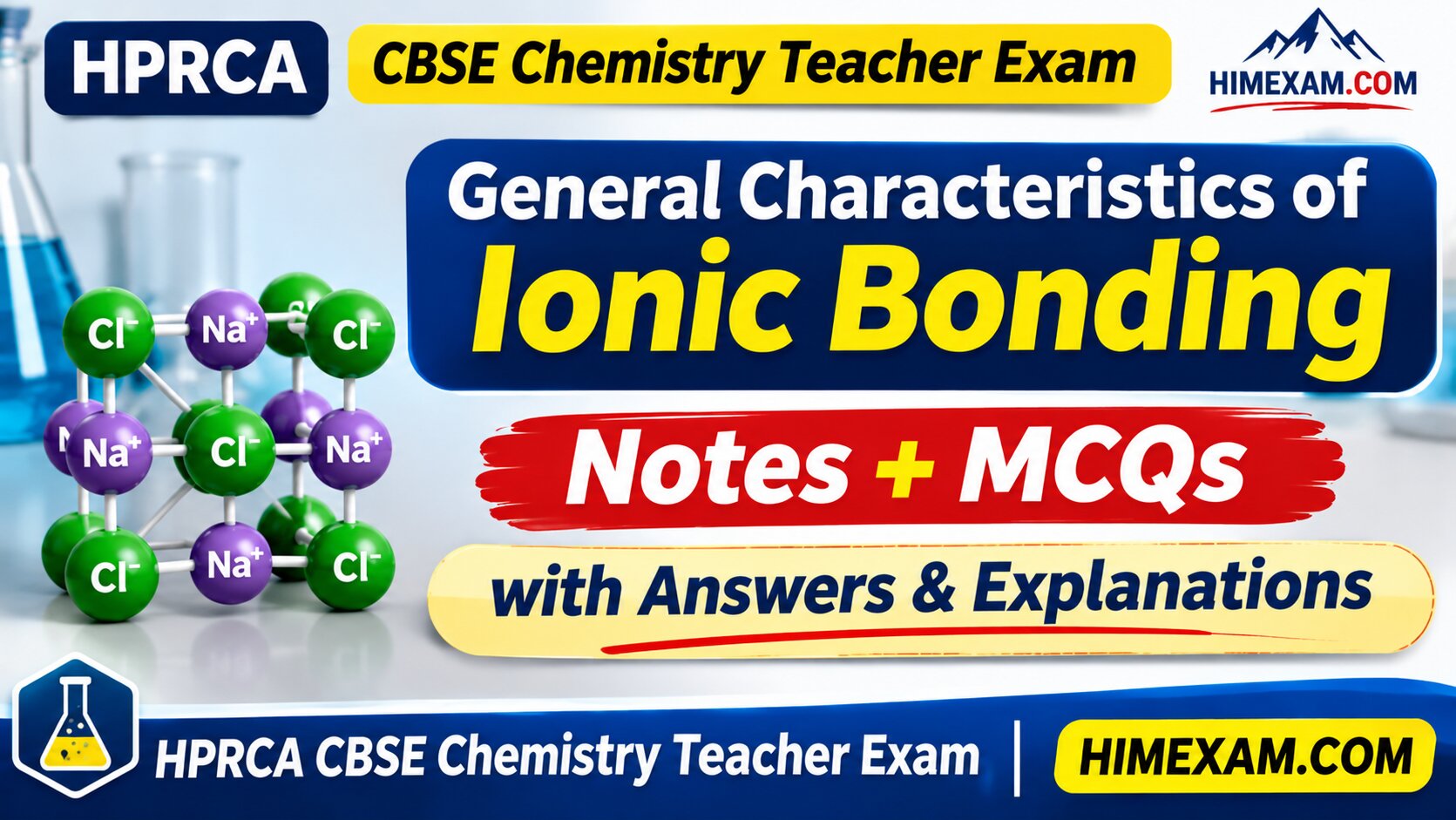


General Characteristics of Ionic Bonding Notes+ MCQs with Answers & Explanations – HPRCA CBSE Chemistry Teacher Exam
General Characteristics of Ionic Bonding – Complete Chemistry Notes
1. Introduction to Chemical Bonding
Chemical bonding refers to the attractive forces that hold atoms or ions together in a chemical substance. Atoms form chemical bonds to achieve a more stable electronic arrangement and lower their overall energy.


Most chemical bonds can be broadly classified into the following categories:
- Ionic bond: Formed through electron transfer and electrostatic attraction between oppositely charged ions.
- Covalent bond: Formed through the sharing of electron pairs between atoms.
- Metallic bond: Involves attraction between positive metal ion cores and delocalised valence electrons.
Ionic bonding is particularly important in compounds formed between electropositive and electronegative elements, although ionic compounds are not restricted to combinations of metals and non-metals.
2. Definition of Ionic Bond
The ionic bond is also known as an electrovalent bond.
In a typical ionic bond:
- One atom loses one or more electrons and forms a cation.
- Another atom gains those electrons and forms an anion.
- The oppositely charged ions attract each other through electrostatic forces.
- The resulting ionic solid generally forms an extended three-dimensional crystal lattice.
Sodium has electronic configuration 2, 8, 1. It loses one electron to form Na+.
Chlorine has electronic configuration 2, 8, 7. It gains one electron to form Cl−.
The oppositely charged ions attract each other:
The formation of the ionic compound involves electron transfer followed by electrostatic attraction. In solid sodium chloride, the ions are arranged in a crystal lattice rather than existing as isolated NaCl molecules.
3. Mechanism of Formation of Ionic Bond
The formation of a typical ionic compound involves several important steps:
Step 1: Removal of Electron from the Metal Atom
An electropositive atom loses one or more electrons to form a positively charged ion. The energy required for the removal of an electron from an isolated gaseous atom is called ionisation enthalpy.
For the removal of successive electrons, the corresponding ionisation enthalpies are represented as first, second, third, and so on.
Step 2: Addition of Electron to the Non-metal Atom
An electronegative atom gains electron(s) and forms a negatively charged ion. The enthalpy change associated with the addition of an electron to an isolated gaseous atom is called electron gain enthalpy.
Electron gain enthalpy is generally negative for many non-metals because energy is released during electron addition. However, this is not universally true for every electron addition.
Step 3: Electrostatic Attraction
The oppositely charged ions attract one another due to Coulombic forces. Their arrangement in a crystal lattice releases lattice energy when the lattice is formed from gaseous ions.
Step 4: Formation of a Stable Ionic Crystal
The ions arrange themselves in a definite three-dimensional pattern. The resulting structure is called an ionic crystal or ionic lattice.
4. Examples of Ionic Bond Formation
4.1 Sodium Chloride (NaCl)
Sodium loses one electron and chlorine gains one electron.
Charge balance: one Na+ ion combines with one Cl− ion.
4.2 Magnesium Oxide (MgO)
Magnesium loses two electrons, while oxygen gains two electrons.
One Mg2+ ion and one O2− ion produce electrically neutral MgO.
4.3 Calcium Chloride (CaCl2)
Calcium loses two electrons, and each chlorine atom gains one electron.
One Ca2+ ion is balanced by two Cl− ions.
4.4 Sodium Oxide (Na2O)
Two sodium atoms each lose one electron, while one oxygen atom gains two electrons.
Two Na+ ions balance one O2− ion.
5. General Characteristics of Ionic Bonding
Ionic compounds possess several characteristic properties arising mainly from the strong electrostatic forces between their ions and their crystal structures.
5.1 Formation of Cations and Anions
Ionic bonding involves the formation of positively and negatively charged ions.
- Cations are formed by the loss of electrons.
- Anions are formed by the gain of electrons.
- The charges of the ions determine the stoichiometric ratio in the formula of an ionic compound.
5.2 Electrostatic Nature
The ionic bond is primarily electrostatic in nature. It results from the Coulombic attraction between oppositely charged ions.
Unlike a typical covalent bond, ionic bonding is not based on a localised shared electron pair between two particular atoms.
5.3 Non-directional Character
Ionic bonding is generally considered non-directional because electrostatic attraction acts in all directions around an ion.
An ion attracts surrounding ions of opposite charge without requiring a particular orientation of an electron-pair overlap.
5.4 Formation of Crystal Lattice
Ionic compounds generally exist as crystalline solids under ordinary conditions. Their ions occupy definite positions in a regular, repeating three-dimensional arrangement.
The structure is maintained by attractive interactions between oppositely charged ions and repulsive interactions between like-charged ions.
5.5 High Melting and Boiling Points
Most ionic compounds have relatively high melting and boiling points because considerable energy is required to overcome the strong electrostatic interactions holding their ionic lattices together.
The melting point depends on several factors, including:
- Magnitude of ionic charges.
- Size of the ions.
- Crystal structure and coordination environment.
- Strength of the overall lattice interactions.
However, ionic compounds do not all have identical or universally high melting points. Some ionic compounds, especially certain organic salts, have comparatively low melting points.
5.6 Hard and Brittle Nature
Many ionic crystals are hard because their ions are held in a strongly bound lattice. However, they are also brittle.
When an external force shifts one layer of ions relative to another, ions with similar charges may come close to each other. The resulting strong repulsion can cause the crystal to fracture.
5.7 Solubility in Polar Solvents
Many ionic compounds dissolve in polar solvents such as water. Polar solvent molecules stabilise separated cations and anions through ion-dipole interactions.
However, solubility depends on the balance between lattice enthalpy, solvation enthalpy, and entropy changes.
Therefore, all ionic compounds are not necessarily soluble in water.
Examples:
- NaCl: soluble in water.
- KNO3: soluble in water.
- AgCl: sparingly soluble in water.
- BaSO4: very sparingly soluble in water.
5.8 Electrical Conductivity
Solid ionic compounds generally do not conduct electricity because their ions are fixed at lattice positions and cannot move freely through the crystal.
When molten or dissolved in a suitable solvent, their ions become mobile and can carry electric current.
| Physical State | Electrical Conductivity | Reason |
|---|---|---|
| Solid ionic compound | Generally does not conduct | Ions are fixed in lattice positions. |
| Molten ionic compound | Conducts electricity | Ions become mobile. |
| Aqueous ionic solution | Conducts if sufficient ions are present | Mobile hydrated ions carry charge. |
5.9 Absence of Discrete Molecules in Ionic Crystals
Ionic solids generally do not consist of separate molecules. They contain a large number of ions arranged in a continuous crystal lattice.
Consequently, their chemical formulas represent the simplest whole-number ratio of cations to anions, known as the formula unit.
For example:
- NaCl represents a 1:1 ratio of Na+ and Cl−.
- MgCl2 represents a 1:2 ratio of Mg2+ and Cl−.
- Al2O3 represents a 2:3 ratio of Al3+ and O2−.
5.10 High Lattice Enthalpy
The stability of ionic crystals is strongly influenced by lattice enthalpy.
Greater electrostatic attraction generally produces a more stable lattice and a larger magnitude of lattice enthalpy.
5.11 Ionic Bonding Is Not Completely Ionic in Every Compound
Many compounds considered ionic possess some degree of covalent character. This occurs because cations can distort the electron clouds of anions, leading to electron density sharing between the ions.
The degree of covalent character is influenced by ionic size, charge and polarising ability.
6. Lattice Enthalpy of Ionic Compounds
For sodium chloride:
When lattice enthalpy is defined for lattice formation, the process is generally exothermic and its value is negative.
Some textbooks and thermochemical calculations define lattice enthalpy in the reverse direction, as the energy required to separate one mole of an ionic solid into gaseous ions. This value is positive.
6.1 Factors Affecting Lattice Enthalpy
Factor 1: Ionic ChargeGreater ionic charges generally produce stronger electrostatic attraction and higher lattice enthalpy in magnitude, provided other factors are comparable.
For example, MgO generally has a much larger lattice enthalpy magnitude than NaCl because MgO contains doubly charged ions.
Factor 2: Ionic RadiusSmaller ions can approach each other more closely, resulting in stronger electrostatic attraction and a greater magnitude of lattice enthalpy.
Factor 3: Crystal StructureThe coordination environment and arrangement of ions also influence the overall lattice energy.
6.2 Coulomb’s Law and Ionic Attraction
The electrostatic interaction between two point charges is described by Coulomb’s law.
Where:
- F = magnitude of electrostatic force.
- q1 and q2 = ionic charges.
- r = distance between the charges.
- ε0 = permittivity of free space.
For oppositely charged ions, the interaction is attractive.
The electrostatic potential energy of two point charges is:
For oppositely charged ions, this potential energy is negative when zero energy is taken at infinite separation.
7. Born–Landé Equation
The Born–Landé equation is used to calculate the lattice energy of an ionic crystal using an electrostatic model with a repulsive term.
Where:
- U = lattice formation energy per mole.
- NA = Avogadro constant.
- M = Madelung constant.
- z+ = charge number of the cation.
- z− = magnitude of charge number of the anion.
- e = elementary charge.
- ε0 = permittivity of free space.
- r0 = nearest-neighbour cation-anion distance.
- n = Born exponent.
The equation describes the balance between long-range electrostatic attraction and short-range repulsion.
7.1 Madelung Constant
The Madelung constant is a dimensionless constant that represents the contribution of the electrostatic interactions of all ions in a crystal lattice.
It depends on the geometry and arrangement of the crystal structure, not merely on the chemical identity of the ions.
For the rock-salt (NaCl) structure, the Madelung constant is approximately 1.7476.
7.2 Born Exponent
The Born exponent represents the strength and nature of short-range repulsion in the Born–Landé model. It is associated with the electronic configurations of the ions and the repulsive potential.
8. Born–Haber Cycle
The Born–Haber cycle is a thermochemical cycle based on Hess’s law. It is used to calculate lattice enthalpy and analyse the energetics involved in the formation of ionic compounds.
It generally includes the following steps:
- Conversion of a metal into gaseous atoms (atomisation or sublimation, depending on the metal’s initial state).
- Dissociation of the non-metal molecule into gaseous atoms, where necessary.
- Ionisation of gaseous metal atoms.
- Electron gain by gaseous non-metal atoms.
- Formation of the ionic solid from gaseous ions.
8.1 Born–Haber Cycle for Sodium Chloride
The overall formation reaction is:
Important thermochemical steps:
Step 1: Sublimation of sodium
Na(s) → Na(g)
Step 2: Ionisation of sodium
Na(g) → Na+(g) + e−
Step 3: Dissociation of chlorine
½Cl2(g) → Cl(g)
Step 4: Electron gain by chlorine
Cl(g) + e− → Cl−(g)
Step 5: Lattice formation
Na+(g) + Cl−(g) → NaCl(s)
According to Hess’s law:
Here:
- ΔHf° = standard enthalpy of formation.
- ΔHsub = enthalpy of sublimation of sodium.
- IE1 = first ionisation enthalpy of sodium.
- D(Cl2) = bond dissociation enthalpy of chlorine.
- ΔHeg = electron gain enthalpy of chlorine.
- ΔHlatt,form = lattice formation enthalpy.
9. Factors Favouring the Formation of Ionic Bonds
The formation of an ionic compound depends on the overall energy change of the process rather than electron transfer alone.
9.1 Low Ionisation Enthalpy
Atoms with low ionisation enthalpy can lose electrons relatively easily. This favours cation formation.
9.2 Favourable Electron Gain Enthalpy
Atoms that release energy on gaining electrons can favour anion formation.
9.3 High Lattice Enthalpy Magnitude
Strong attraction between oppositely charged gaseous ions can release considerable energy when an ionic lattice forms.
9.4 Overall Thermodynamic Stability
The formation of an ionic solid is favoured when the overall Gibbs free energy change is negative under the specified conditions.
Where ΔG is Gibbs free energy change, ΔH is enthalpy change, T is absolute temperature and ΔS is entropy change.
It is important to remember that a favourable enthalpy change alone does not always guarantee spontaneity. Entropy and temperature must also be considered.
10. Factors Affecting Ionic Character
Ionic character refers to the extent to which a bond exhibits ionic behaviour. In real compounds, bonding often exists on a continuum between predominantly ionic and predominantly covalent character.
10.1 Electronegativity Difference
A greater electronegativity difference between two bonded atoms generally favours greater ionic character.
However, electronegativity difference alone cannot accurately determine the actual percentage of ionic character.
10.2 Charge on the Ions
Highly charged ions often experience strong electrostatic interactions. However, highly charged and small cations can also strongly polarise anions, increasing covalent character.
10.3 Size of the Ions
The size of the ions influences their electrostatic attraction and polarisation. Smaller cations generally have greater polarising power.
11. Fajans’ Rules
Fajans’ rules help predict the extent of covalent character in compounds that are primarily ionic.
The basic principle is that a cation can distort the electron cloud of an anion. This distortion is called polarisation.
11.1 Polarising Power of Cation
A cation with a small radius and high positive charge has high charge density and strong polarising power.
Examples:
- Al3+ has greater polarising power than Na+.
- Mg2+ has greater polarising power than Na+.
- Li+ generally has greater polarising power than Cs+ because Li+ is smaller.
11.2 Polarisability of Anion
Larger anions are generally more easily polarised because their outer electron clouds are more diffuse.
For the halide ions, polarisability generally increases in the order:
11.3 Effect of Ionic Charge
Greater positive charge on a cation generally increases its polarising power when other factors are comparable. Greater negative charge on an anion generally increases its polarisability.
11.4 Effect of Electronic Configuration
Cations having a pseudo-noble gas configuration (often involving 18 electrons in the outer shells) may show greater polarising power than comparable cations with noble-gas configurations because of their different shielding characteristics.
LiI has appreciable covalent character because Li+ is small and I− is large and highly polarisable.
CsF is predominantly ionic because Cs+ has low polarising power and F− is relatively difficult to polarise.
12. Comparison Between Ionic and Covalent Bonds
| Property | Ionic Bond | Covalent Bond |
|---|---|---|
| Formation | Electron transfer followed by electrostatic attraction. | Sharing of electron pairs. |
| Nature | Primarily electrostatic. | Primarily electron-pair sharing. |
| Direction | Generally non-directional. | Generally directional. |
| Structure | Usually an extended ionic lattice in solids. | May form discrete molecules or giant covalent networks. |
| Melting point | Often high, but exceptions occur. | Highly variable. |
| Electrical conductivity | Generally conducts when molten or suitably dissolved. | Usually poor, with important exceptions such as graphite. |
| Solubility | Many dissolve in polar solvents. | Depends on molecular polarity and intermolecular interactions. |
| Mechanical property | Crystalline ionic solids are generally hard and brittle. | Depends on molecular or network structure. |
13. Coordination Number in Ionic Crystals
The coordination number of an ion in a crystal is the number of nearest-neighbour ions of opposite charge surrounding it.
Some important crystal structures are:
| Crystal Structure | Example | Coordination Number (Cation : Anion) |
|---|---|---|
| Rock-salt structure | NaCl | 6 : 6 |
| Caesium chloride structure | CsCl | 8 : 8 |
| Zinc blende structure | ZnS | 4 : 4 |
| Fluorite structure | CaF2 | 8 : 4 |
| Anti-fluorite structure | Li2O | 4 : 8 |
The coordination number is influenced by ionic sizes, charge considerations and the crystal structure.
14. Radius Ratio Rule
The radius ratio rule is a simplified geometrical model used to predict the coordination number of ions in ionic crystals.
Where r+ is the radius of the cation and r− is the radius of the anion.
| Radius Ratio | Predicted Coordination Number | Geometry |
|---|---|---|
| 0.155 – 0.225 | 3 | Triangular |
| 0.225 – 0.414 | 4 | Tetrahedral |
| 0.414 – 0.732 | 6 | Octahedral |
| 0.732 – 1.000 | 8 | Cubic |
These are idealised limiting ranges based on geometrical stability assumptions. Real crystal structures can deviate from the predictions because ions are not perfectly rigid spheres and other energetic factors are important.
15. Ionic Compounds Containing Polyatomic Ions
Ionic compounds are not restricted to simple monatomic cations and anions. They may also contain polyatomic ions.
A polyatomic ion is a group of covalently bonded atoms carrying an overall electrical charge.
Examples:
- Ammonium: NH4+
- Hydroxide: OH−
- Nitrate: NO3−
- Sulfate: SO42−
- Carbonate: CO32−
- Phosphate: PO43−
Examples of ionic compounds containing polyatomic ions:
- NH4Cl – Ammonium chloride.
- Na2SO4 – Sodium sulfate.
- CaCO3 – Calcium carbonate.
- KNO3 – Potassium nitrate.
16. Limitations of the Simple Ionic Model
The simple electron-transfer model is useful for understanding ionic compounds, but it does not explain every feature of real ionic solids.
- Many ionic compounds exhibit some covalent character.
- Electron transfer is not always complete in the sense of perfectly localised integer charges in real electron-density distributions.
- Some compounds have relatively low melting points despite containing ions.
- Not all ionic compounds dissolve in water.
- Some ionic solids show complex structures that cannot be predicted accurately using the simple radius ratio rule.
- Polarisation effects can significantly influence bond character and physical properties.
17. Important Applications of Ionic Compounds
- Electrolytes: Many ionic compounds provide mobile ions in aqueous solutions and molten states.
- Fertilizers: Ammonium salts, potassium salts and other ionic compounds supply essential plant nutrients.
- Industrial chemicals: Sodium chloride is used in the manufacture of chlorine, hydrogen and sodium hydroxide.
- Construction materials: Calcium carbonate is an important constituent of limestone and several building materials.
- Medicine: Certain ionic compounds are used in pharmaceutical formulations and electrolyte preparations.
- Energy storage: Ionic materials and electrolytes play important roles in batteries and electrochemical systems.
18. Important One-Liner Facts for Examination
- Ionic bonding is also called electrovalent bonding.
- An ionic bond is primarily electrostatic in nature.
- Ionic bonds are generally non-directional.
- Positively charged ions are called cations.
- Negatively charged ions are called anions.
- Electron transfer alone does not determine the stability of an ionic compound.
- Lattice enthalpy is an important factor in the stability of ionic solids.
- Born–Haber cycle is based on Hess’s law.
- Born–Landé equation is used to calculate lattice energy.
- Madelung constant depends on the crystal structure.
- Solid ionic compounds generally do not conduct electricity.
- Molten ionic compounds can conduct electricity.
- Aqueous ionic solutions conduct electricity due to mobile ions.
- Many ionic solids are hard and brittle.
- Ionic compounds generally have high melting points, although exceptions exist.
- Fajans’ rules explain the development of covalent character in ionic compounds.
- Small, highly charged cations possess high polarising power.
- Large anions are generally more polarisable.
- Iodide ion is more polarisable than fluoride ion.
- NaCl has a rock-salt crystal structure.
- CsCl has an 8:8 coordination environment.
- ZnS (zinc blende) has a 4:4 coordination environment.
- The chemical formula of an ionic compound represents a formula unit.
- Ion-dipole interactions help stabilise ions in polar solvents.
- Greater ionic charge generally increases the magnitude of lattice enthalpy when other factors are comparable.
19. Important Formula Revision
| Concept | Formula / Expression |
|---|---|
| Electrostatic force | F = (1 / 4πε0) × |q1q2| / r2 |
| Electrostatic potential energy | V = (1 / 4πε0) × q1q2 / r |
| Radius ratio | r+ / r− |
| Gibbs free energy | ΔG = ΔH − TΔS |
| Born–Landé equation | U = −(NAMz+z−e2 / 4πε0r0)(1 − 1/n) |
20. Final Revision: Most Important Conceptual Points
Quick Revision
Nature of ionic bond: Electrostatic attraction between oppositely charged ions.
Alternative name: Electrovalent bond.
Bond character: Generally non-directional.
Crystal structure: Three-dimensional arrangement of ions.
Electrical conductivity: Generally absent in solid state but present in molten state and suitable aqueous solutions.
Stability: Strongly influenced by lattice enthalpy and overall Gibbs free energy.
Born–Haber cycle: Based on Hess’s law.
Born–Landé equation: Used for theoretical calculation of lattice energy.
Fajans’ rules: Explain covalent character due to polarisation.
Important physical properties: Crystalline nature, brittleness, relatively high melting points and characteristic solubility behaviour.
General Characteristics of Ionic Bonding – 55 Important MCQs
Section 1: Basic Concepts and Formation of Ionic Bonds
Question 1. Which of the following best describes the nature of an ionic bond?आयनिक बंध की प्रकृति का सर्वोत्तम वर्णन निम्नलिखित में से कौन-सा है?
Question 2. The alternative name of an ionic bond is:आयनिक बंध का दूसरा नाम क्या है?
Question 3. Which of the following processes represents the formation of a sodium cation?निम्नलिखित में से कौन-सी प्रक्रिया सोडियम धनायन के निर्माण को दर्शाती है?
Question 4. Which of the following compounds contains ions in a 1:2 cation-to-anion ratio?निम्नलिखित में से किस यौगिक में धनायन और ऋणायन का अनुपात 1:2 है?
Question 5. Which factor is most directly responsible for holding ions together in a typical ionic crystal?सामान्य आयनिक क्रिस्टल में आयनों को एक साथ बनाए रखने के लिए मुख्य रूप से कौन-सा कारक उत्तरदायी है?
Question 6. Which of the following statements about ionic compounds is correct?आयनिक यौगिकों के संबंध में निम्नलिखित में से कौन-सा कथन सही है?
Question 7. Which pair of ions forms magnesium oxide?मैग्नीशियम ऑक्साइड का निर्माण किस आयन युग्म से होता है?
Question 8. Which of the following is the most appropriate description of a formula unit?सूत्र इकाई (Formula Unit) का सबसे उपयुक्त वर्णन कौन-सा है?
Question 9. Which statement correctly explains why ionic bonding is generally non-directional?आयनिक बंध सामान्यतः अदिशात्मक क्यों होता है? सही कथन चुनिए।
Question 10. Which of the following is formed when two sodium atoms transfer their electrons to one oxygen atom?जब दो सोडियम परमाणु अपने इलेक्ट्रॉन एक ऑक्सीजन परमाणु को स्थानांतरित करते हैं, तो कौन-सा यौगिक बनता है?
Section 2: Physical Properties and Lattice Enthalpy
Question 11. Why are many ionic compounds characterised by high melting points?अनेक आयनिक यौगिकों के गलनांक उच्च क्यों होते हैं?
Question 12. Solid sodium chloride does not conduct electricity mainly because:ठोस सोडियम क्लोराइड मुख्यतः किस कारण विद्युत का संचालन नहीं करता है?
Question 13. An ionic compound conducts electricity in the molten state because:आयनिक यौगिक गलित अवस्था में विद्युत का संचालन क्यों करता है?
Question 14. Which of the following ions is expected to have the strongest electrostatic attraction with a singly charged anion, assuming comparable interionic distances?यदि आयनों के बीच की दूरी लगभग समान हो, तो निम्नलिखित में से किस आयन का एकल ऋणावेशित आयन के साथ सबसे प्रबल स्थिरवैद्युत आकर्षण होगा?
Question 15. Which of the following ionic compounds is generally expected to have the largest lattice enthalpy magnitude?निम्नलिखित में से किस आयनिक यौगिक की जालक एन्थैल्पी का परिमाण सामान्यतः सबसे अधिक अपेक्षित है?
Question 16. What is the sign of lattice enthalpy when it is defined as the enthalpy change for forming an ionic solid from gaseous ions?जब जालक एन्थैल्पी को गैसीय आयनों से आयनिक ठोस के निर्माण की एन्थैल्पी के रूप में परिभाषित किया जाता है, तो इसका चिह्न क्या होता है?
Question 17. Which of the following factors generally increases the magnitude of lattice enthalpy, other factors being comparable?अन्य कारक समान होने पर निम्नलिखित में से कौन-सा कारक जालक एन्थैल्पी के परिमाण को सामान्यतः बढ़ाता है?
Question 18. Which of the following statements correctly describes the brittleness of ionic crystals?आयनिक क्रिस्टलों की भंगुरता का सही कारण निम्नलिखित में से कौन-सा है?
Question 19. Which of the following statements regarding the solubility of ionic compounds is correct?आयनिक यौगिकों की विलेयता के संबंध में कौन-सा कथन सही है?
Question 20. Which interaction is primarily responsible for stabilising ions in aqueous solution?जलीय विलयन में आयनों को स्थिर करने के लिए मुख्य रूप से कौन-सी अंतःक्रिया उत्तरदायी है?
Section 3: Lattice Energy, Born–Haber Cycle and Advanced Concepts
Question 21. The Born–Haber cycle is based on which fundamental thermodynamic law?बॉर्न–हैबर चक्र किस मूल ऊष्मागतिक नियम पर आधारित है?
Question 22. Which of the following is NOT a typical step in the Born–Haber cycle for the formation of NaCl from its elements?तत्वों से NaCl के निर्माण के बॉर्न–हैबर चक्र में निम्नलिखित में से कौन-सा सामान्य चरण नहीं है?
Question 23. Which equation correctly represents the first ionisation of gaseous magnesium?गैसीय मैग्नीशियम के प्रथम आयनीकरण को कौन-सा समीकरण सही रूप से दर्शाता है?
Question 24. Which equation represents the second ionisation of magnesium?मैग्नीशियम के द्वितीय आयनीकरण को कौन-सा समीकरण दर्शाता है?
Question 25. The Madelung constant of an ionic crystal primarily depends on:किसी आयनिक क्रिस्टल का मैडेलुंग स्थिरांक मुख्यतः किस पर निर्भर करता है?
Question 26. Which equation is commonly used to calculate the lattice energy of an ionic crystal using electrostatic attraction and short-range repulsion?स्थिरवैद्युत आकर्षण और अल्प दूरी प्रतिकर्षण का उपयोग करके आयनिक क्रिस्टल की जालक ऊर्जा की गणना के लिए सामान्यतः कौन-सा समीकरण उपयोग किया जाता है?
Question 27. In the Born–Landé equation, the Born exponent (n) is associated with:बॉर्न–लांडे समीकरण में बॉर्न घातांक (n) किससे संबंधित है?
Question 28. Which of the following expressions correctly represents the radius ratio used in the radius ratio rule?त्रिज्या अनुपात नियम में प्रयुक्त त्रिज्या अनुपात को कौन-सा व्यंजक सही रूप में दर्शाता है?
Question 29. Which coordination number is generally associated with the rock-salt structure of NaCl?NaCl की रॉक-सॉल्ट संरचना में सामान्यतः कौन-सी समन्वय संख्या पाई जाती है?
Question 30. Which of the following compounds possesses the caesium chloride-type crystal structure under ordinary conditions?सामान्य परिस्थितियों में निम्नलिखित में से किस यौगिक में सीज़ियम क्लोराइड प्रकार की क्रिस्टल संरचना होती है?
Section 4: Fajans’ Rules and Covalent Character
Question 31. Fajans’ rules are primarily used to predict:फाजन्स के नियमों का उपयोग मुख्यतः किसका अनुमान लगाने के लिए किया जाता है?
Question 32. Which type of cation generally has the highest polarising power?किस प्रकार के धनायन में सामान्यतः सबसे अधिक ध्रुवीकरण क्षमता होती है?
Question 33. Which of the following halide ions is the most polarisable?निम्नलिखित में से कौन-सा हैलाइड आयन सबसे अधिक ध्रुवणशील है?
Question 34. Which compound is expected to show greater covalent character due to the combination of a small cation and a large anion?छोटे धनायन और बड़े ऋणायन के संयोजन के कारण किस यौगिक में अधिक सहसंयोजक चरित्र अपेक्षित है?
Question 35. Which of the following comparisons is generally correct according to Fajans’ rules?फाजन्स के नियमों के अनुसार निम्नलिखित में से कौन-सी तुलना सामान्यतः सही है?
Question 36. Which of the following statements about covalent character in ionic compounds is correct?आयनिक यौगिकों में सहसंयोजक चरित्र के संबंध में कौन-सा कथन सही है?
Section 5: Statement-Based and Assertion–Reason Questions
Question 37. Consider the following statements regarding ionic compounds:
आयनिक यौगिकों के संबंध में निम्नलिखित कथनों पर विचार कीजिए:
Statement I: Solid ionic compounds generally do not conduct electricity.
कथन I: ठोस आयनिक यौगिक सामान्यतः विद्युत का संचालन नहीं करते हैं।
Statement II: Their ions are fixed at definite positions in the crystal lattice.
कथन II: इनके आयन क्रिस्टल जालक में निश्चित स्थानों पर स्थित होते हैं।
Choose the correct answer / सही विकल्प चुनिए:
Question 38. Consider the following statements about ionic bonding:
आयनिक बंधन के संबंध में निम्नलिखित कथनों पर विचार कीजिए:
I. Ionic bonds are generally non-directional.
I. आयनिक बंध सामान्यतः अदिशात्मक होते हैं।
II. Ionic attraction is primarily electrostatic.
II. आयनिक आकर्षण मुख्यतः स्थिरवैद्युत प्रकृति का होता है।
III. Every ionic compound is completely free from covalent character.
III. प्रत्येक आयनिक यौगिक सहसंयोजक चरित्र से पूर्णतः मुक्त होता है।
Which statements are correct? / कौन-से कथन सही हैं?
Question 39. Consider the following statements regarding lattice enthalpy:
जालक एन्थैल्पी के संबंध में निम्नलिखित कथनों पर विचार कीजिए:
I. Higher ionic charges generally increase its magnitude.
I. अधिक आयनिक आवेश सामान्यतः इसके परिमाण को बढ़ाते हैं।
II. Smaller interionic distances generally increase its magnitude.
II. आयनों के बीच कम दूरी सामान्यतः इसके परिमाण को बढ़ाती है।
III. The Madelung constant depends on crystal structure.
III. मैडेलुंग स्थिरांक क्रिस्टल संरचना पर निर्भर करता है।
Choose the correct option / सही विकल्प चुनिए:
Question 40. Consider the following statements about Fajans’ rules:
फाजन्स के नियमों के संबंध में निम्नलिखित कथनों पर विचार कीजिए:
I. A smaller cation generally has greater polarising power.
I. छोटा धनायन सामान्यतः अधिक ध्रुवीकरण क्षमता रखता है।
II. A larger anion is generally more polarisable.
II. बड़ा ऋणायन सामान्यतः अधिक ध्रुवणशील होता है।
III. Greater polarisation generally increases covalent character.
III. अधिक ध्रुवीकरण सामान्यतः सहसंयोजक चरित्र बढ़ाता है।
Which of the above statements are correct? / उपर्युक्त में से कौन-से कथन सही हैं?
Question 41. Assertion (A): Ionic compounds are generally brittle.
अभिकथन (A): आयनिक यौगिक सामान्यतः भंगुर होते हैं।
Reason (R): When ionic layers shift, like-charged ions may come close together and repel each other strongly.
कारण (R): आयनिक परतों के खिसकने पर समान आवेश वाले आयन पास आ सकते हैं और एक-दूसरे को प्रबल रूप से प्रतिकर्षित करते हैं।
Choose the correct answer / सही उत्तर चुनिए:
Question 42. Assertion (A): MgO generally has a greater lattice enthalpy magnitude than NaCl.
अभिकथन (A): MgO की जालक एन्थैल्पी का परिमाण सामान्यतः NaCl से अधिक होता है।
Reason (R): MgO contains doubly charged ions, whereas NaCl contains singly charged ions.
कारण (R): MgO में द्विआवेशित आयन होते हैं, जबकि NaCl में एकल आवेशित आयन होते हैं।
Question 43. Assertion (A): All ionic compounds are soluble in water.
अभिकथन (A): सभी आयनिक यौगिक जल में घुलनशील होते हैं।
Reason (R): Water is a polar solvent and can stabilise ions through ion-dipole interactions.
कारण (R): जल एक ध्रुवीय विलायक है और आयन-द्विध्रुव अंतःक्रिया द्वारा आयनों को स्थिर कर सकता है।
Question 44. Assertion (A): Ionic bonding is generally non-directional.
अभिकथन (A): आयनिक बंध सामान्यतः अदिशात्मक होता है।
Reason (R): Electrostatic forces between ions are independent of a specific orbital orientation.
कारण (R): आयनों के बीच स्थिरवैद्युत बल किसी विशेष कक्षक अभिविन्यास पर निर्भर नहीं करते हैं।
Question 45. Consider the following statements about coordination numbers in ionic crystals:
आयनिक क्रिस्टलों में समन्वय संख्या के संबंध में निम्नलिखित कथनों पर विचार कीजिए:
I. NaCl has a 6:6 coordination environment.
I. NaCl में 6:6 समन्वय व्यवस्था होती है।
II. CsCl has an 8:8 coordination environment.
II. CsCl में 8:8 समन्वय व्यवस्था होती है।
III. Zinc blende ZnS has a 4:4 coordination environment.
III. जिंक ब्लेंड ZnS में 4:4 समन्वय व्यवस्था होती है।
Section 6: Advanced Conceptual and Application-Based Questions
Question 46. Which of the following ionic compounds contains a polyatomic cation?निम्नलिखित में से किस आयनिक यौगिक में बहुपरमाणुक धनायन उपस्थित होता है?
Question 47. Which of the following compounds contains covalent bonds within a polyatomic ion and ionic attraction between ions?निम्नलिखित में से किस यौगिक में बहुपरमाणुक आयन के अंदर सहसंयोजक बंध तथा आयनों के बीच आयनिक आकर्षण होता है?
Question 48. Which of the following compounds has the anti-fluorite crystal structure?निम्नलिखित में से किस यौगिक में एंटी-फ्लोराइट क्रिस्टल संरचना होती है?
Question 49. In the fluorite structure of CaF₂, the coordination numbers of Ca²⁺ and F⁻ respectively are:CaF₂ की फ्लोराइट संरचना में क्रमशः Ca²⁺ और F⁻ की समन्वय संख्याएँ क्या हैं?
Question 50. Which of the following statements correctly describes the relationship between ionic charge and electrostatic potential energy?आयनिक आवेश और स्थिरवैद्युत स्थितिज ऊर्जा के बीच संबंध का सही वर्णन कौन-सा है?
Question 51. Which of the following conditions favours the formation of a stable ionic solid most directly?निम्नलिखित में से कौन-सी परिस्थिति स्थिर आयनिक ठोस के निर्माण को सबसे प्रत्यक्ष रूप से अनुकूल बनाती है?
Question 52. Which of the following statements regarding electron gain enthalpy is correct?इलेक्ट्रॉन ग्रहण एन्थैल्पी के संबंध में कौन-सा कथन सही है?
Question 53. Which of the following pairs is correctly matched?निम्नलिखित में से कौन-सा युग्म सही सुमेलित है?
Question 54. Which of the following compounds is generally expected to have greater covalent character according to Fajans’ rules?फाजन्स के नियमों के अनुसार निम्नलिखित में से किस यौगिक में सामान्यतः अधिक सहसंयोजक चरित्र अपेक्षित है?
Question 55. Which of the following statements provides the most complete explanation of why ionic compounds may show both ionic and covalent characteristics?आयनिक यौगिकों में आयनिक और सहसंयोजक दोनों विशेषताएँ क्यों पाई जा सकती हैं? इसका सबसे पूर्ण स्पष्टीकरण कौन-सा है?
Final Revision – Important Examination Points
1. Ionic bonding is electrostatic and generally non-directional.
2. Lattice enthalpy is an important factor in ionic solid stability.
3. Born–Haber cycle is based on Hess’s law.
4. Born–Landé equation includes the Madelung constant and Born exponent.
5. Fajans’ rules explain covalent character arising from polarisation.
6. NaCl: 6:6 coordination; CsCl: 8:8 coordination; ZnS: 4:4 coordination.
7. Solid ionic compounds generally do not conduct electricity, whereas molten ionic compounds can conduct electricity.
8. All ionic compounds are not necessarily soluble in water.
Practice all 55 questions carefully and revise the explanations along with the correct answers.
हमारे बारे में – Himexam.com
Himexam.com हिमाचल प्रदेश व अखिल भारतीय प्रतियोगी परीक्षाओं के लिए एक विश्वसनीय पोर्टल है। यहाँ आपको नवीनतम HP Govt Jobs, All India Jobs, HP GK, करेंट अफेयर्स, वन लाइनर प्रश्न, जिलेवार GK और पिछले वर्षों के प्रश्न पत्र की जानकारी एक ही जगह मिलती है। हमारी कोशिश है कि हर अभ्यर्थी को सही और समय पर अध्ययन सामग्री मिले।
📚 महत्वपूर्ण लिंक
 WhatsApp
 Facebook
 Telegram
 Instagram

Hello everyone! My name is Gaurav, My aim is to provide quality educational content, free study materials, and exam preparation resources to help students and job aspirants achieve their goals. I believe quality education should be accessible to everyone.