

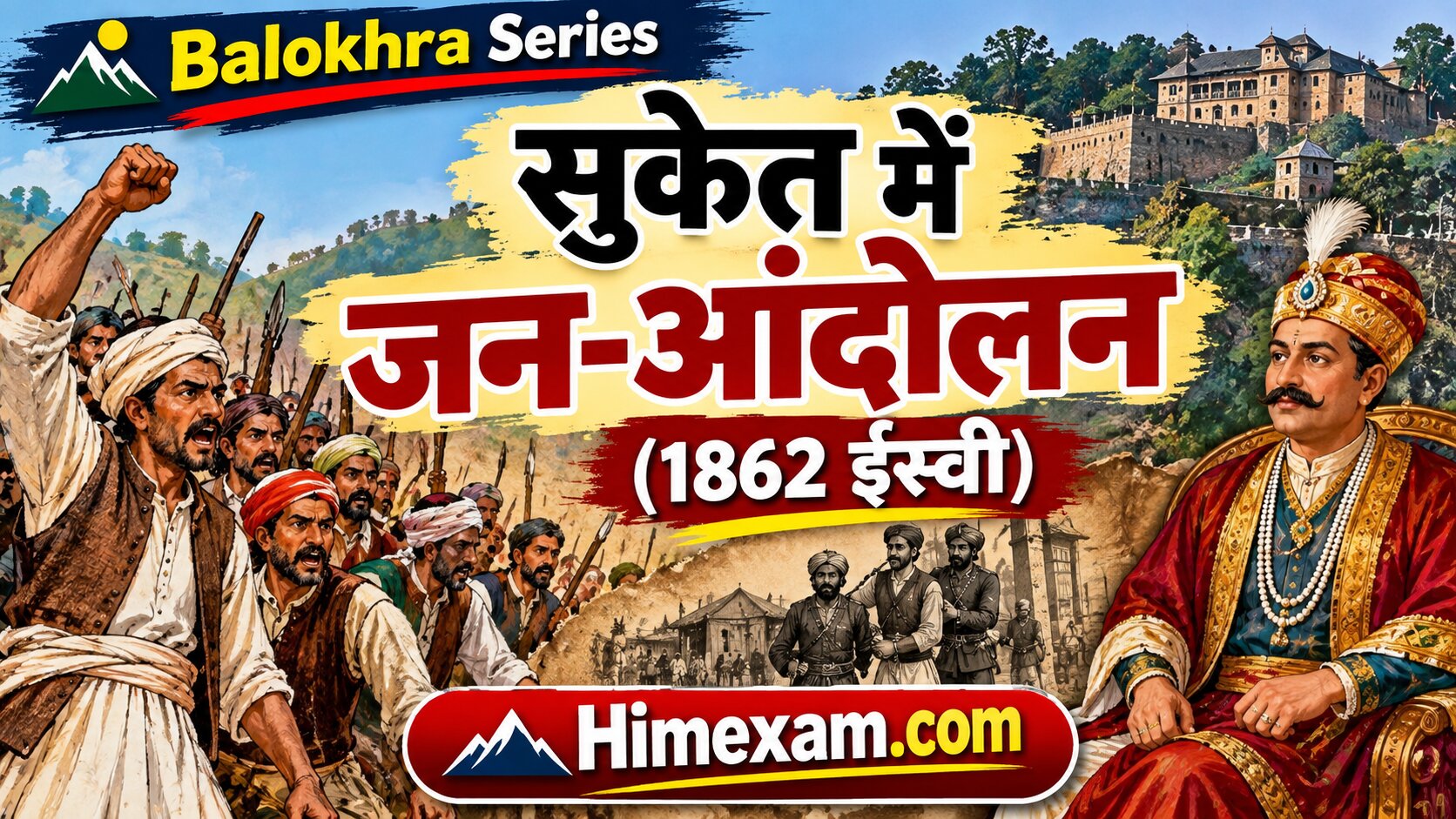




Suket Jan Andolan 1862: सुकेत में जन-आंदोलन का इतिहास | Suket People’s Movement
सुकेत में जन-आंदोलन (1862 ईस्वी) हिमाचल प्रदेश के इतिहास की एक महत्वपूर्ण घटना थी। यह आंदोलन सुकेत रियासत में प्रशासनिक अत्याचार और जनता पर लगाए जा रहे भारी दंड के विरोध में हुआ था। इस आंदोलन से संबंधित घटनाएँ राजा उग्रसेन के शासनकाल से जुड़ी हैं।
The Suket People’s Movement of 1862 AD was an important event in the history of Himachal Pradesh. The movement arose in the Suket princely state against administrative oppression and the heavy penalties imposed on the people. The events associated with this movement took place during the reign of Raja Ugrasen.
सुकेत जन-आंदोलन 1862: प्रमुख तथ्य | Key Facts of Suket People’s Movement
| विषय / Topic | विवरण / Details |
|---|---|
| जन-आंदोलन Suket People’s Movement |
1862 ईस्वी / 1862 AD |
| राजा Raja |
राजा उग्रसेन (1836–1876) Raja Ugrasen (1836–1876) |
| वजीर Wazir |
नरोत्तम, बाद में धुंगल वजीर Narotam, followed by Dhungal as Wazir |
| आंदोलन का कारण Cause |
प्रशासनिक अत्याचार और जनता पर भारी दंड Administrative oppression and heavy penalties imposed on people |
| प्रमुख घटना Major Event |
धुंगल वजीर को लोगों द्वारा पकड़कर ‘गढ़-चवासी’ स्थान पर 12 दिनों तक बंदी बनाया गया। Dhungal Wazir was captured by the people and kept confined at ‘Garh-Chawasi’ for twelve days. |
| दंड Punishment |
₹20,000 का जुर्माना और 9 महीने की कैद A fine of ₹20,000 and imprisonment for nine months |
| आंदोलन का स्थानीय नाम Local Name |
‘द्रुह’ ‘Druh’ |
नरोत्तम का अत्याचारी प्रशासन | Administration of Narotam
राजा उग्रसेन के शासनकाल में नरोत्तम वजीर था। उसे एक अत्याचारी प्रशासक के रूप में वर्णित किया गया है। उसके प्रशासन से जनता बहुत दुखी थी। उसने कुछ ब्राह्मण परिवारों पर दंड लगाया, जिसके कारण लोगों में उसके प्रति असंतोष बढ़ गया।
लोगों ने नरोत्तम के कार्यों का विरोध किया और उसे गिरफ्तार करने की मांग की, लेकिन राजा ने इस कार्रवाई को आगे नहीं बढ़ाया। यहां तक कि राजा के पुत्र रुद्र सेन ने भी नरोत्तम का विरोध किया। अंततः राजा ने नरोत्तम को पद से हटा दिया।
Narotam was the Wazir during the reign of Raja Ugrasen. He is described as an oppressive administrator whose actions caused considerable dissatisfaction among the people. He imposed penalties on some Brahmin families, which increased public resentment.
The people protested against Narotam and demanded his arrest, but the Raja initially did not take action. Even the Raja’s son, Rudra Sen, opposed the Wazir. Eventually, the Raja removed Narotam from his position.
धुंगल को वजीर बनाया गया | Appointment of Dhungal as Wazir
नरोत्तम को हटाने के बाद राजा ने उसके स्थान पर धुंगल को वजीर बनाया। हालांकि, धुंगल ने भी उच्चवर्ग के लोगों से भारी दंड वसूलना शुरू कर दिया। इससे जनता में असंतोष फिर से बढ़ गया।
After Narotam was removed, the Raja appointed Dhungal as the Wazir. However, Dhungal also began imposing and collecting heavy penalties from people belonging to the upper sections of society. This again increased public dissatisfaction.
धुंगल वजीर की गिरफ्तारी | Capture of Dhungal Wazir
एक दिन धुंगल वजीर पहाड़ी क्षेत्र के दौरे पर गया हुआ था। इसी दौरान लोगों ने उसे पकड़ लिया और ‘गढ़-चवासी’ नामक स्थान पर लगभग 12 दिनों तक बंदी बनाकर रखा।
Dhungal Wazir was once visiting a hilly area when the people captured him. They kept him confined at a place known as ‘Garh-Chawasi’ for twelve days.
राजा द्वारा धुंगल को दंड | Punishment Given to Dhungal
धुंगल को तब छोड़ा गया जब राजा ने उसे छोड़ने का आदेश दिया। इसके बाद राजा स्वयं गढ़-चवासी गया और लोगों की शिकायतें सुनीं। शिकायतों तथा धुंगल वजीर के अपराधों को देखते हुए राजा ने उसे:
- ₹20,000 का जुर्माना लगाया।
- 9 महीने की कैद की सजा दी।
After ordering Dhungal’s release, the Raja went to Garh-Chawasi and heard the grievances of the people. Considering the complaints and the offences committed by Dhungal Wazir, the Raja imposed a fine of ₹20,000 and sentenced him to nine months of imprisonment.
सुकेत में इस विद्रोह को क्या कहा जाता है? | What Was This Rebellion Called?
सुकेत में 1862 ईस्वी के इस जन-आंदोलन/विद्रोह को ‘द्रुह’ कहा जाता है। यह घटना सुकेत रियासत में जनता और प्रशासन के बीच उत्पन्न संघर्ष का महत्वपूर्ण उदाहरण मानी जाती है।
In Suket, this rebellion of 1862 AD is referred to as ‘Druh’. The event represents an important episode of conflict between the people and the administration in the Suket princely state.
परीक्षा के लिए महत्वपूर्ण बिंदु | Important Exam Points
- सुकेत जन-आंदोलन कब हुआ? — 1862 ईस्वी
When did the Suket People’s Movement take place? — 1862 AD - उस समय सुकेत का राजा कौन था? — राजा उग्रसेन (1836–1876)
Who was the Raja of Suket? — Raja Ugrasen (1836–1876) - नरोत्तम कौन था? — सुकेत का वजीर
Who was Narotam? — Wazir of Suket - नरोत्तम के बाद किसे वजीर बनाया गया? — धुंगल
Who was appointed Wazir after Narotam? — Dhungal - धुंगल को लोगों ने कितने दिनों तक बंदी बनाया? — 12 दिन
For how many days was Dhungal kept captive? — 12 days - धुंगल को कहाँ बंदी बनाया गया? — गढ़-चवासी
Where was Dhungal confined? — Garh-Chawasi - धुंगल पर कितना जुर्माना लगाया गया? — ₹20,000
What fine was imposed on Dhungal? — ₹20,000 - धुंगल को कितने महीने की कैद हुई? — 9 महीने
How long was Dhungal imprisoned? — 9 months - सुकेत में इस विद्रोह को किस नाम से जाना जाता है? — ‘द्रुह’
By what name was this rebellion known in Suket? — ‘Druh’
MCQs: सुकेत जन–आंदोलन, 1862 ई.
Question 1: सुकेत में 1862 ई. के जन–आंदोलन के संदर्भ में निम्नलिखित कथनों पर विचार कीजिए: / With reference to the 1862 CE people’s movement in Suket, consider the following statements:
- यह आंदोलन वज़ीर नरोत्तम के अत्याचारों और दमनकारी प्रशासन के विरुद्ध शुरू हुआ था। / The movement began against the atrocities and oppressive administration of Wazir Narottam.
- नरोत्तम को हटाए जाने के बाद धुंगल वज़ीर बना। / After Narottam was removed, Dhungal became the Wazir.
- धुंगल के समय ‘दंड’ के रूप में जुर्माने वसूलने की प्रथा जारी रही। / During Dhungal’s tenure, the practice of collecting fines known as ‘Dand’ continued.
Which of the statements given above is/are correct? / उपर्युक्त में से कौन–सा/से कथन सही है/हैं?
A) 1 and 2 only / केवल 1 और 2
B) 2 and 3 only / केवल 2 और 3
C) 1 and 3 only / केवल 1 और 3
D) 1, 2 and 3 / 1, 2 और 3
Answer: D) 1, 2 and 3 / 1, 2 और 3
Question 2: सुकेत के 1862 ई. के आंदोलन के संदर्भ में निम्नलिखित घटनाओं का सही कालानुक्रमिक क्रम कौन–सा है? / Which of the following is the correct chronological sequence of events related to the 1862 CE movement in Suket?
- नरोत्तम का पद से हटना / Removal of Narottam
- धुंगल का वज़ीर बनना / Appointment of Dhungal as Wazir
- धुंगल को गढ़–चवासी में बंदी बनाया जाना / Dhungal being imprisoned at Garh-Chawasi
- धुंगल को नौ महीने के कारावास और ₹20,000 के जुर्माने की सजा / Dhungal being sentenced to nine months’ imprisonment and fined ₹20,000
A) 1 → 2 → 3 → 4
B) 2 → 1 → 3 → 4
C) 1 → 3 → 2 → 4
D) 3 → 1 → 2 → 4
Answer: A) 1 → 2 → 3 → 4 / 1 → 2 → 3 → 4
Question 3: निम्नलिखित में से कौन–सा युग्म सुकेत के 1862 ई. के जन–आंदोलन के संदर्भ में सही सुमेलित है? / Which of the following pairs is correctly matched with reference to the 1862 CE people’s movement in Suket?
A) नरोत्तम — गढ़–चवासी में 12 दिन की कैद / Narottam — Imprisoned for 12 days at Garh-Chawasi
B) धुंगल — गढ़–चवासी में 12 दिन की कैद / Dhungal — Imprisoned for 12 days at Garh-Chawasi
C) रूद्र सेन — ₹20,000 का जुर्माना / Rudra Sen — Fined ₹20,000
D) उग्रसेन — नौ महीने की कैद / Ugar Sen — Imprisoned for nine months
Answer: B) धुंगल — गढ़–चवासी में 12 दिन की कैद / Dhungal — Imprisoned for 12 days at Garh-Chawasi
Question: निम्नलिखित कथनों पर विचार कीजिए: / Consider the following statements:
- धुंगल को लोगों ने तब पकड़ा जब वह पहाड़ी क्षेत्रों के दौरे पर था। / Dhungal was seized by the people while he was touring the hill areas.
- लोगों ने उसे गढ़–चवासी में 12 दिनों तक बंदी बनाकर रखा। / The people kept him imprisoned at Garh-Chawasi for 12 days.
- उसे राजा के आदेश के बाद मुक्त किया गया। / He was released after the Raja’s order.
Which of the statements given above is/are correct? / उपर्युक्त में से कौन–सा/से कथन सही है/हैं?
A) 1 only / केवल 1
B) 1 and 2 only / केवल 1 और 2
C) 2 and 3 only / केवल 2 और 3
D) 1, 2 and 3 / 1, 2 और 3
Answer: D) 1, 2 and 3 / 1, 2 और 3
Question 4: सुकेत के 1862 ई. के जन–आंदोलन के संदर्भ में निम्नलिखित में से कौन–सा विकल्प घटनाओं और व्यक्तियों का सही संबंध दर्शाता है? / Which option correctly represents the relationship between the events and personalities associated with the 1862 CE Suket movement?
A) नरोत्तम — बाद में धुंगल द्वारा प्रतिस्थापित / Narottam — Later replaced by Dhungal
B) धुंगल — नरोत्तम का तत्काल पूर्ववर्ती / Dhungal — Immediate predecessor of Narottam
C) रूद्र सेन — 1862 में सुकेत के शासक / Rudra Sen — Ruler of Suket in 1862
D) धुंगल — सुकेत का राजा / Dhungal — Raja of Suket
Answer: A) नरोत्तम — बाद में धुंगल द्वारा प्रतिस्थापित / Narottam — Later replaced by Dhungal
Question: धुंगल वज़ीर के विरुद्ध लोगों की कार्रवाई के बाद राजा उग्रसेन द्वारा की गई कार्रवाई के संदर्भ में निम्नलिखित में से सही विकल्प चुनिए। / Choose the correct option regarding the action taken by Raja Ugar Sen after the people’s action against Wazir Dhungal.
A) ₹10,000 जुर्माना और 6 महीने की कैद / ₹10,000 fine and six months’ imprisonment
B) ₹20,000 जुर्माना और 9 महीने की कैद / ₹20,000 fine and nine months’ imprisonment
C) ₹20,000 जुर्माना और 12 महीने की कैद / ₹20,000 fine and twelve months’ imprisonment
D) ₹50,000 जुर्माना और 9 महीने की कैद / ₹50,000 fine and nine months’ imprisonment
Answer: B) ₹20,000 जुर्माना और 9 महीने की कैद / ₹20,000 fine and nine months’ imprisonment
Question 5: निम्नलिखित कथनों पर विचार कीजिए: / Consider the following statements:
- 1862 ई. का आंदोलन सुकेत रियासत में हुआ था। / The 1862 CE movement took place in the Suket State.
- आंदोलन का संबंध वज़ीरों के दमनकारी प्रशासन से था। / The movement was associated with oppressive administration by the Wazirs.
- धुंगल को लोगों ने गढ़–चवासी में बंदी बनाया था। / Dhungal was imprisoned by the people at Garh-Chawasi.
- धुंगल को बाद में राजा द्वारा ₹20,000 का जुर्माना लगाया गया। / Dhungal was later fined ₹20,000 by the Raja.
Which of the statements given above are correct? / उपर्युक्त में से कौन–से कथन सही हैं?
A) 1 and 2 only / केवल 1 और 2
B) 2 and 3 only / केवल 2 और 3
C) 1, 3 and 4 only / केवल 1, 3 और 4
D) 1, 2, 3 and 4 / 1, 2, 3 और 4
Answer: D) 1, 2, 3 and 4 / 1, 2, 3 और 4
Question 6: सुकेत के 1862 ई. के जन–आंदोलन के बारे में निम्नलिखित में से कौन–सा कथन स्रोत–साक्ष्य से सबसे सीधे समर्थित है? / Which of the following statements about the 1862 CE Suket movement is most directly supported by historical source evidence?
A) धुंगल को लोगों ने 12 दिनों तक गढ़–चवासी में बंदी रखा। / The people kept Dhungal imprisoned at Garh-Chawasi for 12 days.
B) नरोत्तम को लोगों ने 12 दिनों तक गढ़–चवासी में बंदी रखा। / The people kept Narottam imprisoned at Garh-Chawasi for 12 days.
C) रूद्र सेन ने धुंगल को गढ़–चवासी में बंदी बनाया। / Rudra Sen imprisoned Dhungal at Garh-Chawasi.
D) राजा उग्रसेन को लोगों ने गढ़–चवासी में बंदी बनाया। / Raja Ugar Sen was imprisoned at Garh-Chawasi.
Answer: A) धुंगल को लोगों ने 12 दिनों तक गढ़–चवासी में बंदी रखा। / The people kept Dhungal imprisoned at Garh-Chawasi for 12 days.
Question 7: सुकेत के 1862 ई. के जन–आंदोलन के संबंध में निम्नलिखित में से कौन–सा क्रम सही है? / Which of the following sequences is correct regarding the 1862 CE Suket movement?
A) नरोत्तम → धुंगल → गढ़–चवासी की घटना → राजा द्वारा दंड / Narottam → Dhungal → Garh-Chawasi incident → Punishment by the Raja
B) धुंगल → नरोत्तम → गढ़–चवासी की घटना → राजा द्वारा दंड / Dhungal → Narottam → Garh-Chawasi incident → Punishment by the Raja
C) नरोत्तम → गढ़–चवासी → धुंगल → राजा द्वारा दंड / Narottam → Garh-Chawasi → Dhungal → Punishment by the Raja
D) गढ़–चवासी → नरोत्तम → धुंगल → राजा द्वारा दंड / Garh-Chawasi → Narottam → Dhungal → Punishment by the Raja
Answer: A) नरोत्तम → धुंगल → गढ़–चवासी की घटना → राजा द्वारा दंड / Narottam → Dhungal → Garh-Chawasi incident → Punishment by the Raja
हमारे बारे में – Himexam.com
Himexam.com हिमाचल प्रदेश व अखिल भारतीय प्रतियोगी परीक्षाओं के लिए एक विश्वसनीय पोर्टल है। यहाँ आपको नवीनतम HP Govt Jobs, All India Jobs, HP GK, करेंट अफेयर्स, वन लाइनर प्रश्न, जिलेवार GK और पिछले वर्षों के प्रश्न पत्र की जानकारी एक ही जगह मिलती है। हमारी कोशिश है कि हर अभ्यर्थी को सही और समय पर अध्ययन सामग्री मिले।
 WhatsApp
 Facebook
 Telegram
 Instagram