

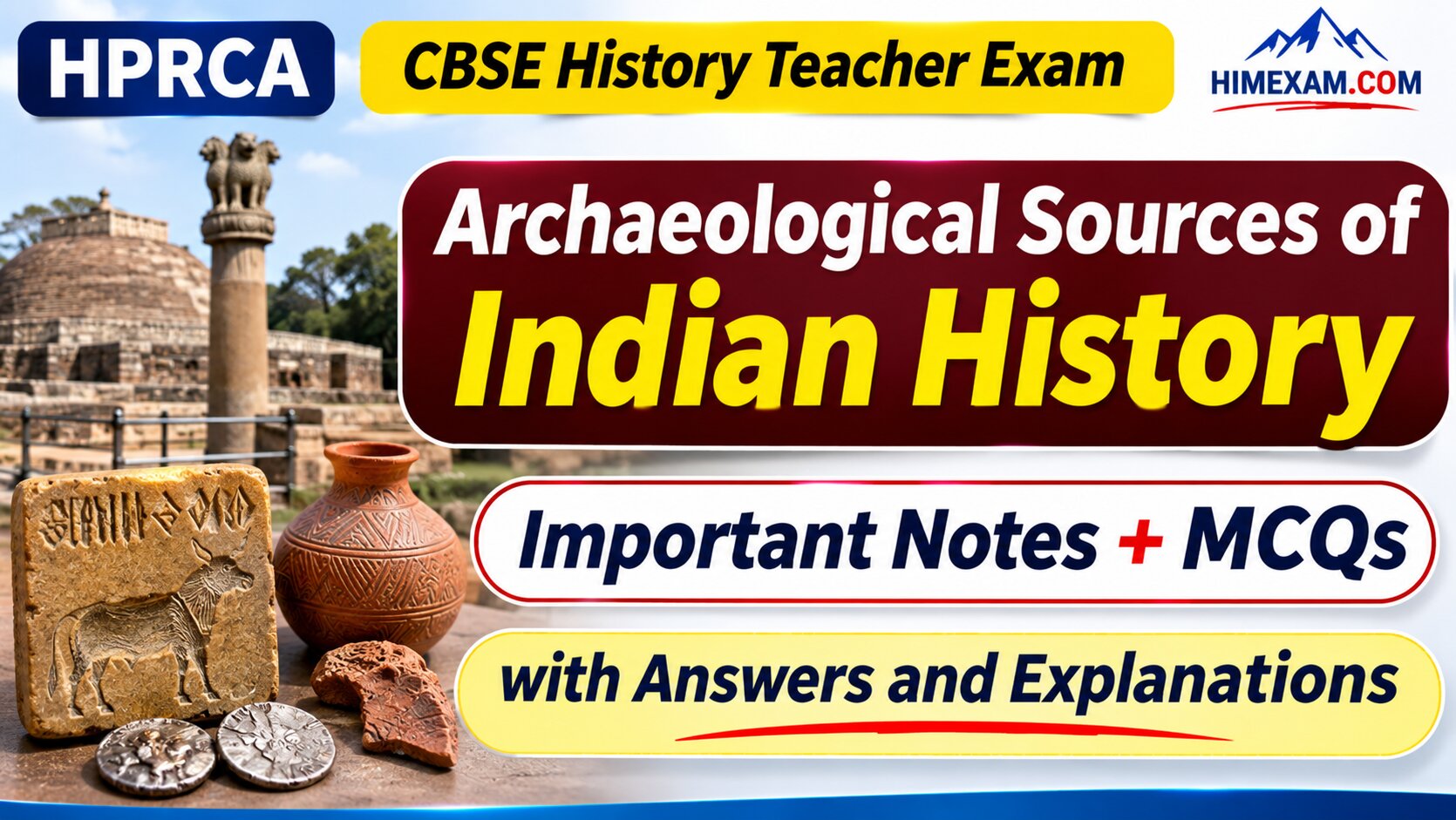


Archaeological Sources of Indian History: Important Notes + MCQs with Answers and Explanations
Archaeological Sources of Indian History
Topic 1 | HP CBSE History Teacher Examination


अध्याय 1 | भारतीय इतिहास के पुरातात्त्विक स्रोत
Archaeological sources are among the most important tools for understanding ancient Indian history. They provide material evidence of past human activities, including settlements, political institutions, trade, agriculture, religious beliefs, technology, art and architecture.
पुरातात्त्विक स्रोत प्राचीन भारतीय इतिहास को समझने के सबसे महत्त्वपूर्ण साधनों में से एक हैं। ये मानव की प्राचीन गतिविधियों, बस्तियों, राजनीतिक संस्थाओं, व्यापार, कृषि, धार्मिक मान्यताओं, तकनीक, कला और स्थापत्य के भौतिक प्रमाण प्रदान करते हैं।
1. Meaning and Definition of Archaeological Sources
Meaning of Archaeology / पुरातत्त्व का अर्थ
Archaeology is the systematic study of the human past through the recovery, documentation, scientific analysis and interpretation of material remains.
पुरातत्त्व (Archaeology) मानव अतीत का व्यवस्थित अध्ययन है, जिसमें भौतिक अवशेषों की खोज, अभिलेखन, वैज्ञानिक विश्लेषण और व्याख्या की जाती है।
Archaeological sources include all material remains left behind by human beings, whether deliberately created or accidentally preserved.
पुरातात्त्विक स्रोतों में मानव द्वारा निर्मित या संयोगवश सुरक्षित रह गए सभी भौतिक अवशेष शामिल होते हैं।
Major Archaeological Sources / प्रमुख पुरातात्त्विक स्रोत
- Inscriptions (अभिलेख)
- Coins (सिक्के)
- Monuments and architecture (स्मारक एवं स्थापत्य)
- Excavated settlements and structures (उत्खनित बस्तियाँ एवं संरचनाएँ)
- Pottery and ceramics (मृद्भांड एवं मिट्टी के बर्तन)
- Tools and weapons (औजार एवं हथियार)
- Seals and sealings (मुहरें एवं मुद्रांकन)
- Sculptures and terracotta objects (मूर्तियाँ एवं टेराकोटा वस्तुएँ)
- Paintings and rock art (चित्रकला एवं शैलचित्र)
- Human, animal and plant remains (मानव, पशु एवं वनस्पति अवशेष)
- Burials and funerary remains (कब्रें एवं अंत्येष्टि अवशेष)
- Environmental and geological evidence (पर्यावरणीय एवं भूवैज्ञानिक प्रमाण)
महत्त्वपूर्ण तथ्य: पुरातत्त्व केवल प्राचीन इमारतों या वस्तुओं की खोज तक सीमित नहीं है। इसमें वस्तुओं के आपसी संबंध, उनके मिलने का स्थान, पुरातात्त्विक परतों और उनसे संबंधित मानवीय गतिविधियों का अध्ययन भी किया जाता है।
2. Development of Archaeological Studies in India
भारत में पुरातात्त्विक अध्ययन का विकास
The systematic study of India’s archaeological heritage developed gradually through the efforts of scholars, antiquarians, historians and government institutions.
भारत की पुरातात्त्विक विरासत का व्यवस्थित अध्ययन विद्वानों, इतिहासकारों, पुरावस्तु विशेषज्ञों तथा सरकारी संस्थाओं के प्रयासों से धीरे-धीरे विकसित हुआ।
Important Personalities / प्रमुख व्यक्तित्व
| Personality / व्यक्तित्व | Contribution / योगदान |
|---|---|
| Sir William Jones | Founded the Asiatic Society of Bengal in Calcutta in 1784. / 1784 में कलकत्ता में एशियाटिक सोसाइटी की स्थापना की। |
| James Prinsep | Deciphered the Brahmi script of Ashokan inscriptions in 1837, making a major breakthrough in Indian epigraphy. / 1837 में अशोक के अभिलेखों की ब्राह्मी लिपि को पढ़ने में महत्त्वपूर्ण सफलता प्राप्त की। |
| Alexander Cunningham | Regarded as the Father of Indian Archaeology; served as the first Director-General of the ASI. / भारतीय पुरातत्त्व का जनक माना जाता है; ASI के प्रथम महानिदेशक रहे। |
| John Marshall | Director-General of ASI from 1902 to 1928; played a major role in the excavation and recognition of the Indus Civilisation. / 1902 से 1928 तक ASI के महानिदेशक; सिंधु सभ्यता के उत्खनन और पहचान में प्रमुख भूमिका। |
| Rakhal Das Banerji | Associated with the discovery and excavation of Mohenjo-daro. / मोहनजोदड़ो की खोज एवं उत्खनन से संबंधित। |
| Daya Ram Sahni | Led the excavation of Harappa in 1921. / 1921 में हड़प्पा के उत्खनन का नेतृत्व किया। |
| Mortimer Wheeler | Promoted systematic excavation methods and stratigraphic training in Indian archaeology; served as Director-General of ASI from 1944 to 1948. / व्यवस्थित उत्खनन एवं स्तर-विज्ञान आधारित प्रशिक्षण को प्रोत्साहित किया। |
| H.D. Sankalia | Made major contributions to prehistoric and protohistoric archaeology in India. / भारत के प्रागैतिहासिक एवं आद्य-ऐतिहासिक पुरातत्त्व में महत्त्वपूर्ण योगदान। |
| B.B. Lal | Contributed to excavations at sites such as Hastinapura and Kalibangan and to Indian archaeology. / हस्तिनापुर एवं कालीबंगा जैसे स्थलों के उत्खनन में योगदान। |
| Amalananda Ghosh | Played an important role in the exploration and excavation of Harappan sites, including Kalibangan. / कालीबंगा सहित हड़प्पा स्थलों के अन्वेषण एवं उत्खनन में योगदान। |
Archaeological Survey of India (ASI) / भारतीय पुरातत्त्व सर्वेक्षण
- Established in 1861 as a department of the Government of India. / 1861 में भारत सरकार के विभाग के रूप में स्थापित।
- Alexander Cunningham was its first Director-General. / अलेक्जेंडर कनिंघम इसके प्रथम महानिदेशक थे।
- It works under the Ministry of Culture, Government of India. / यह भारत सरकार के संस्कृति मंत्रालय के अंतर्गत कार्य करता है।
- Its responsibilities include archaeological exploration, excavation, conservation, documentation and protection of monuments and sites of national importance. / इसके कार्यों में पुरातात्त्विक अन्वेषण, उत्खनन, संरक्षण, अभिलेखन तथा राष्ट्रीय महत्त्व के स्मारकों की सुरक्षा शामिल है।
- The Epigraphy Branch of ASI was established in 1886 at Bangalore. / ASI की अभिलेख शाखा 1886 में बंगलौर में स्थापित हुई थी।
परीक्षा में एशियाटिक सोसाइटी (1784), भारतीय पुरातत्त्व सर्वेक्षण (1861) और ASI की अभिलेख शाखा (1886) की स्थापना को आपस में भ्रमित न करें।
3. Exploration and Excavation
अन्वेषण एवं उत्खनन
A. Archaeological Exploration / पुरातात्त्विक अन्वेषण
Exploration is the systematic search for archaeological sites and remains on the ground, underwater or through remote-sensing techniques.
अन्वेषण वह व्यवस्थित प्रक्रिया है जिसके माध्यम से भूमि, जल के नीचे या रिमोट सेंसिंग तकनीकों द्वारा पुरातात्त्विक स्थलों एवं अवशेषों की खोज की जाती है।
Common methods include:
- Field walking: Walking over a landscape to identify pottery, tools and other surface remains. / भूमि पर पैदल चलकर बर्तनों, औजारों एवं अन्य अवशेषों की पहचान करना।
- Topographical survey: Recording the physical features and location of an archaeological site. / स्थल की भौगोलिक बनावट एवं स्थिति का अभिलेखन।
- Aerial photography: Identifying buried structures through differences in vegetation, soil marks and shadows. / वनस्पति, मिट्टी के निशान एवं छाया के अंतर से दबे हुए ढाँचों की पहचान।
- Remote sensing: Using satellite imagery and other sensing technologies to locate archaeological features. / उपग्रह चित्रों एवं अन्य तकनीकों द्वारा पुरातात्त्विक संरचनाओं का पता लगाना।
- Geophysical survey: Using methods such as magnetometry, electrical resistivity and ground-penetrating radar. / मैग्नेटोमेट्री, विद्युत प्रतिरोधकता एवं ग्राउंड पेनेट्रेटिंग रडार का प्रयोग।
B. Archaeological Excavation / पुरातात्त्विक उत्खनन
Excavation is the controlled and systematic removal of soil and other deposits to uncover archaeological remains.
उत्खनन वह नियंत्रित एवं व्यवस्थित प्रक्रिया है जिसमें मिट्टी तथा अन्य जमावों को हटाकर पुरातात्त्विक अवशेषों को उजागर किया जाता है।
It helps archaeologists understand the sequence of human occupation, construction, destruction and cultural change at a site.
यह पुरातत्त्वविदों को किसी स्थल पर मानव निवास, निर्माण, विनाश तथा सांस्कृतिक परिवर्तन के क्रम को समझने में सहायता करता है।
Types of Excavation / उत्खनन के प्रकार
- Vertical excavation: Concentrates on digging deeper to understand different chronological layers and cultural sequences. / विभिन्न कालक्रमिक परतों एवं सांस्कृतिक क्रम को समझने के लिए गहराई में उत्खनन।
- Horizontal excavation: Exposes a wider area to understand the layout and arrangement of structures belonging to a particular phase. / किसी विशेष काल के भवनों एवं संरचनाओं की योजना समझने के लिए विस्तृत क्षेत्र में उत्खनन।
- Rescue excavation: Conducted to document and recover archaeological remains threatened by construction, development or natural damage. / निर्माण, विकास परियोजनाओं या प्राकृतिक क्षति से प्रभावित होने वाले अवशेषों को बचाने के लिए उत्खनन।
- Underwater excavation: Conducted at submerged archaeological sites, including shipwrecks and ancient ports. / जलमग्न पुरातात्त्विक स्थलों, जहाजों के अवशेषों एवं प्राचीन बंदरगाहों का उत्खनन।
Stratigraphy / स्तर-विज्ञान
Stratigraphy is the study of archaeological layers (strata) and their sequence. In an undisturbed deposit, lower layers are generally older than upper layers.
स्तर-विज्ञान में पुरातात्त्विक परतों तथा उनके क्रम का अध्ययन किया जाता है। अविक्षुब्ध जमाव में सामान्यतः निचली परतें ऊपरी परतों से पुरानी होती हैं।
अध्यारोपण का नियम: अविक्षुब्ध परतों में नीचे की परत सामान्यतः ऊपर की परत से पहले जमा हुई होती है।
Important limitation: The law may not apply straightforwardly where layers have been disturbed by pits, burials, erosion, construction, animal activity or later human intervention.
महत्त्वपूर्ण सीमा: गड्ढों, कब्रों, अपरदन, निर्माण, पशुओं की गतिविधियों अथवा बाद के मानवीय हस्तक्षेप से परतें प्रभावित होने पर यह नियम सीधे लागू नहीं किया जा सकता।
Important Excavation Terms / महत्त्वपूर्ण शब्दावली
- Stratum: A single archaeological layer. / पुरातात्त्विक परत।
- Strata: Plural of stratum. / परतों का बहुवचन।
- Trench: A long, narrow excavation cut. / लंबा एवं संकरा उत्खनन क्षेत्र।
- Grid system: Dividing an excavation area into measured squares for accurate recording. / सटीक अभिलेखन हेतु उत्खनन क्षेत्र को मापित वर्गों में बाँटना।
- Feature: A non-portable archaeological remain such as a hearth, wall, pit or floor. / चूल्हा, दीवार, गड्ढा या फर्श जैसी स्थिर संरचना।
- Context: The precise archaeological position or deposit associated with a find. / किसी अवशेष से संबंधित उसका विशिष्ट पुरातात्त्विक स्थान या जमाव।
- Assemblage: A group of archaeological objects found together in a particular context. / एक ही संदर्भ में प्राप्त पुरावस्तुओं का समूह।
- Provenience: The exact three-dimensional location of an archaeological find. / किसी पुरावस्तु का सटीक त्रि-आयामी स्थान।
- Provenance: The history of ownership, origin or archaeological recovery of an object. / किसी वस्तु का उद्गम, प्राप्ति एवं स्वामित्व इतिहास।
4. Inscriptions (Epigraphy)
अभिलेख एवं अभिलेखशास्त्र
Epigraphy is the study, decipherment, editing and interpretation of inscriptions engraved or written on durable materials such as stone, metal, pottery and other objects.
अभिलेखशास्त्र (Epigraphy) पत्थर, धातु, मिट्टी के बर्तन एवं अन्य वस्तुओं पर उत्कीर्ण या लिखे गए लेखों के अध्ययन, लिप्यंतरण, संपादन तथा व्याख्या का विज्ञान है।
A person who studies inscriptions is called an Epigraphist.
अभिलेखों का अध्ययन करने वाले विद्वान को अभिलेखशास्त्री (Epigraphist) कहते हैं।
Materials Used for Inscriptions / अभिलेखों की सामग्री
- Stone slabs and rocks / पत्थर की शिलाएँ एवं चट्टानें
- Pillars / स्तंभ
- Copper plates / ताम्रपत्र
- Temple walls and pillars / मंदिरों की दीवारें एवं स्तंभ
- Cave walls / गुफाओं की दीवारें
- Metal objects / धातु की वस्तुएँ
- Pottery and seals / मिट्टी के बर्तन एवं मुहरें
Types of Inscriptions / अभिलेखों के प्रकार
1. Royal Inscriptions / राजकीय अभिलेख
These were issued by kings or rulers and often record their achievements, orders, policies, donations or administrative decisions.
ये राजा या शासकों द्वारा जारी किए जाते थे और इनमें उनकी उपलब्धियों, आदेशों, नीतियों, दान तथा प्रशासनिक निर्णयों का उल्लेख मिलता है।
2. Prashastis / प्रशस्तियाँ
Prashastis are eulogistic inscriptions composed to praise the achievements, qualities and victories of rulers. They are valuable but must be critically examined because they may exaggerate royal achievements.
प्रशस्तियाँ वे अभिलेख हैं जिनमें शासकों के गुणों, उपलब्धियों एवं विजयों की प्रशंसा की जाती है। ये महत्त्वपूर्ण स्रोत हैं, लेकिन इनमें अतिशयोक्ति हो सकती है, इसलिए इनका आलोचनात्मक अध्ययन आवश्यक है।
3. Donative Inscriptions / दान संबंधी अभिलेख
These record donations made by kings, merchants, artisans, monks and ordinary individuals to religious institutions.
इनमें राजाओं, व्यापारियों, शिल्पकारों, भिक्षुओं एवं सामान्य लोगों द्वारा धार्मिक संस्थाओं को दिए गए दान का विवरण मिलता है।
4. Copper-Plate Inscriptions / ताम्रपत्र अभिलेख
These often record land grants, tax privileges, boundaries, beneficiaries and the rights associated with donated land.
इनमें प्रायः भूमि अनुदान, कर संबंधी छूट, भूमि की सीमाएँ, लाभार्थी तथा भूमि से जुड़े अधिकारों का विवरण होता है।
5. Religious Inscriptions / धार्मिक अभिलेख
These provide information about temples, monasteries, religious donations, sects and religious practices.
ये मंदिरों, मठों, धार्मिक दान, संप्रदायों तथा धार्मिक प्रथाओं की जानकारी देते हैं।
6. Administrative and Legal Inscriptions / प्रशासनिक एवं कानूनी अभिलेख
These include records relating to land boundaries, taxation, village administration, grants, agreements and official orders.
इनमें भूमि की सीमाओं, कर व्यवस्था, ग्राम प्रशासन, अनुदान, समझौतों तथा शासकीय आदेशों की जानकारी मिलती है।
Important Inscriptions of Ancient India / प्राचीन भारत के प्रमुख अभिलेख
| Inscription / अभिलेख | Associated Ruler / संबंधित शासक | Historical Importance / ऐतिहासिक महत्त्व |
|---|---|---|
| Major Rock Edicts | Ashoka | Describe Dhamma, administration, welfare measures, religious tolerance and royal policy. / धम्म, प्रशासन, लोककल्याण एवं धार्मिक सहिष्णुता की जानकारी। |
| Rummindei (Lumbini) Inscription | Ashoka | Records Ashoka’s visit to the Buddha’s birthplace and a tax concession to Lumbini. / बुद्ध के जन्मस्थान की अशोक द्वारा यात्रा तथा कर में छूट का उल्लेख। |
| Nigali Sagar Inscription | Ashoka | Records the enlargement of the stupa of Kanakamuni Buddha. / कनकमुनि बुद्ध के स्तूप के विस्तार का उल्लेख। |
| Maski Inscription | Ashoka | Important because it uses the name Ashoka in association with Devanampiya Piyadasi. / देवानांप्रिय प्रियदर्शी के साथ अशोक नाम के प्रयोग के कारण महत्त्वपूर्ण। |
| Junagadh (Girnar) Inscription | Rudradaman I | Circa 150 CE; famous early long Sanskrit inscription. It describes the repair of Sudarshana Lake and the achievements of Rudradaman. / लगभग 150 ईस्वी; प्रारंभिक विस्तृत संस्कृत अभिलेखों में प्रसिद्ध। सुदर्शन झील की मरम्मत का उल्लेख। |
| Prayaga Prashasti / Allahabad Pillar Inscription | Samudragupta | Composed by Harishena; describes military campaigns, political relations and achievements. / हरिषेण द्वारा रचित; समुद्रगुप्त की विजयों एवं राजनीतिक संबंधों का वर्णन। |
| Mehrauli Iron Pillar Inscription | King Chandra, generally identified with Chandragupta II | Describes the achievements of King Chandra and demonstrates advanced iron-working technology. / राजा चंद्र की उपलब्धियों एवं उन्नत लौह तकनीक की जानकारी। |
| Aihole Inscription | Pulakeshin II | Composed by Ravikirti in 634 CE; describes Chalukya achievements and political events. / 634 ईस्वी में रविकीर्ति द्वारा रचित; चालुक्य उपलब्धियों का वर्णन। |
| Uttaramerur Inscriptions | Chola period | Provide details of local self-government, village assemblies and committee selection. / स्थानीय स्वशासन, ग्राम सभाओं एवं समितियों की चयन प्रक्रिया की जानकारी। |
| Hathigumpha Inscription | Kharavela | Records the achievements and activities of the Kalinga ruler Kharavela. / कलिंग शासक खारवेल की उपलब्धियों एवं गतिविधियों का वर्णन। |
Ashokan Inscriptions / अशोक के अभिलेख
Ashoka’s inscriptions are among the most important epigraphic sources for reconstructing the Mauryan Empire. They provide direct evidence of royal communication and policies.
अशोक के अभिलेख मौर्य साम्राज्य के पुनर्निर्माण के सबसे महत्त्वपूर्ण अभिलेखीय स्रोतों में से हैं। ये शाही आदेशों एवं नीतियों का प्रत्यक्ष प्रमाण प्रदान करते हैं।
Major categories:
- Major Rock Edicts: Fourteen major rock edicts, with some regional variations and additional separate edicts. / चौदह प्रमुख शिलालेख, जिनमें क्षेत्रीय भिन्नताएँ तथा कुछ पृथक शिलालेख भी मिलते हैं।
- Minor Rock Edicts: Shorter records, including personal religious statements and references to the king. / छोटे अभिलेख जिनमें धार्मिक विचार एवं राजा से संबंधित उल्लेख मिलते हैं।
- Pillar Edicts: Inscriptions engraved on stone pillars. / पत्थर के स्तंभों पर उत्कीर्ण अभिलेख।
- Cave Inscriptions: Records associated with caves, including donations to the Ajivikas at Barabar. / गुफाओं से संबंधित अभिलेख, जिनमें बराबर की गुफाओं में आजीवकों को दान का उल्लेख है।
महत्त्वपूर्ण: अशोक के अभिलेख उपमहाद्वीप के विभिन्न क्षेत्रों में पाए गए हैं। इनमें क्षेत्र के अनुसार भाषा एवं लिपि में अंतर मिलता है। अधिकांश अभिलेख प्राकृत भाषा और ब्राह्मी लिपि में हैं, जबकि उत्तर-पश्चिम में खरोष्ठी, यूनानी एवं अरामाइक रूप भी मिलते हैं।
Scripts and Languages / लिपियाँ एवं भाषाएँ
| Script / लिपि | Features / विशेषताएँ |
|---|---|
| Brahmi | Generally written from left to right; used extensively in Ashokan inscriptions. / सामान्यतः बाएँ से दाएँ लिखी जाती थी; अशोक के अभिलेखों में व्यापक प्रयोग। |
| Kharosthi | Written from right to left; used mainly in the northwestern regions. / दाएँ से बाएँ लिखी जाती थी; मुख्यतः उत्तर-पश्चिमी क्षेत्रों में प्रयोग। |
| Greek | Used in some northwestern inscriptions, including bilingual records. / उत्तर-पश्चिम के कुछ अभिलेखों में प्रयोग। |
| Aramaic | Found in some northwestern inscriptions associated with the Achaemenid and Hellenistic cultural sphere. / उत्तर-पश्चिम के कुछ अभिलेखों में प्राप्त। |
| Tamil-Brahmi | An early adaptation of Brahmi for writing Tamil; important for early historic South India. / तमिल भाषा के लेखन हेतु ब्राह्मी का प्रारंभिक रूपांतर। |
| Gupta Script | Developed from Brahmi and used during the Gupta period. / ब्राह्मी से विकसित; गुप्त काल में प्रचलित। |
James Prinsep: His decipherment of Brahmi in 1837 was a turning point in the study of ancient Indian history.
जेम्स प्रिंसेप: 1837 में ब्राह्मी लिपि को पढ़ना प्राचीन भारतीय इतिहास के अध्ययन में एक महत्त्वपूर्ण मोड़ था।
5. Coins (Numismatics)
सिक्के एवं मुद्राशास्त्र
Numismatics is the systematic study of coins, currency and related monetary objects.
मुद्राशास्त्र (Numismatics) सिक्कों, मुद्रा एवं उनसे संबंधित मौद्रिक वस्तुओं का व्यवस्थित अध्ययन है।
A person who studies coins is called a Numismatist.
सिक्कों का अध्ययन करने वाले विशेषज्ञ को मुद्राशास्त्री (Numismatist) कहते हैं।
What Information Do Coins Provide? / सिक्कों से क्या जानकारी मिलती है?
- Names and titles of rulers. / शासकों के नाम एवं उपाधियाँ।
- Political authority and succession. / राजनीतिक सत्ता एवं उत्तराधिकार।
- Religious beliefs and symbols. / धार्मिक मान्यताएँ एवं प्रतीक।
- Trade and commercial networks. / व्यापार एवं वाणिज्यिक नेटवर्क।
- Metallurgy and technological development. / धातुकर्म एवं तकनीकी विकास।
- Economic conditions and monetary systems. / आर्थिक स्थिति एवं मौद्रिक व्यवस्था।
- Art, portraiture and royal representation. / कला, चित्रांकन एवं राजकीय प्रतीकवाद।
- Geographical circulation and political influence. / भौगोलिक प्रसार एवं राजनीतिक प्रभाव।
Major Types of Ancient Indian Coins / प्राचीन भारतीय सिक्कों के प्रमुख प्रकार
1. Punch-Marked Coins / आहत सिक्के
- Among the earliest widely circulated coins in ancient India. / प्राचीन भारत में प्रचलित सबसे प्रारंभिक सिक्कों में शामिल।
- Generally made of silver, although copper examples also exist. / सामान्यतः चाँदी के, हालांकि ताँबे के उदाहरण भी मिलते हैं।
- Symbols were punched separately onto metal pieces. / धातु के टुकड़ों पर अलग-अलग प्रतीक आहत किए जाते थे।
- Often associated with the Mahajanapada and early historic periods. / महाजनपद एवं प्रारंभिक ऐतिहासिक काल से संबंधित।
- They are not generally inscribed with the names or portraits of individual rulers. / सामान्यतः इन पर शासकों के नाम या चित्र नहीं मिलते।
2. Indo-Greek Coins / हिंद-यूनानी सिक्के
- Often bear portraits of rulers on one side. / एक ओर शासकों के चित्र मिलते हैं।
- Frequently contain Greek and, in some cases, Kharosthi legends. / इनमें प्रायः यूनानी तथा कुछ मामलों में खरोष्ठी लेख मिलते हैं।
- Important for studying Indo-Greek political history and cultural interaction. / हिंद-यूनानी राजनीतिक इतिहास एवं सांस्कृतिक संपर्क के अध्ययन में उपयोगी।
3. Kushana Coins / कुषाण सिक्के
- Large-scale gold coinage is an important feature of Kushana monetary history. / कुषाण मौद्रिक इतिहास में बड़े पैमाने पर स्वर्ण सिक्के महत्त्वपूर्ण हैं।
- Coins depict rulers and a variety of deities. / सिक्कों पर शासकों तथा विभिन्न देवी-देवताओं के चित्र मिलते हैं।
- Kanishka’s coinage includes Greek-derived legends and images of Iranian, Greek and Indian deities. / कनिष्क के सिक्कों पर यूनानी मूल की लिपि तथा ईरानी, यूनानी एवं भारतीय देवी-देवताओं के चित्र मिलते हैं।
- They help understand trade, political connections and religious plurality. / व्यापार, राजनीतिक संपर्क एवं धार्मिक विविधता समझने में सहायक।
4. Gupta Coins / गुप्त सिक्के
- Known particularly for their artistic quality and extensive gold issues. / कलात्मक गुणवत्ता एवं स्वर्ण सिक्कों के लिए प्रसिद्ध।
- Include types such as Archer, Horseman, Lyrist and Ashvamedha. / इनमें धनुर्धर, अश्वारोही, वीणावादक एवं अश्वमेध प्रकार शामिल हैं।
- Provide information about royal titles, military achievements, religious ideas and court culture. / शाही उपाधियों, सैन्य उपलब्धियों, धार्मिक विचारों एवं दरबारी संस्कृति की जानकारी देते हैं।
5. Satavahana Coins / सातवाहन सिक्के
- Issued in metals including lead, copper and silver, with regional variation. / क्षेत्रीय भिन्नताओं के साथ सीसा, ताँबा एवं चाँदी में जारी।
- Some coins carry ship, elephant, lion and other motifs. / कुछ सिक्कों पर जहाज, हाथी, सिंह आदि के चिह्न मिलते हैं।
- Useful for understanding Deccan trade, political authority and regional economy. / दक्कन के व्यापार, राजनीतिक सत्ता एवं क्षेत्रीय अर्थव्यवस्था के अध्ययन में उपयोगी।
6. South Indian Coins / दक्षिण भारतीय सिक्के
Coins of the Cholas, Cheras, Pandyas and other South Indian dynasties provide information about royal symbols, trade, regional authority and commercial activity.
चोल, चेर, पांड्य एवं अन्य दक्षिण भारतीय राजवंशों के सिक्के राजकीय प्रतीकों, व्यापार, क्षेत्रीय सत्ता एवं वाणिज्यिक गतिविधियों की जानकारी देते हैं।
Important Coin Symbols / प्रमुख सिक्का प्रतीक
| Symbol / प्रतीक | Historical relevance / ऐतिहासिक महत्त्व |
|---|---|
| Elephant / हाथी | May represent royal, religious or cultural associations. / राजकीय, धार्मिक या सांस्कृतिक संबंध। |
| Bull / बैल | May be associated with religious or regional symbolism. / धार्मिक अथवा क्षेत्रीय प्रतीकवाद। |
| Ship / जहाज | Can provide evidence of maritime connections. / समुद्री संपर्कों का संकेत। |
| Garuda / गरुड़ | Important in Gupta royal and religious symbolism. / गुप्त राजकीय एवं धार्मिक प्रतीकवाद में महत्त्वपूर्ण। |
| King’s portrait / राजा का चित्र | Provides information about royal representation and political authority. / राजकीय छवि एवं राजनीतिक सत्ता की जानकारी। |
महत्त्वपूर्ण अंतर: आहत सिक्के भारत के सबसे प्रारंभिक प्रचलित सिक्कों में शामिल हैं। शासकों के चित्र एवं नाम वाले सिक्कों के विकास में हिंद-यूनानियों का विशेष योगदान था।
6. Monuments and Architectural Remains
स्मारक एवं स्थापत्य अवशेष
Monuments are physical structures created by human societies for religious, political, residential, commemorative or public purposes.
स्मारक वे भौतिक संरचनाएँ हैं जिन्हें मानव समाज ने धार्मिक, राजनीतिक, आवासीय, स्मारकीय अथवा सार्वजनिक उद्देश्यों के लिए बनाया।
Major Categories / प्रमुख श्रेणियाँ
A. Religious Architecture / धार्मिक स्थापत्य
- Stupas: Buddhist monuments generally associated with relics, commemorative functions and worship. / बौद्ध स्मारक, जो सामान्यतः अवशेषों, स्मृति एवं पूजा से संबंधित होते हैं।
- Chaityas: Buddhist prayer halls, often containing a stupa. / बौद्ध प्रार्थना सभाएँ, जिनमें प्रायः स्तूप होता है।
- Viharas: Monastic residences or monasteries. / बौद्ध मठ अथवा भिक्षुओं के निवास।
- Temples: Structures associated with Hindu, Buddhist and Jain traditions. / हिंदू, बौद्ध एवं जैन परंपराओं से संबंधित धार्मिक संरचनाएँ।
- Rock-cut architecture: Structures excavated directly from natural rock. / प्राकृतिक चट्टानों को काटकर बनाई गई संरचनाएँ।
B. Secular Architecture / लौकिक स्थापत्य
- Fortifications and city walls. / दुर्ग एवं नगर की दीवारें।
- Palaces and residential structures. / महल एवं आवासीय भवन।
- Wells, reservoirs and water-management structures. / कुएँ, जलाशय एवं जल प्रबंधन संरचनाएँ।
- Roads, bridges and drainage systems. / सड़कें, पुल एवं जल निकासी प्रणालियाँ।
- Warehouses, workshops and marketplaces. / भंडारगृह, कार्यशालाएँ एवं बाजार।
Important Architectural Sites / प्रमुख स्थापत्य स्थल
| Site / स्थल | Location / स्थान | Importance / महत्त्व |
|---|---|---|
| Sanchi | Madhya Pradesh | Famous Buddhist stupas and gateways. / बौद्ध स्तूप एवं तोरण। |
| Bharhut | Madhya Pradesh | Important early Buddhist sculptural and railing remains. / प्रारंभिक बौद्ध मूर्तिकला एवं वेदिका अवशेष। |
| Amaravati | Andhra Pradesh | Important Buddhist stupa and sculptural tradition. / बौद्ध स्तूप एवं मूर्तिकला परंपरा। |
| Ajanta | Maharashtra | Buddhist caves, paintings and sculptures. / बौद्ध गुफाएँ, चित्रकला एवं मूर्तियाँ। |
| Ellora | Maharashtra | Buddhist, Hindu and Jain rock-cut monuments. / बौद्ध, हिंदू एवं जैन शैलकृत स्मारक। |
| Elephanta | Maharashtra | Rock-cut Shaiva monuments, including the famous Maheshmurti. / शैव शैलकृत स्मारक एवं प्रसिद्ध महेशमूर्ति। |
| Mahabalipuram | Tamil Nadu | Pallava rock-cut caves, monolithic rathas and structural temples. / पल्लवकालीन गुफाएँ, एकाश्म रथ एवं मंदिर। |
| Udayagiri | Madhya Pradesh | Gupta-period cave monuments and inscriptions. / गुप्तकालीन गुफाएँ एवं अभिलेख। |
| Barabar Caves | Bihar | Among the earliest surviving rock-cut cave groups; associated with Mauryan patronage. / सबसे प्राचीन सुरक्षित शैलकृत गुफा समूहों में से एक; मौर्यकालीन संरक्षण से संबंधित। |
Temple Architecture / मंदिर स्थापत्य
Indian temple architecture developed distinctive regional styles.
भारतीय मंदिर स्थापत्य में विभिन्न क्षेत्रीय शैलियों का विकास हुआ।
| Style / शैली | Region / क्षेत्र | Main Features / प्रमुख विशेषताएँ |
|---|---|---|
| Nagara | North India / उत्तर भारत | Curvilinear shikhara is a major characteristic. / वक्राकार शिखर प्रमुख विशेषता है। |
| Dravida | South India / दक्षिण भारत | Pyramidal vimana over the sanctum and elaborate temple complexes. / गर्भगृह के ऊपर पिरामिडाकार विमान एवं विस्तृत मंदिर परिसर। |
| Vesara | Deccan / दक्कन | Scholarly term commonly used for certain Deccan temple traditions combining or adapting features; not a single uniform style. / दक्कन की कुछ मिश्रित या अनुकूलित स्थापत्य परंपराओं के लिए प्रयुक्त शब्द; इसकी एक समान शैली नहीं थी। |
7. Pottery and Ceramics
मृद्भांड एवं मिट्टी के बर्तन
Pottery is one of the most commonly recovered archaeological materials. It is useful for identifying cultural phases, technological skills, food habits, trade connections and patterns of settlement.
मृद्भांड पुरातात्त्विक उत्खनन में प्राप्त होने वाली सबसे सामान्य सामग्रियों में से एक हैं। इनके माध्यम से सांस्कृतिक चरणों, तकनीकी कौशल, भोजन की आदतों, व्यापारिक संपर्कों एवं बस्ती के स्वरूप का अध्ययन किया जाता है।
Important Pottery Traditions / प्रमुख मृद्भांड परंपराएँ
1. Black and Red Ware (BRW) / काला-लाल मृद्भांड
- Characterised by black and red colouration, often produced through controlled firing conditions. / नियंत्रित पकाने की प्रक्रिया से काले एवं लाल रंग का निर्माण।
- Found at several archaeological sites in different regions and periods. / विभिन्न क्षेत्रों एवं कालों के अनेक पुरातात्त्विक स्थलों पर प्राप्त।
- Not restricted to one single civilisation or period. / किसी एक सभ्यता या काल तक सीमित नहीं।
2. Painted Grey Ware (PGW) / चित्रित धूसर मृद्भांड
- Fine grey pottery decorated with black painted geometric patterns. / महीन धूसर बर्तन जिन पर काले रंग से ज्यामितीय आकृतियाँ बनाई जाती थीं।
- Associated with several early Iron Age settlements in the northwestern and upper Gangetic regions. / उत्तर-पश्चिमी एवं ऊपरी गंगा क्षेत्र की कई प्रारंभिक लौहयुगीन बस्तियों से संबंधित।
- Important sites include Hastinapura, Ahichchhatra and Atranjikhera. / प्रमुख स्थल हस्तिनापुर, अहिच्छत्र एवं अतरंजीखेड़ा।
3. Northern Black Polished Ware (NBPW) / उत्तरी काली चमकीली मृद्भांड परंपरा
- Known for its highly polished, glossy surface, usually black or dark shades. / अत्यधिक चमकदार सतह, सामान्यतः काले या गहरे रंग।
- Associated with the urbanisation of the middle Gangetic region and other parts of northern India. / मध्य गंगा क्षेत्र एवं उत्तर भारत के अन्य भागों में नगरीकरण से संबंधित।
- Commonly dated broadly to the early first millennium BCE through the early centuries BCE, with regional variations. / सामान्यतः प्रथम सहस्राब्दी ईसा पूर्व के प्रारंभिक भाग से लेकर ईसा पूर्व की प्रारंभिक शताब्दियों तक, क्षेत्रीय भिन्नताओं के साथ।
- Important sites include Rajghat, Kaushambi, Pataliputra and other early historic settlements. / प्रमुख स्थल राजघाट, कौशाम्बी, पाटलिपुत्र आदि।
4. Ochre Coloured Pottery (OCP) / गेरुए रंग के मृद्भांड
- Characterised by a reddish or ochre-coloured surface, often fragile and weathered. / लालिमा या गेरुए रंग की सतह, प्रायः कमजोर एवं क्षरित।
- Found in parts of the upper Gangetic region. / ऊपरी गंगा क्षेत्र के कुछ भागों में प्राप्त।
- Often discussed in relation to the Copper Hoard culture, though the association is not universal. / प्रायः ताम्र संचय संस्कृति के साथ अध्ययन किया जाता है, हालांकि यह संबंध हर जगह समान नहीं है।
5. Harappan Pottery / हड़प्पाई मृद्भांड
- Commonly wheel-made and often red ware painted with black designs. / सामान्यतः चाक पर निर्मित लाल मृद्भांड जिन पर काले रंग से चित्रांकन मिलता है।
- Includes geometric and plant motifs, as well as animal designs. / ज्यामितीय, वनस्पति एवं पशु आकृतियों का चित्रांकन।
- Useful for identifying regional variations and cultural continuity. / क्षेत्रीय भिन्नताओं एवं सांस्कृतिक निरंतरता की पहचान में उपयोगी।
परीक्षा हेतु सावधानी: मृद्भांड किसी पुरातात्त्विक संस्कृति के संकेतक हैं, लेकिन केवल इनके आधार पर लोगों की भाषा, जातीयता या राजनीतिक पहचान निश्चित नहीं की जा सकती।
8. Seals and Sealings
मुहरें एवं मुद्रांकन
Seals are objects bearing engraved designs or symbols, while sealings are impressions made by pressing a seal onto a soft material such as clay.
मुहरें वे वस्तुएँ हैं जिन पर आकृतियाँ या प्रतीक उत्कीर्ण होते हैं, जबकि मुद्रांकन वह छाप है जो मिट्टी जैसे मुलायम पदार्थ पर मुहर दबाने से बनती है।
Harappan Seals / हड़प्पाई मुहरें
- Commonly made of steatite, though other materials were also used. / सामान्यतः सेलखड़ी से निर्मित, हालांकि अन्य पदार्थ भी प्रयुक्त हुए।
- Often contain animal motifs and short inscriptions. / इन पर प्रायः पशु आकृतियाँ एवं छोटे लेख मिलते हैं।
- Common motifs include the unicorn-like animal, bull, elephant, rhinoceros and tiger. / प्रमुख आकृतियों में एक-सींग वाला पशु, बैल, हाथी, गैंडा एवं बाघ शामिल हैं।
- May have served identification, administrative, commercial or ritual functions. / इनका प्रयोग पहचान, प्रशासनिक, व्यापारिक अथवा अनुष्ठानिक कार्यों में हुआ होगा।
- The Indus script remains undeciphered. / सिंधु लिपि अभी तक पढ़ी नहीं जा सकी है।
Important Facts / महत्त्वपूर्ण तथ्य
- The famous Pashupati-like seal was discovered at Mohenjo-daro. Its interpretation as a deity or proto-Shiva remains debated. / प्रसिद्ध पशुपति जैसी आकृति वाली मुहर मोहनजोदड़ो से मिली थी। इसे देवता या आद्य-शिव मानने की व्याख्या विवादित है।
- Harappan seals were generally small and often square. / हड़प्पाई मुहरें सामान्यतः छोटी एवं प्रायः वर्गाकार होती थीं।
- Sealings can help identify control over goods and commercial transactions. / मुद्रांकन से वस्तुओं के नियंत्रण एवं व्यापारिक लेन-देन की जानकारी मिल सकती है।
9. Sculptures, Terracotta and Art Objects
मूर्तिकला, टेराकोटा एवं कलात्मक वस्तुएँ
Sculptures and art objects reveal religious beliefs, social practices, artistic traditions, technology and the aesthetic preferences of past communities.
मूर्तियाँ एवं कलात्मक वस्तुएँ प्राचीन समुदायों की धार्मिक मान्यताओं, सामाजिक प्रथाओं, कलात्मक परंपराओं, तकनीक एवं सौंदर्यबोध की जानकारी देती हैं।
Major Forms / प्रमुख प्रकार
- Stone sculptures: Statues and relief panels made of stone. / पत्थर की मूर्तियाँ एवं उत्कीर्ण पैनल।
- Bronze sculptures: Metal images often made through casting techniques. / धातु की मूर्तियाँ, जिन्हें प्रायः ढलाई तकनीक से बनाया जाता था।
- Terracotta figurines: Objects made from baked clay. / पकी हुई मिट्टी से बनी आकृतियाँ।
- Ivory objects: Decorative and functional objects made of ivory. / हाथीदाँत से बनी सजावटी एवं उपयोगी वस्तुएँ।
- Beads and ornaments: Jewellery and decorative objects made from stones, shells, metals and other materials. / पत्थर, शंख, धातु आदि से बने आभूषण एवं सजावटी वस्तुएँ।
Important Examples / प्रमुख उदाहरण
- Dancing Girl of Mohenjo-daro: A bronze figurine made using the lost-wax casting technique. / मोहनजोदड़ो की कांस्य नर्तकी, जिसे मोम-क्षय ढलाई तकनीक से बनाया गया था।
- Priest-King figure: A famous steatite sculpture from Mohenjo-daro; its identification as a king or priest is uncertain. / मोहनजोदड़ो की प्रसिद्ध सेलखड़ी मूर्ति; इसे राजा या पुरोहित मानना निश्चित नहीं है।
- Mother-goddess interpretation: Some Harappan terracotta female figurines have traditionally been interpreted as mother-goddess images, but their precise meaning is uncertain. / कुछ हड़प्पाई स्त्री टेराकोटा मूर्तियों को पारंपरिक रूप से मातृदेवी से जोड़ा गया है, लेकिन उनका वास्तविक अर्थ निश्चित नहीं है।
- Lion Capital of Ashoka: A famous Mauryan sculptural achievement from Sarnath. / सारनाथ का प्रसिद्ध मौर्यकालीन सिंह शीर्ष।
- Gandhara and Mathura sculptures: Important traditions of ancient Indian sculpture. / प्राचीन भारतीय मूर्तिकला की महत्त्वपूर्ण परंपराएँ।
10. Tools, Weapons and Technology
औजार, हथियार एवं तकनीक
Tools and weapons help archaeologists reconstruct technological progress, economic activities, occupational specialisation and patterns of human adaptation.
औजार एवं हथियार पुरातत्त्वविदों को तकनीकी विकास, आर्थिक गतिविधियों, व्यावसायिक विशेषज्ञता तथा मानव अनुकूलन के स्वरूप को समझने में सहायता करते हैं।
Major Technological Phases / प्रमुख तकनीकी चरण
| Period / काल | Typical Evidence / सामान्य प्रमाण | Significance / महत्त्व |
|---|---|---|
| Palaeolithic / पुरापाषाण | Hand axes, cleavers, flakes and other stone tools. / हस्तकुठार, विदारणी एवं शल्क औजार। | Hunting, gathering and early tool-making. / शिकार, भोजन संग्रह एवं प्रारंभिक औजार निर्माण। |
| Mesolithic / मध्यपाषाण | Microliths, small stone tools, bone objects. / लघुपाषाण औजार एवं अस्थि वस्तुएँ। | Adaptation to diverse environments and varied subsistence strategies. / विविध पर्यावरण एवं आजीविका रणनीतियों के अनुकूलन। |
| Neolithic / नवपाषाण | Ground and polished stone axes, grinding stones, pottery at many sites. / घिसे-पॉलिश किए पत्थर के औजार, पीसने के पत्थर एवं अनेक स्थलों पर मृद्भांड। | In many regions, evidence of farming and settled life. / कई क्षेत्रों में कृषि एवं स्थायी जीवन के प्रमाण। |
| Chalcolithic / ताम्रपाषाण | Copper objects and stone tools used together. / ताँबे की वस्तुएँ एवं पत्थर के औजार साथ-साथ। | Metal use alongside traditional stone technology. / पारंपरिक पाषाण तकनीक के साथ धातु का प्रयोग। |
| Iron Age / लौह युग | Iron tools, weapons and agricultural implements. / लोहे के औजार, हथियार एवं कृषि उपकरण। | Expansion of iron technology and its varied economic uses. / लौह तकनीक का विस्तार एवं आर्थिक उपयोग। |
11. Human, Animal and Plant Remains
मानव, पशु एवं वनस्पति अवशेष
Biological remains are essential for understanding diet, health, domestication, agriculture, migration, environment and human-animal relationships.
जैविक अवशेष भोजन, स्वास्थ्य, पशुपालन, कृषि, प्रवास, पर्यावरण तथा मानव-पशु संबंधों को समझने में अत्यंत उपयोगी हैं।
Important Categories / प्रमुख श्रेणियाँ
- Human skeletal remains: Provide information about age, sex estimation, health, disease, trauma and population history. / आयु, लिंग अनुमान, स्वास्थ्य, रोग, चोट एवं जनसंख्या इतिहास की जानकारी।
- Animal bones: Help identify domesticated and wild animals, food habits and pastoral activities. / पालतू एवं जंगली पशुओं, भोजन की आदतों तथा पशुपालन की जानकारी।
- Charred grains: Provide evidence of crops and agricultural practices. / फसलों एवं कृषि पद्धतियों के प्रमाण।
- Pollen: Helps reconstruct past vegetation and environmental conditions. / प्राचीन वनस्पति एवं पर्यावरणीय परिस्थितियों की जानकारी।
- Phytoliths: Microscopic silica bodies produced by plants; useful in studying ancient vegetation and plant use. / पौधों द्वारा निर्मित सूक्ष्म सिलिका संरचनाएँ, जो वनस्पति एवं पौधों के उपयोग के अध्ययन में सहायक हैं।
- Seeds and nutshells: Reveal the use of plants for food and other purposes. / भोजन एवं अन्य उद्देश्यों के लिए पौधों के उपयोग की जानकारी।
- Fish bones and shells: Provide evidence of aquatic food resources and coastal or riverine activity. / जलीय भोजन संसाधनों एवं तटीय अथवा नदी संबंधी गतिविधियों के प्रमाण।
Scientific Sub-disciplines / संबंधित वैज्ञानिक शाखाएँ
- Archaeobotany: Study of plant remains from archaeological contexts. / पुरातात्त्विक संदर्भों से प्राप्त वनस्पति अवशेषों का अध्ययन।
- Zooarchaeology: Study of animal remains from archaeological sites. / पुरातात्त्विक स्थलों से प्राप्त पशु अवशेषों का अध्ययन।
- Bioarchaeology: Study of human biological remains in archaeological contexts. / पुरातात्त्विक संदर्भ में मानव जैविक अवशेषों का अध्ययन।
- Palaeoanthropology: Study of human evolution through fossil evidence. / जीवाश्म प्रमाणों के आधार पर मानव विकास का अध्ययन।
- Environmental Archaeology: Study of past human-environment relationships. / अतीत में मानव एवं पर्यावरण के संबंधों का अध्ययन।
12. Burials and Funerary Archaeology
कब्रें एवं अंत्येष्टि पुरातत्त्व
Burial practices provide evidence about beliefs concerning death, social organisation, status differences, rituals and community identities.
दफनाने की प्रथाएँ मृत्यु संबंधी मान्यताओं, सामाजिक संगठन, सामाजिक स्तरों, अनुष्ठानों तथा सामुदायिक पहचान के प्रमाण प्रदान करती हैं।
Major Burial Types / प्रमुख दफन प्रकार
- Primary burial: The body is buried at the place where it was originally deposited. / शव को उसके मूल दफन स्थान पर रखा जाता है।
- Secondary burial: Bones or selected remains are transferred and deposited after an earlier stage of burial or exposure. / प्रारंभिक दफन या अन्य प्रक्रिया के बाद अस्थियों अथवा चुने हुए अवशेषों को दूसरी जगह रखा जाता है।
- Cist burial: Burial in a stone-built chamber or box. / पत्थरों से बने कक्ष या पेटी में दफन।
- Urn burial: Human remains placed in a pottery urn. / मानव अवशेषों को मिट्टी के पात्र में रखना।
- Dolmen: A megalithic structure made with upright stones and a large capstone. / खड़े पत्थरों एवं ऊपर रखे बड़े पत्थर से बनी महापाषाण संरचना।
- Menhir: A large upright standing stone. / खड़ा किया गया विशाल एकाश्म पत्थर।
- Cairn: A mound or structure made of stones, sometimes associated with burials. / पत्थरों से बना ढेर या संरचना, कभी-कभी कब्र से संबंधित।
- Rock-cut chamber: A burial chamber excavated into rock. / चट्टान काटकर बनाया गया कब्र कक्ष।
महत्त्वपूर्ण: कब्रों में प्राप्त वस्तुएँ सामाजिक स्तर या धार्मिक प्रथाओं का संकेत दे सकती हैं, लेकिन केवल महँगी वस्तुओं की उपस्थिति से मृत व्यक्ति की निश्चित सामाजिक स्थिति सिद्ध नहीं होती।
13. Rock Paintings and Cave Art
शैलचित्र एवं गुफा कला
Rock art consists of paintings, engravings and other images made on natural rock surfaces and in caves.
शैलकला में प्राकृतिक चट्टानों एवं गुफाओं की सतहों पर बनाए गए चित्र, उत्कीर्ण आकृतियाँ एवं अन्य कलात्मक अभिव्यक्तियाँ शामिल हैं।
Important Features / प्रमुख विशेषताएँ
- Depictions of animals and hunting scenes. / पशुओं एवं शिकार के दृश्यों का चित्रण।
- Human figures and group activities. / मानव आकृतियाँ एवं सामूहिक गतिविधियाँ।
- Dancing, rituals and social events. / नृत्य, अनुष्ठान एवं सामाजिक घटनाएँ।
- Use of natural pigments such as red ochre and other mineral colours. / लाल गेरू एवं अन्य खनिज रंगों जैसे प्राकृतिक रंगों का उपयोग।
- Evidence of changing artistic traditions across different periods. / विभिन्न कालों में कलात्मक परंपराओं में परिवर्तन के प्रमाण।
Important Site: Bhimbetka / भीमबेटका
- Located in Raisen district, Madhya Pradesh. / मध्य प्रदेश के रायसेन जिले में स्थित।
- Famous for prehistoric rock shelters and paintings. / प्रागैतिहासिक शैलाश्रयों एवं चित्रों के लिए प्रसिद्ध।
- Contains evidence of human occupation across a long chronological span. / लंबे कालखंड में मानव निवास के प्रमाण।
- Inscribed on the UNESCO World Heritage List in 2003. / 2003 में UNESCO विश्व धरोहर सूची में शामिल।
14. Scientific Dating Methods in Archaeology
पुरातत्त्व में वैज्ञानिक काल निर्धारण की विधियाँ
Dating methods help establish the age of archaeological objects, deposits, structures and events. They are broadly divided into relative dating and absolute or chronometric dating.
काल निर्धारण की विधियाँ पुरातात्त्विक वस्तुओं, जमावों, संरचनाओं एवं घटनाओं की आयु निर्धारित करने में सहायता करती हैं। इन्हें मुख्यतः सापेक्ष काल निर्धारण तथा निरपेक्ष या कालमितीय निर्धारण में बाँटा जाता है।
A. Relative Dating / सापेक्ष काल निर्धारण
Relative dating determines whether an object or layer is older or younger than another without necessarily assigning an exact calendar date.
सापेक्ष काल निर्धारण से यह पता लगाया जाता है कि कोई वस्तु या परत दूसरी वस्तु या परत की तुलना में पुरानी है या नई, लेकिन इससे आवश्यक रूप से सटीक कैलेंडर तिथि प्राप्त नहीं होती।
- Stratigraphy: Uses the sequence of archaeological layers. / पुरातात्त्विक परतों के क्रम का उपयोग।
- Typology: Compares the forms and styles of objects. / वस्तुओं के आकार एवं शैली की तुलना।
- Seriation: Arranges artefacts or assemblages in a sequence based on changes in their frequency or style. / वस्तुओं की शैली या आवृत्ति के आधार पर क्रम निर्धारित करना।
- Cross-dating: Compares objects with similar material or stylistic features from independently dated contexts. / स्वतंत्र रूप से निर्धारित काल वाले समान अवशेषों से तुलना।
B. Absolute / Chronometric Dating / निरपेक्ष काल निर्धारण
These methods provide numerical age estimates, usually with a margin of uncertainty.
इन विधियों से संख्यात्मक आयु का अनुमान प्राप्त होता है, जिसमें सामान्यतः कुछ अनिश्चितता या त्रुटि सीमा होती है।
1. Radiocarbon Dating (Carbon-14) / रेडियोकार्बन विधि
- Developed by Willard F. Libby. / विलार्ड एफ. लिब्बी द्वारा विकसित।
- Used to date once-living organic materials such as charcoal, wood, seeds, bone collagen and other suitable samples. / लकड़ी, कोयला, बीज, अस्थि कोलेजन जैसे जैविक पदार्थों की आयु निर्धारित करने में उपयोग।
- Carbon-14 has a half-life of approximately 5,730 years. / कार्बन-14 का अर्ध-आयुकाल लगभग 5,730 वर्ष है।
- Its useful range is generally up to around 50,000 years, depending on sample quality and laboratory conditions. / इसकी उपयोगी सीमा सामान्यतः लगभग 50,000 वर्ष तक होती है, जो नमूने की गुणवत्ता एवं प्रयोगशाला परिस्थितियों पर निर्भर करती है।
- Radiocarbon ages are calibrated because atmospheric carbon-14 levels have varied over time. / वायुमंडलीय कार्बन-14 के स्तर में समय के साथ परिवर्तन के कारण रेडियोकार्बन तिथियों का अंशांकन किया जाता है।
2. Dendrochronology / वृक्ष वलय काल निर्धारण
- Based on the study of annual growth rings in trees. / वृक्षों के वार्षिक वृद्धि वलयों का अध्ययन।
- Can provide highly precise calendar dates when suitable reference sequences exist. / उपयुक्त संदर्भ क्रम उपलब्ध होने पर अत्यधिक सटीक कैलेंडर तिथियाँ प्रदान कर सकती है।
- Useful for dating wooden structures and artefacts. / लकड़ी की संरचनाओं एवं वस्तुओं की तिथि निर्धारित करने में उपयोगी।
3. Thermoluminescence (TL) Dating / तापदीप्ति काल निर्धारण
- Used particularly for suitable heated materials such as pottery and burnt clay. / विशेष रूप से मिट्टी के बर्तनों एवं पकी हुई मिट्टी जैसी गर्म की गई वस्तुओं में उपयोग।
- Measures light emitted when a sample is heated in the laboratory. / प्रयोगशाला में नमूने को गर्म करने पर निकलने वाले प्रकाश को मापता है।
- Can estimate the time elapsed since the material was last sufficiently heated. / सामग्री को अंतिम बार पर्याप्त रूप से गर्म किए जाने के बाद बीते समय का अनुमान।
4. Optically Stimulated Luminescence (OSL) / प्रकाश उद्दीप्त दीप्ति विधि
- Used to date the last exposure of suitable mineral grains, commonly quartz or feldspar, to sunlight before burial. / उपयुक्त खनिज कणों, सामान्यतः क्वार्ट्ज या फेल्डस्पार, के दफन होने से पहले अंतिम बार सूर्य के प्रकाश के संपर्क का समय निर्धारित करती है।
- Useful for dating sediments and archaeological deposits. / तलछट एवं पुरातात्त्विक जमावों की तिथि निर्धारण में उपयोगी।
5. Potassium-Argon (K-Ar) Dating / पोटैशियम-आर्गन विधि
- Used mainly for dating suitable volcanic rocks and geological deposits. / मुख्यतः उपयुक्त ज्वालामुखीय चट्टानों एवं भूवैज्ञानिक जमावों की आयु निर्धारित करने में उपयोग।
- Important in studying very ancient geological contexts and human evolution. / अत्यंत प्राचीन भूवैज्ञानिक संदर्भों एवं मानव विकास के अध्ययन में उपयोगी।
6. Archaeomagnetic Dating / पुरातात्त्विक चुंबकीय काल निर्धारण
- Based on changes in Earth’s magnetic field recorded by heated materials. / गर्म पदार्थों में दर्ज पृथ्वी के चुंबकीय क्षेत्र के परिवर्तनों पर आधारित।
- Can be applied to suitable hearths, kilns and furnaces. / उपयुक्त चूल्हों, भट्टियों एवं धातु गलाने वाली संरचनाओं में उपयोगी।
7. Uranium-Series Dating / यूरेनियम-श्रृंखला विधि
- Used for suitable calcium-carbonate deposits, cave formations and some other materials. / उपयुक्त कैल्शियम कार्बोनेट जमावों, गुफा संरचनाओं एवं अन्य सामग्रियों में उपयोग।
- Useful in certain prehistoric and palaeoenvironmental studies. / कुछ प्रागैतिहासिक एवं पुरापर्यावरणीय अध्ययनों में उपयोगी।
Comparison of Dating Methods / काल निर्धारण विधियों की तुलना
| Method / विधि | Material / सामग्री | Basic Principle / मूल सिद्धांत |
|---|---|---|
| Radiocarbon | Organic remains / जैविक अवशेष | Decay of Carbon-14 / कार्बन-14 का क्षय |
| Dendrochronology | Tree rings / वृक्ष वलय | Annual growth patterns / वार्षिक वृद्धि क्रम |
| Thermoluminescence | Heated pottery and minerals / गर्म किए गए बर्तन एवं खनिज | Stored radiation energy released as light / संचित विकिरण ऊर्जा का प्रकाश के रूप में उत्सर्जन |
| OSL | Quartz and feldspar sediments / क्वार्ट्ज एवं फेल्डस्पार तलछट | Time since last exposure to sunlight / अंतिम बार सूर्य के प्रकाश के संपर्क का समय |
| Potassium-Argon | Volcanic rocks / ज्वालामुखीय चट्टानें | Radioactive decay of potassium-40 / पोटैशियम-40 का रेडियोधर्मी क्षय |
| Archaeomagnetic | Heated structures / गर्म की गई संरचनाएँ | Past geomagnetic field record / प्राचीन भू-चुंबकीय क्षेत्र का अभिलेख |
| Uranium-Series | Suitable carbonate deposits / उपयुक्त कार्बोनेट जमाव | Radioactive decay within uranium series / यूरेनियम श्रृंखला में रेडियोधर्मी क्षय |
परीक्षा उपयोगी तथ्य: रेडियोकार्बन विधि सामान्य पत्थर के औजारों की प्रत्यक्ष आयु निर्धारित नहीं करती। यह पुरातात्त्विक संदर्भ से संबंधित उपयुक्त जैविक पदार्थों की आयु निर्धारित करती है।
15. Important Archaeological Sites of Ancient India
प्राचीन भारत के प्रमुख पुरातात्त्विक स्थल
The following sites are particularly important for understanding prehistoric, protohistoric and early historic developments in the Indian subcontinent.
निम्नलिखित स्थल भारतीय उपमहाद्वीप के प्रागैतिहासिक, आद्य-ऐतिहासिक एवं प्रारंभिक ऐतिहासिक विकास को समझने के लिए महत्त्वपूर्ण हैं।
| Site / स्थल | Present Location / वर्तमान स्थान | Major Archaeological Importance / प्रमुख पुरातात्त्विक महत्त्व |
|---|---|---|
| Harappa | Punjab, Pakistan | Major Mature Harappan urban centre; excavated by Daya Ram Sahni in 1921. / प्रमुख परिपक्व हड़प्पाई नगर; 1921 में दयाराम साहनी द्वारा उत्खनन। |
| Mohenjo-daro | Sindh, Pakistan | Great Bath, planned streets, drainage and major Harappan structures. / विशाल स्नानागार, नियोजित सड़कें एवं जल निकासी। |
| Dholavira | Gujarat, India | Water management, reservoirs, fortified city and distinctive urban planning. / जल प्रबंधन, जलाशय, दुर्गीकृत नगर एवं विशिष्ट नगर योजना। |
| Lothal | Gujarat, India | Harappan settlement with craft production, beads and maritime connections; famous for a basin often interpreted as a dockyard. / शिल्प उत्पादन, मनके एवं समुद्री संपर्क; प्रसिद्ध जलाशय को प्रायः गोदी माना जाता है। |
| Kalibangan | Rajasthan, India | Evidence of a ploughed field, fire altars and Harappan settlement phases. / जुते हुए खेत, अग्निवेदियों एवं हड़प्पाई बस्ती के चरणों के प्रमाण। |
| Rakhigarhi | Haryana, India | One of the largest known Harappan sites. / सबसे बड़े ज्ञात हड़प्पाई स्थलों में से एक। |
| Banawali | Haryana, India | Important Harappan settlement with multiple cultural phases. / विभिन्न सांस्कृतिक चरणों वाली महत्त्वपूर्ण हड़प्पाई बस्ती। |
| Surkotada | Gujarat, India | Fortified Harappan settlement; animal bone identifications have been debated. / दुर्गीकृत हड़प्पाई बस्ती; पशु अस्थियों की पहचान पर बहस हुई है। |
| Burzahom | Kashmir, India | Neolithic evidence including pit dwellings and bone tools. / नवपाषाणकालीन गड्ढा आवास एवं अस्थि औजार। |
| Mehrgarh | Balochistan, Pakistan | Early evidence of farming, herding and settled life in the region. / क्षेत्र में प्रारंभिक कृषि, पशुपालन एवं स्थायी जीवन के प्रमाण। |
| Chirand | Bihar, India | Neolithic and Chalcolithic cultural remains. / नवपाषाण एवं ताम्रपाषाण सांस्कृतिक अवशेष। |
| Inamgaon | Maharashtra, India | Important Chalcolithic settlement of the Deccan. / दक्कन की महत्त्वपूर्ण ताम्रपाषाण बस्ती। |
| Navdatoli | Madhya Pradesh, India | Important Chalcolithic settlement associated with the Malwa cultural tradition. / मालवा सांस्कृतिक परंपरा से संबंधित ताम्रपाषाण बस्ती। |
| Hastinapura | Uttar Pradesh, India | Important early historic site and a key Painted Grey Ware settlement. / महत्त्वपूर्ण प्रारंभिक ऐतिहासिक स्थल एवं चित्रित धूसर मृद्भांड बस्ती। |
| Kaushambi | Uttar Pradesh, India | Important ancient urban and political centre. / प्राचीन नगरीय एवं राजनीतिक केंद्र। |
| Taxila | Punjab, Pakistan | Important ancient urban, educational, commercial and cultural centre. / प्राचीन नगरीय, शैक्षिक, व्यापारिक एवं सांस्कृतिक केंद्र। |
| Arikamedu | Tamil Nadu, India | Important archaeological evidence of Indo-Roman trade and craft activity. / भारत-रोमन व्यापार एवं शिल्प गतिविधियों के प्रमाण। |
| Adichanallur | Tamil Nadu, India | Famous for urn burials and Iron Age remains. / कलश कब्रों एवं लौहयुगीन अवशेषों के लिए प्रसिद्ध। |
| Brahmagiri | Karnataka, India | Important prehistoric and megalithic archaeological site. / महत्त्वपूर्ण प्रागैतिहासिक एवं महापाषाण स्थल। |
| Bhimbetka | Madhya Pradesh, India | Prehistoric rock shelters and paintings. / प्रागैतिहासिक शैलाश्रय एवं चित्रकला। |
16. Archaeological Sources and Reconstruction of Indian History
भारतीय इतिहास के पुनर्निर्माण में पुरातात्त्विक स्रोतों की भूमिका
Archaeological evidence is especially valuable when written records are absent, incomplete or biased. It allows historians to reconstruct many aspects of life that are not adequately described in literary texts.
जब लिखित स्रोत उपलब्ध नहीं होते, अधूरे होते हैं या पक्षपातपूर्ण होते हैं, तब पुरातात्त्विक प्रमाण विशेष रूप से उपयोगी होते हैं। इनके माध्यम से इतिहासकार उन अनेक पहलुओं का पुनर्निर्माण कर सकते हैं जिनका साहित्यिक ग्रंथों में पर्याप्त वर्णन नहीं मिलता।
A. Political History / राजनीतिक इतिहास
- Identification of rulers, dynasties and political territories. / शासकों, राजवंशों एवं राजनीतिक क्षेत्रों की पहचान।
- Evidence of conquests, administration and royal policies. / विजय, प्रशासन एवं शाही नीतियों के प्रमाण।
- Chronology through inscriptions and coins. / अभिलेखों एवं सिक्कों द्वारा कालक्रम का निर्धारण।
B. Economic History / आर्थिक इतिहास
- Evidence of agriculture, irrigation and animal husbandry. / कृषि, सिंचाई एवं पशुपालन के प्रमाण।
- Information about trade, markets, craft production and exchange networks. / व्यापार, बाजार, शिल्प उत्पादन एवं विनिमय नेटवर्क की जानकारी।
- Coins provide information about monetary systems and circulation. / सिक्के मौद्रिक व्यवस्था एवं मुद्रा के प्रसार की जानकारी देते हैं।
C. Social History / सामाजिक इतिहास
- Settlement patterns and domestic architecture. / बस्ती का स्वरूप एवं घरेलू स्थापत्य।
- Food habits, clothing accessories and everyday objects. / खानपान, पहनावे के सामान एवं दैनिक उपयोग की वस्तुएँ।
- Burials and differences in funerary practices. / कब्रों एवं अंत्येष्टि प्रथाओं में अंतर।
- Occupational specialisation and craft communities. / व्यावसायिक विशेषज्ञता एवं शिल्प समुदाय।
D. Religious History / धार्मिक इतिहास
- Temples, stupas, monasteries and shrines. / मंदिर, स्तूप, मठ एवं धार्मिक स्थल।
- Religious inscriptions and donations. / धार्मिक अभिलेख एवं दान।
- Iconography and religious symbols. / प्रतिमा विज्ञान एवं धार्मिक प्रतीक।
E. Cultural and Technological History / सांस्कृतिक एवं तकनीकी इतिहास
- Development of pottery, metalworking and sculpture. / मृद्भांड, धातुकर्म एवं मूर्तिकला का विकास।
- Architectural and artistic traditions. / स्थापत्य एवं कलात्मक परंपराएँ।
- Evolution of tools and production techniques. / औजारों एवं उत्पादन तकनीकों का विकास।
17. Limitations of Archaeological Sources
पुरातात्त्विक स्रोतों की सीमाएँ
Although archaeology provides valuable historical evidence, it does not always give a complete or straightforward picture of the past.
यद्यपि पुरातत्त्व अत्यंत उपयोगी ऐतिहासिक प्रमाण प्रदान करता है, फिर भी यह हमेशा अतीत की संपूर्ण या सरल तस्वीर प्रस्तुत नहीं करता।
- Incomplete evidence: Many objects have been destroyed, damaged or lost. / अनेक वस्तुएँ नष्ट, क्षतिग्रस्त या लुप्त हो चुकी हैं।
- Preservation bias: Stone and metal often survive better than wood, cloth, leather and other perishable materials. / पत्थर एवं धातु लकड़ी, कपड़े तथा चमड़े जैसी नष्ट होने वाली सामग्रियों से अधिक सुरक्षित रहते हैं।
- Limited written information: Many archaeological objects do not carry inscriptions or explanations. / अनेक पुरातात्त्विक वस्तुओं पर लेख या व्याख्या नहीं होती।
- Interpretative problems: The same object may have different possible meanings. / एक ही वस्तु की अलग-अलग व्याख्याएँ संभव हैं।
- Dating difficulties: Contamination, disturbance and unsuitable samples can affect dating results. / संदूषण, परतों में गड़बड़ी एवं अनुपयुक्त नमूने काल निर्धारण को प्रभावित कर सकते हैं।
- Limited representation: Archaeological evidence may not represent every social group equally. / पुरातात्त्विक प्रमाण सभी सामाजिक समूहों का समान प्रतिनिधित्व नहीं करते।
- Destructive nature of excavation: Excavation permanently removes archaeological deposits, so detailed recording is essential. / उत्खनन में पुरातात्त्विक जमाव स्थायी रूप से हटते हैं, इसलिए विस्तृत अभिलेखन आवश्यक है।
- Modern disturbance: Construction, agriculture, illegal digging and natural processes may damage sites. / निर्माण, कृषि, अवैध खुदाई एवं प्राकृतिक प्रक्रियाएँ स्थलों को नुकसान पहुँचा सकती हैं।
ऐतिहासिक पद्धति: महत्त्वपूर्ण ऐतिहासिक निष्कर्ष निकालने से पहले पुरातात्त्विक खोजों की तुलना अभिलेखों, साहित्यिक ग्रंथों, वैज्ञानिक आँकड़ों, पर्यावरणीय प्रमाणों तथा अन्य स्वतंत्र स्रोतों से करनी चाहिए।
18. Important Archaeological Terminology
महत्त्वपूर्ण पुरातात्त्विक शब्दावली
| Term / शब्द | Meaning / अर्थ |
|---|---|
| Artefact | An object made, modified or used by humans. / मानव द्वारा निर्मित, परिवर्तित या उपयोग की गई वस्तु। |
| Ecofact | Natural remains that provide evidence of human activity or past environments. / प्राकृतिक अवशेष जो मानव गतिविधियों या प्राचीन पर्यावरण की जानकारी देते हैं। |
| Feature | A non-portable archaeological structure or deposit. / स्थिर पुरातात्त्विक संरचना या जमाव। |
| Site | A place where evidence of past human activity is found. / वह स्थान जहाँ प्राचीन मानवीय गतिविधियों के प्रमाण मिलते हैं। |
| Culture | An archaeological assemblage or pattern of material remains associated with a particular time and region. / किसी समय एवं क्षेत्र से संबंधित भौतिक अवशेषों का समूह या प्रतिरूप। |
| Typology | Classification of artefacts based on form, style or function. / आकार, शैली या उपयोग के आधार पर पुरावस्तुओं का वर्गीकरण। |
| Stratigraphy | Study of layers and their sequence. / परतों एवं उनके क्रम का अध्ययन। |
| Seriation | Arranging artefacts or assemblages in a chronological sequence. / पुरावस्तुओं को कालक्रम में व्यवस्थित करना। |
| Epigraphy | Study of inscriptions. / अभिलेखों का अध्ययन। |
| Numismatics | Study of coins. / सिक्कों का अध्ययन। |
| Palaeography | Study of ancient writing systems and scripts. / प्राचीन लेखन प्रणालियों एवं लिपियों का अध्ययन। |
| Iconography | Study and interpretation of images and symbols. / चित्रों एवं प्रतीकों का अध्ययन और व्याख्या। |
| Conservation | Scientific measures to stabilise and protect cultural heritage. / सांस्कृतिक विरासत को सुरक्षित एवं स्थिर रखने के वैज्ञानिक उपाय। |
| Restoration | Careful treatment intended to recover aspects of an object’s earlier appearance. / वस्तु के पूर्व स्वरूप के कुछ पहलुओं को पुनः प्राप्त करने हेतु सावधानीपूर्वक उपचार। |
| Provenience | Exact archaeological findspot and recorded context. / पुरावस्तु का सटीक प्राप्ति स्थान एवं संदर्भ। |
| Assemblage | A collection of associated artefacts from a context. / किसी संदर्भ से संबंधित पुरावस्तुओं का समूह। |
19. Difference Between Archaeological and Literary Sources
पुरातात्त्विक एवं साहित्यिक स्रोतों में अंतर
| Basis / आधार | Archaeological Sources / पुरातात्त्विक स्रोत | Literary Sources / साहित्यिक स्रोत |
|---|---|---|
| Nature / प्रकृति | Material remains. / भौतिक अवशेष। | Written or orally transmitted texts. / लिखित या मौखिक रूप से प्रसारित ग्रंथ। |
| Examples / उदाहरण | Coins, inscriptions, tools, pottery and monuments. / सिक्के, अभिलेख, औजार, मृद्भांड एवं स्मारक। | Vedas, Puranas, Buddhist texts, Jain texts and historical literature. / वेद, पुराण, बौद्ध ग्रंथ, जैन ग्रंथ एवं ऐतिहासिक साहित्य। |
| Evidence / प्रमाण | Often provides evidence of material life and physical activities. / भौतिक जीवन एवं गतिविधियों के प्रमाण। | Provides information about ideas, traditions, beliefs and narrated events. / विचारों, परंपराओं, मान्यताओं एवं वर्णित घटनाओं की जानकारी। |
| Limitations / सीमाएँ | May be incomplete, damaged or difficult to interpret. / अपूर्ण, क्षतिग्रस्त या व्याख्या में कठिन। | May reflect the author’s viewpoint, genre, purpose and later additions. / लेखक के दृष्टिकोण, उद्देश्य एवं बाद के परिवर्तनों से प्रभावित। |
| Historical Use / ऐतिहासिक उपयोग | Reconstructs settlements, technology, economy, art and chronology. / बस्तियों, तकनीक, अर्थव्यवस्था, कला एवं कालक्रम का पुनर्निर्माण। | Reconstructs intellectual, religious, political and social traditions. / बौद्धिक, धार्मिक, राजनीतिक एवं सामाजिक परंपराओं का पुनर्निर्माण। |
20. Important Facts for Competitive Examinations
प्रतियोगी परीक्षाओं के लिए महत्त्वपूर्ण तथ्य
- Archaeology is the study of the human past through material remains. / भौतिक अवशेषों के माध्यम से मानव अतीत का अध्ययन पुरातत्त्व है।
- The Asiatic Society of Bengal was founded in 1784 by Sir William Jones. / एशियाटिक सोसाइटी की स्थापना 1784 में विलियम जोन्स ने की।
- The Archaeological Survey of India was established in 1861. / ASI की स्थापना 1861 में हुई।
- Alexander Cunningham was the first Director-General of ASI. / अलेक्जेंडर कनिंघम ASI के प्रथम महानिदेशक थे।
- ASI’s Epigraphy Branch was established in 1886 at Bangalore. / ASI की अभिलेख शाखा 1886 में बंगलौर में स्थापित हुई।
- James Prinsep deciphered Brahmi in 1837. / जेम्स प्रिंसेप ने 1837 में ब्राह्मी लिपि को पढ़ा।
- Kharosthi was written from right to left. / खरोष्ठी दाएँ से बाएँ लिखी जाती थी।
- Most Ashokan inscriptions were composed in Prakrit. / अशोक के अधिकांश अभिलेख प्राकृत में हैं।
- Rudradaman’s Junagadh inscription is a famous early long Sanskrit inscription. / रुद्रदामन का जूनागढ़ अभिलेख प्रारंभिक विस्तृत संस्कृत अभिलेखों में प्रसिद्ध है।
- Harishena composed the Prayaga Prashasti of Samudragupta. / हरिषेण ने समुद्रगुप्त की प्रयाग प्रशस्ति की रचना की।
- Ravikirti composed the Aihole inscription of Pulakeshin II in 634 CE. / रविकीर्ति ने 634 ईस्वी में पुलकेशिन द्वितीय का ऐहोल अभिलेख रचा।
- Punch-marked coins are among the earliest widely circulated coins in India. / आहत सिक्के भारत के प्रारंभिक प्रचलित सिक्कों में शामिल हैं।
- Indo-Greek coins are important for their ruler portraits and legends. / हिंद-यूनानी सिक्के शासकों के चित्र एवं लेखों के लिए महत्त्वपूर्ण हैं।
- Kushana and Gupta rulers issued important gold coin series. / कुषाण एवं गुप्त शासकों ने महत्त्वपूर्ण स्वर्ण सिक्का श्रृंखलाएँ जारी कीं।
- The Indus script has not yet been deciphered. / सिंधु लिपि अभी तक पढ़ी नहीं जा सकी है।
- The Great Bath was discovered at Mohenjo-daro. / विशाल स्नानागार मोहनजोदड़ो से प्राप्त हुआ।
- Dholavira is especially noted for its water-management system. / धोलावीरा अपनी जल प्रबंधन प्रणाली के लिए प्रसिद्ध है।
- Kalibangan is known for evidence of a ploughed field. / कालीबंगा जुते हुए खेत के प्रमाण के लिए प्रसिद्ध है।
- Burzahom is known for Neolithic pit dwellings. / बुर्जहोम नवपाषाणकालीन गड्ढा आवासों के लिए प्रसिद्ध है।
- Bhimbetka is famous for prehistoric rock shelters and paintings. / भीमबेटका प्रागैतिहासिक शैलाश्रयों एवं चित्रों के लिए प्रसिद्ध है।
- Carbon-14 has a half-life of approximately 5,730 years. / कार्बन-14 का अर्ध-आयुकाल लगभग 5,730 वर्ष है।
- Thermoluminescence is useful for dating suitable heated materials such as pottery. / तापदीप्ति विधि पके हुए मिट्टी के बर्तनों जैसी उपयुक्त गर्म की गई वस्तुओं की आयु निर्धारण में उपयोगी है।
- OSL is used to estimate the last exposure of suitable mineral grains to sunlight. / OSL उपयुक्त खनिज कणों के अंतिम सूर्य प्रकाश संपर्क का अनुमान लगाती है।
- Stratigraphy is the study of archaeological layers and their sequence. / स्तर-विज्ञान पुरातात्त्विक परतों एवं उनके क्रम का अध्ययन है।
- Numismatics is the study of coins. / मुद्राशास्त्र सिक्कों का अध्ययन है।
- Epigraphy is the study of inscriptions. / अभिलेखशास्त्र अभिलेखों का अध्ययन है।
- Palaeography is the study of ancient scripts and writing. / पुरालिपिशास्त्र प्राचीन लिपियों एवं लेखन का अध्ययन है।
- Iconography is the study of images and symbols. / प्रतिमा विज्ञान चित्रों एवं प्रतीकों का अध्ययन है।
21. Quick Revision: One-Liner Questions
त्वरित पुनरावृत्ति
- Father of Indian Archaeology: Alexander Cunningham. / भारतीय पुरातत्त्व के जनक: अलेक्जेंडर कनिंघम।
- Founder of Asiatic Society: Sir William Jones. / एशियाटिक सोसाइटी के संस्थापक: विलियम जोन्स।
- Year of establishment of ASI: 1861. / ASI की स्थापना: 1861।
- Year of establishment of Epigraphy Branch: 1886. / अभिलेख शाखा की स्थापना: 1886।
- Decipherment of Brahmi: James Prinsep, 1837. / ब्राह्मी लिपि का पाठ: जेम्स प्रिंसेप, 1837।
- Study of inscriptions: Epigraphy. / अभिलेखों का अध्ययन: अभिलेखशास्त्र।
- Study of coins: Numismatics. / सिक्कों का अध्ययन: मुद्राशास्त्र।
- Study of ancient scripts: Palaeography. / प्राचीन लिपियों का अध्ययन: पुरालिपिशास्त्र।
- Study of images: Iconography. / चित्रों का अध्ययन: प्रतिमा विज्ञान।
- Author of Prayaga Prashasti: Harishena. / प्रयाग प्रशस्ति के रचयिता: हरिषेण।
- Author of Aihole inscription: Ravikirti. / ऐहोल अभिलेख के रचयिता: रविकीर्ति।
- Famous Sanskrit inscription of Rudradaman: Junagadh inscription. / रुद्रदामन का प्रसिद्ध संस्कृत अभिलेख: जूनागढ़ अभिलेख।
- Famous water-management Harappan site: Dholavira. / जल प्रबंधन के लिए प्रसिद्ध हड़प्पाई स्थल: धोलावीरा।
- Site of the Great Bath: Mohenjo-daro. / विशाल स्नानागार का स्थल: मोहनजोदड़ो।
- Site of ploughed field: Kalibangan. / जुते हुए खेत का स्थल: कालीबंगा।
- Neolithic pit dwellings: Burzahom. / नवपाषाणकालीन गड्ढा आवास: बुर्जहोम।
- Prehistoric rock paintings: Bhimbetka. / प्रागैतिहासिक शैलचित्र: भीमबेटका।
- Half-life of Carbon-14: Approximately 5,730 years. / कार्बन-14 का अर्ध-आयुकाल: लगभग 5,730 वर्ष।
- Indus script: Undeciphered. / सिंधु लिपि: अपठित।
- Lost-wax casting: Used to make the Dancing Girl of Mohenjo-daro. / मोम-क्षय ढलाई: मोहनजोदड़ो की नर्तकी बनाने की तकनीक।
Archaeological Sources of Indian History – Important MCQs
भारतीय इतिहास के पुरातात्त्विक स्रोत – महत्त्वपूर्ण बहुविकल्पीय प्रश्न
HPRCA CBSE History Teacher Examination |
Question: Which of the following best defines archaeology as an academic discipline? प्रश्न: निम्नलिखित में से कौन-सा पुरातत्त्व को एक शैक्षणिक विषय के रूप में सबसे अच्छी तरह परिभाषित करता है?
Question: Who founded the Asiatic Society of Bengal in 1784? प्रश्न: 1784 में एशियाटिक सोसाइटी ऑफ बंगाल की स्थापना किसने की थी?
Question: Who is widely regarded as the Father of Indian Archaeology and became the first Director-General of the Archaeological Survey of India? प्रश्न: भारतीय पुरातत्त्व का जनक किसे माना जाता है, जो भारतीय पुरातत्त्व सर्वेक्षण के प्रथम महानिदेशक भी बने?
Question: In which year was the Archaeological Survey of India originally established? प्रश्न: भारतीय पुरातत्त्व सर्वेक्षण (ASI) की मूल रूप से स्थापना किस वर्ष हुई थी?
Question: James Prinsep is particularly remembered in Indian historiography for which major contribution? प्रश्न: भारतीय इतिहासलेखन में जेम्स प्रिंसेप को मुख्य रूप से किस महत्त्वपूर्ण योगदान के लिए याद किया जाता है?
Question: The Archaeological Survey of India’s Epigraphy Branch was established in which year and at which place? प्रश्न: भारतीय पुरातत्त्व सर्वेक्षण की अभिलेख शाखा की स्थापना किस वर्ष और किस स्थान पर हुई थी?
Question: Which of the following terms refers specifically to the study, decipherment and interpretation of inscriptions? प्रश्न: निम्नलिखित में से कौन-सा शब्द विशेष रूप से अभिलेखों के अध्ययन, पाठ एवं व्याख्या को दर्शाता है?
Question: Which branch of historical study deals primarily with the classification and interpretation of ancient coins? प्रश्न: इतिहास अध्ययन की कौन-सी शाखा मुख्य रूप से प्राचीन सिक्कों के वर्गीकरण एवं व्याख्या से संबंधित है?
Question: Who composed the famous Prayaga Prashasti describing the achievements and conquests of Samudragupta? प्रश्न: समुद्रगुप्त की उपलब्धियों एवं विजयों का वर्णन करने वाली प्रसिद्ध प्रयाग प्रशस्ति की रचना किसने की थी?
Question: The Junagadh inscription of Rudradaman I, dated to approximately 150 CE, is especially significant because it is: प्रश्न: रुद्रदामन प्रथम का लगभग 150 ईस्वी का जूनागढ़ अभिलेख विशेष रूप से किस कारण महत्त्वपूर्ण है?
Question: Which inscription is particularly important for information about the local self-government system and village committees during the Chola period? प्रश्न: चोल काल में स्थानीय स्वशासन व्यवस्था एवं ग्राम समितियों की जानकारी के लिए कौन-सा अभिलेख विशेष रूप से महत्त्वपूर्ण है?
Question: Which of the following statements correctly describes the Hathigumpha inscription? प्रश्न: हाथीगुम्फा अभिलेख के संबंध में निम्नलिखित में से कौन-सा कथन सही है?
Question: Which of the following scripts was traditionally written from right to left and was used in the northwestern regions of the Indian subcontinent? प्रश्न: निम्नलिखित में से कौन-सी लिपि परंपरागत रूप से दाएँ से बाएँ लिखी जाती थी तथा भारतीय उपमहाद्वीप के उत्तर-पश्चिमी क्षेत्रों में प्रचलित थी?
Question: Which Ashokan inscription is particularly important because it explicitly uses the name ‘Ashoka’ in association with the title Devanampiya Piyadasi? प्रश्न: कौन-सा अशोक अभिलेख विशेष रूप से महत्त्वपूर्ण है क्योंकि इसमें देवानांप्रिय प्रियदर्शी की पहचान के साथ ‘अशोक’ नाम का स्पष्ट उल्लेख मिलता है?
Question: The Rummindei inscription of Ashoka is associated with which important historical event or place? प्रश्न: अशोक का रुम्मिनदेई अभिलेख किस महत्त्वपूर्ण ऐतिहासिक घटना या स्थान से संबंधित है?
Question: Who composed the Aihole inscription of Pulakeshin II dated to 634 CE? प्रश्न: 634 ईस्वी के पुलकेशिन द्वितीय के ऐहोल अभिलेख की रचना किसने की थी?
Question: Which of the following statements about Ashokan inscriptions is correct? प्रश्न: अशोक के अभिलेखों के संबंध में निम्नलिखित में से कौन-सा कथन सही है?
Question: The Mehrauli Iron Pillar inscription refers to a ruler named Chandra, who is generally identified by historians as: प्रश्न: महरौली लौह स्तंभ अभिलेख में चंद्र नामक शासक का उल्लेख मिलता है, जिसे सामान्यतः इतिहासकार किस शासक के रूप में पहचानते हैं?
Question: Which of the following is a characteristic feature of early punch-marked coins of India? प्रश्न: भारत के प्रारंभिक आहत सिक्कों की प्रमुख विशेषता निम्नलिखित में से कौन-सी है?
Question: Which group of coins is particularly noted for the use of ruler portraits and legends in Greek and Kharosthi scripts? प्रश्न: किस समूह के सिक्के शासकों के चित्रों तथा यूनानी एवं खरोष्ठी लिपियों में लेखों के लिए विशेष रूप से प्रसिद्ध हैं?
Question: Which ancient Indian dynasty is particularly known for issuing a rich variety of gold coins depicting rulers and different deities? प्रश्न: कौन-सा प्राचीन भारतीय राजवंश शासकों एवं विभिन्न देवी-देवताओं को दर्शाने वाले विविध स्वर्ण सिक्कों के लिए विशेष रूप से प्रसिद्ध है?
Question: The gold coins of the Gupta rulers are especially valuable to historians because they provide information about: प्रश्न: गुप्त शासकों के स्वर्ण सिक्के इतिहासकारों के लिए विशेष रूप से महत्त्वपूर्ण हैं क्योंकि वे किसकी जानकारी देते हैं?
Question: Which material was most commonly used for manufacturing Harappan seals? प्रश्न: हड़प्पाई मुहरों के निर्माण में सबसे अधिक किस पदार्थ का प्रयोग किया जाता था?
Question: Which statement about the famous so-called Pashupati seal from Mohenjo-daro is most appropriate from a critical archaeological perspective? प्रश्न: मोहनजोदड़ो से प्राप्त प्रसिद्ध तथाकथित पशुपति मुहर के संबंध में आलोचनात्मक पुरातात्त्विक दृष्टिकोण से कौन-सा कथन सबसे उपयुक्त है?
Question: What is the most appropriate distinction between a seal and a sealing in archaeology? प्रश्न: पुरातत्त्व में मुहर एवं मुद्रांकन के बीच सबसे उपयुक्त अंतर क्या है?
Question: Which technique was used in producing the famous bronze Dancing Girl figurine discovered at Mohenjo-daro? प्रश्न: मोहनजोदड़ो से प्राप्त प्रसिद्ध कांस्य नर्तकी की मूर्ति बनाने में किस तकनीक का प्रयोग किया गया था?
Question: In an undisturbed archaeological deposit, which principle generally helps establish the relative chronological relationship between layers? प्रश्न: अविक्षुब्ध पुरातात्त्विक जमाव में कौन-सा सिद्धांत सामान्यतः परतों के सापेक्ष कालक्रमिक संबंध को निर्धारित करने में सहायता करता है?
Question: Which type of excavation is most suitable when archaeologists want to understand the chronological sequence of occupation by studying deposits at greater depth? प्रश्न: जब पुरातत्त्वविद अधिक गहराई पर स्थित जमावों का अध्ययन करके निवास के कालक्रम को समझना चाहते हैं, तो कौन-सा उत्खनन सबसे उपयुक्त होता है?
Question: Which method of archaeological investigation uses satellite imagery and other sensing technologies to identify buried or hidden archaeological features? प्रश्न: पुरातात्त्विक अनुसंधान की कौन-सी विधि उपग्रह चित्रों एवं अन्य संवेदन तकनीकों का उपयोग करके दबे हुए या छिपे हुए पुरातात्त्विक अवशेषों की पहचान करती है?
Question: Which pottery tradition is characterised by a grey-coloured surface decorated with black painted geometric designs and is associated with several early Iron Age settlements of northern India? प्रश्न: कौन-सी मृद्भांड परंपरा धूसर सतह एवं काले रंग की ज्यामितीय आकृतियों के लिए प्रसिद्ध है तथा उत्तर भारत की कई प्रारंभिक लौहयुगीन बस्तियों से संबंधित है?
Question: Northern Black Polished Ware is particularly associated with which major historical development in northern India? प्रश्न: उत्तरी काली चमकीली मृद्भांड परंपरा उत्तर भारत के किस प्रमुख ऐतिहासिक विकास से विशेष रूप से संबंधित है?
Question: Which archaeological site has provided important evidence of a ploughed field associated with the Harappan civilisation? प्रश्न: हड़प्पा सभ्यता से संबंधित जुते हुए खेत का महत्त्वपूर्ण प्रमाण किस पुरातात्त्विक स्थल से प्राप्त हुआ है?
Question: Which Harappan site is particularly famous for its sophisticated water-management system, reservoirs and distinctive urban planning? प्रश्न: कौन-सा हड़प्पाई स्थल अपनी उन्नत जल प्रबंधन प्रणाली, जलाशयों एवं विशिष्ट नगर योजना के लिए विशेष रूप से प्रसिद्ध है?
Question: Which archaeological site is associated with Neolithic pit dwellings in the Kashmir Valley? प्रश्न: कश्मीर घाटी में नवपाषाणकालीन गड्ढा आवासों से कौन-सा पुरातात्त्विक स्थल संबंधित है?
Question: Which archaeological site in present-day Pakistan is especially important for early evidence of farming and animal domestication in the northwestern region of South Asia? प्रश्न: वर्तमान पाकिस्तान में स्थित कौन-सा पुरातात्त्विक स्थल दक्षिण एशिया के उत्तर-पश्चिमी क्षेत्र में प्रारंभिक कृषि एवं पशुपालन के प्रमाणों के लिए विशेष रूप से महत्त्वपूर्ण है?
Question: Which of the following statements about Black and Red Ware is correct? प्रश्न: काला-लाल मृद्भांड के संबंध में निम्नलिखित में से कौन-सा कथन सही है?
Question: The famous Great Bath of the Harappan civilisation was discovered at which site? प्रश्न: हड़प्पा सभ्यता का प्रसिद्ध विशाल स्नानागार किस स्थल से प्राप्त हुआ था?
Question: Which archaeological site is famous for prehistoric rock shelters and paintings and was included in the UNESCO World Heritage List in 2003? प्रश्न: कौन-सा पुरातात्त्विक स्थल प्रागैतिहासिक शैलाश्रयों एवं चित्रों के लिए प्रसिद्ध है तथा 2003 में UNESCO विश्व धरोहर सूची में शामिल किया गया?
Question: Which of the following is the most appropriate distinction between a primary burial and a secondary burial? प्रश्न: प्राथमिक दफन एवं द्वितीयक दफन के बीच सबसे उपयुक्त अंतर क्या है?
Question: The Carbon-14 dating method was developed by which scientist? प्रश्न: कार्बन-14 काल निर्धारण विधि का विकास किस वैज्ञानिक ने किया था?
Question: What is the approximate half-life of Carbon-14 used in radiocarbon dating? प्रश्न: रेडियोकार्बन काल निर्धारण में प्रयुक्त कार्बन-14 का लगभग अर्ध-आयुकाल कितना है?
Question: Which dating method is most directly suitable for determining the age of charcoal, seeds and other once-living organic remains? प्रश्न: कोयला, बीज एवं अन्य पूर्व में जीवित रहे जैविक अवशेषों की आयु निर्धारित करने के लिए कौन-सी विधि सबसे उपयुक्त है?
Question: Dendrochronology determines the age of suitable wooden materials primarily through the study of: प्रश्न: वृक्ष वलय काल निर्धारण विधि में उपयुक्त लकड़ी की आयु मुख्य रूप से किसके अध्ययन से निर्धारित की जाती है?
Question: Thermoluminescence dating is particularly useful for determining the time elapsed since which event in suitable archaeological materials? प्रश्न: तापदीप्ति काल निर्धारण विधि उपयुक्त पुरातात्त्विक सामग्रियों में किस घटना के बाद बीते समय का अनुमान लगाने के लिए विशेष रूप से उपयोगी है?
Question: Optically Stimulated Luminescence (OSL) dating is mainly based on determining the time since suitable mineral grains were last exposed to: प्रश्न: प्रकाश उद्दीप्त दीप्ति (OSL) काल निर्धारण विधि मुख्य रूप से यह पता लगाने पर आधारित है कि उपयुक्त खनिज कण अंतिम बार किसके संपर्क में कब आए थे?
Question: Potassium-Argon dating is particularly useful for determining the age of: प्रश्न: पोटैशियम-आर्गन काल निर्धारण विधि विशेष रूप से किसकी आयु निर्धारित करने में उपयोगी है?
Question: Which dating method uses changes in the Earth’s magnetic field recorded in suitable heated archaeological structures? प्रश्न: कौन-सी काल निर्धारण विधि उपयुक्त गर्म की गई पुरातात्त्विक संरचनाओं में दर्ज पृथ्वी के चुंबकीय क्षेत्र के परिवर्तनों का उपयोग करती है?
Question: Which of the following correctly distinguishes relative dating from absolute or chronometric dating? प्रश्न: निम्नलिखित में से कौन-सा सापेक्ष काल निर्धारण एवं निरपेक्ष या कालमितीय काल निर्धारण के बीच सही अंतर बताता है?
Question: Consider the following statements regarding archaeological excavation: प्रश्न: पुरातात्त्विक उत्खनन के संबंध में निम्नलिखित कथनों पर विचार कीजिए:
Statement I: Excavation is a controlled and systematic process of removing archaeological deposits. कथन I: उत्खनन पुरातात्त्विक जमावों को हटाने की नियंत्रित एवं व्यवस्थित प्रक्रिया है।
Statement II: Excavation can be repeated on exactly the same undisturbed deposits without affecting the original archaeological record. कथन II: मूल पुरातात्त्विक अभिलेख को प्रभावित किए बिना उन्हीं अविक्षुब्ध परतों का बिल्कुल उसी रूप में बार-बार उत्खनन किया जा सकता है।
Question: Consider the following statements about archaeological stratigraphy: प्रश्न: पुरातात्त्विक स्तर-विज्ञान के संबंध में निम्नलिखित कथनों पर विचार कीजिए:
Statement I: Lower layers are generally older than upper layers in an undisturbed deposit. कथन I: अविक्षुब्ध जमाव में निचली परतें सामान्यतः ऊपरी परतों से पुरानी होती हैं।
Statement II: Disturbances such as pits and later burials can alter the original sequence of archaeological deposits. कथन II: गड्ढे एवं बाद के दफन जैसी गतिविधियाँ पुरातात्त्विक जमावों के मूल क्रम को बदल सकती हैं।
Question: Consider the following statements about archaeological coins: प्रश्न: पुरातात्त्विक सिक्कों के संबंध में निम्नलिखित कथनों पर विचार कीजिए:
Statement I: Coins can provide information about rulers, titles and political authority. कथन I: सिक्के शासकों, उपाधियों एवं राजनीतिक सत्ता की जानकारी दे सकते हैं।
Statement II: The circulation of coins can help historians study trade and monetary networks. कथन II: सिक्कों का प्रसार इतिहासकारों को व्यापार एवं मौद्रिक नेटवर्क का अध्ययन करने में सहायता करता है।
Statement III: Every ancient coin provides a complete and unbiased account of the economy of its period. कथन III: प्रत्येक प्राचीन सिक्का अपने काल की अर्थव्यवस्था का संपूर्ण एवं निष्पक्ष विवरण प्रदान करता है।
Question: Examine the following statements concerning archaeological evidence and historical interpretation: प्रश्न: पुरातात्त्विक प्रमाणों एवं ऐतिहासिक व्याख्या के संबंध में निम्नलिखित कथनों की जाँच कीजिए:
Statement I: The presence of a particular pottery type automatically establishes the language spoken by the people who used it. कथन I: किसी विशेष प्रकार के मृद्भांड की उपस्थिति से उन लोगों की भाषा स्वतः निर्धारित हो जाती है जिन्होंने इसका उपयोग किया था।
Statement II: Archaeological evidence must be interpreted in its cultural and chronological context. कथन II: पुरातात्त्विक प्रमाणों की व्याख्या उनके सांस्कृतिक एवं कालक्रमिक संदर्भ में की जानी चाहिए।
Question: Consider the following statements about archaeological dating methods: प्रश्न: पुरातात्त्विक काल निर्धारण विधियों के संबंध में निम्नलिखित कथनों पर विचार कीजिए:
Statement I: Radiocarbon dating is used for suitable once-living organic materials. कथन I: रेडियोकार्बन विधि का उपयोग उपयुक्त पूर्व-जीवित जैविक पदार्थों के लिए किया जाता है।
Statement II: Ordinary stone tools can always be directly dated by measuring their Carbon-14 content. कथन II: सामान्य पत्थर के औजारों की कार्बन-14 मात्रा मापकर हमेशा प्रत्यक्ष आयु निर्धारित की जा सकती है।
Statement III: Radiocarbon dates generally require calibration to account for changes in atmospheric Carbon-14 levels. कथन III: वायुमंडलीय कार्बन-14 के स्तर में परिवर्तन को ध्यान में रखने के लिए रेडियोकार्बन तिथियों का सामान्यतः अंशांकन आवश्यक होता है।
Question: Which of the following statements correctly explains the importance of copper-plate inscriptions in reconstructing early Indian history? प्रश्न: प्रारंभिक भारतीय इतिहास के पुनर्निर्माण में ताम्रपत्र अभिलेखों के महत्त्व को निम्नलिखित में से कौन-सा कथन सही ढंग से स्पष्ट करता है?
Statement I: They often record land grants and privileges. कथन I: इनमें प्रायः भूमि अनुदान एवं विशेषाधिकारों का उल्लेख होता है।
Statement II: They may provide details of beneficiaries, boundaries and tax exemptions. कथन II: इनमें लाभार्थियों, भूमि की सीमाओं एवं कर छूट की जानकारी मिल सकती है।
Statement III: They are exclusively religious poems and never contain administrative information. कथन III: ये केवल धार्मिक कविताएँ होती हैं तथा इनमें कभी प्रशासनिक जानकारी नहीं होती।
Question: Consider the following statements about archaeological preservation: प्रश्न: पुरातात्त्विक संरक्षण के संबंध में निम्नलिखित कथनों पर विचार कीजिए:
Statement I: Stone and metal objects often survive better than organic materials such as cloth and wood. कथन I: पत्थर एवं धातु की वस्तुएँ अक्सर कपड़े एवं लकड़ी जैसे जैविक पदार्थों की तुलना में अधिक सुरक्षित रहती हैं।
Statement II: The archaeological record is therefore affected by preservation bias. कथन II: इसलिए पुरातात्त्विक अभिलेख संरक्षण संबंधी पक्षपात से प्रभावित होता है।
Question: Examine the following statements regarding the archaeological evidence of ancient Indian trade: प्रश्न: प्राचीन भारतीय व्यापार के पुरातात्त्विक प्रमाणों के संबंध में निम्नलिखित कथनों की जाँच कीजिए:
Statement I: Imported pottery and foreign coins may provide evidence of long-distance commercial contacts. कथन I: आयातित मृद्भांड एवं विदेशी सिक्के दूरस्थ व्यापारिक संपर्कों के प्रमाण प्रदान कर सकते हैं।
Statement II: Beads, workshops and production remains may help identify craft and manufacturing activities. कथन II: मनके, कार्यशालाएँ एवं उत्पादन अवशेष शिल्प एवं निर्माण गतिविधियों की पहचान में सहायता कर सकते हैं।
Statement III: Every imported object proves that the people of the site personally travelled to the place of origin. कथन III: प्रत्येक आयातित वस्तु यह सिद्ध करती है कि उस स्थल के लोग स्वयं उसके मूल स्थान तक गए थे।
Question: Consider the following statements regarding archaeological exploration methods: प्रश्न: पुरातात्त्विक अन्वेषण की विधियों के संबंध में निम्नलिखित कथनों पर विचार कीजिए:
Statement I: Field walking can help identify artefacts scattered on the ground surface. कथन I: पैदल सर्वेक्षण से भूमि की सतह पर बिखरी पुरावस्तुओं की पहचान की जा सकती है।
Statement II: Geophysical survey can help identify buried features without necessarily excavating them. कथन II: भूभौतिकीय सर्वेक्षण बिना आवश्यक रूप से उत्खनन किए दबे हुए अवशेषों की पहचान करने में सहायता कर सकता है।
Statement III: Aerial photography is useful only for photographing already excavated artefacts. कथन III: हवाई फोटोग्राफी केवल पहले से उत्खनित पुरावस्तुओं की तस्वीर लेने में उपयोगी है।
Question: Which of the following statements about archaeological context is most accurate? प्रश्न: पुरातात्त्विक संदर्भ के संबंध में निम्नलिखित में से कौन-सा कथन सबसे सटीक है?
Question: Which of the following pairs is incorrectly matched? प्रश्न: निम्नलिखित में से कौन-सा युग्म गलत सुमेलित है?
Question: Which of the following is the most appropriate example of an ecofact rather than an artefact? प्रश्न: निम्नलिखित में से कौन-सा उदाहरण मानव निर्मित पुरावस्तु के बजाय पर्यावरणीय अवशेष (Ecofact) का सबसे उपयुक्त उदाहरण है?
Question: Which of the following best explains the historical value of animal bones recovered from archaeological sites? प्रश्न: पुरातात्त्विक स्थलों से प्राप्त पशु अस्थियों के ऐतिहासिक महत्त्व को निम्नलिखित में से कौन-सा विकल्प सबसे अच्छी तरह स्पष्ट करता है?
(A) Both A and R are true, and R correctly explains A. / A एवं R दोनों सही हैं तथा R, A की सही व्याख्या करता है।
(B) Both A and R are true, but R does not correctly explain A. / A एवं R दोनों सही हैं, लेकिन R, A की सही व्याख्या नहीं करता।
(C) A is true, but R is false. / A सही है, लेकिन R गलत है।
(D) A is false, but R is true. / A गलत है, लेकिन R सही है।
Question: Assertion (A): Archaeological evidence is particularly valuable for reconstructing the history of communities that left few or no written records. अभिकथन (A): जिन समुदायों ने बहुत कम या कोई लिखित अभिलेख नहीं छोड़े, उनके इतिहास के पुनर्निर्माण में पुरातात्त्विक प्रमाण विशेष रूप से उपयोगी हैं।
Reason (R): Material remains such as tools, pottery, settlements and burials can provide evidence of their social and economic life. कारण (R): औजार, मृद्भांड, बस्तियाँ एवं कब्रें जैसे भौतिक अवशेष उनके सामाजिक एवं आर्थिक जीवन के प्रमाण प्रदान कर सकते हैं।
Question: Assertion (A): The discovery of a large number of coins at an archaeological site may provide evidence of commercial activity. अभिकथन (A): किसी पुरातात्त्विक स्थल पर बड़ी संख्या में सिक्कों की प्राप्ति व्यापारिक गतिविधियों का प्रमाण प्रदान कर सकती है।
Reason (R): Coins can circulate through exchange networks and reveal aspects of monetary circulation. कारण (R): सिक्के विनिमय नेटवर्क के माध्यम से प्रसारित हो सकते हैं तथा मौद्रिक प्रसार के पहलुओं को दर्शा सकते हैं।
Question: Assertion (A): All archaeological objects recovered from an excavation can be assigned an exact calendar date merely on the basis of their depth. अभिकथन (A): उत्खनन से प्राप्त सभी पुरातात्त्विक वस्तुओं को केवल उनकी गहराई के आधार पर सटीक कैलेंडर तिथि दी जा सकती है।
Reason (R): Stratigraphy generally establishes relative chronological relationships, and disturbed deposits may complicate interpretation. कारण (R): स्तर-विज्ञान सामान्यतः सापेक्ष कालक्रमिक संबंध स्थापित करता है तथा विक्षुब्ध जमाव व्याख्या को जटिल बना सकते हैं।
Question: Assertion (A): The Junagadh inscription of Rudradaman I is an important source for the study of Sanskrit epigraphy. अभिकथन (A): रुद्रदामन प्रथम का जूनागढ़ अभिलेख संस्कृत अभिलेखशास्त्र के अध्ययन का महत्त्वपूर्ण स्रोत है।
Reason (R): It is a famous early long Sanskrit inscription and records the repair of Sudarshana Lake. कारण (R): यह प्रारंभिक विस्तृत संस्कृत अभिलेखों में प्रसिद्ध है तथा सुदर्शन झील की मरम्मत का उल्लेख करता है।
Question: Assertion (A): Archaeological interpretations should always be treated as final and unchangeable once an object has been discovered. अभिकथन (A): किसी वस्तु की खोज हो जाने के बाद उसकी पुरातात्त्विक व्याख्या को हमेशा अंतिम एवं अपरिवर्तनीय मानना चाहिए।
Reason (R): New discoveries, improved scientific techniques and fresh contextual analysis can modify earlier interpretations. कारण (R): नई खोजें, उन्नत वैज्ञानिक तकनीकें एवं नए संदर्भ विश्लेषण पुरानी व्याख्याओं को बदल सकते हैं।
Question: Match List I with List II and select the correct code. प्रश्न: सूची I का सूची II से मिलान कीजिए और सही कूट चुनिए।
List I / सूची I
1. Harishena / हरिषेण
2. Ravikirti / रविकीर्ति
3. Rudradaman I / रुद्रदामन प्रथम
4. Kharavela / खारवेल
List II / सूची II
a. Hathigumpha inscription / हाथीगुम्फा अभिलेख
b. Prayaga Prashasti / प्रयाग प्रशस्ति
c. Junagadh inscription / जूनागढ़ अभिलेख
d. Aihole inscription / ऐहोल अभिलेख
Question: Match the archaeological sites with their most characteristic evidence. प्रश्न: पुरातात्त्विक स्थलों का उनके सबसे विशिष्ट प्रमाणों से मिलान कीजिए।
List I / सूची I
1. Burzahom / बुर्जहोम
2. Kalibangan / कालीबंगा
3. Mohenjo-daro / मोहनजोदड़ो
4. Dholavira / धोलावीरा
List II / सूची II
a. Great Bath / विशाल स्नानागार
b. Water-management system / जल प्रबंधन प्रणाली
c. Pit dwellings / गड्ढा आवास
d. Ploughed field / जुता हुआ खेत
Question: Match the dating methods in List I with the materials or principles in List II. प्रश्न: सूची I की काल निर्धारण विधियों का सूची II की सामग्रियों या सिद्धांतों से मिलान कीजिए।
List I / सूची I
1. Radiocarbon / रेडियोकार्बन
2. Dendrochronology / वृक्ष वलय
3. Thermoluminescence / तापदीप्ति
4. Potassium-Argon / पोटैशियम-आर्गन
List II / सूची II
a. Tree rings / वृक्ष वलय
b. Carbon-14 decay / कार्बन-14 का क्षय
c. Heated pottery and minerals / गर्म किए गए मृद्भांड एवं खनिज
d. Suitable volcanic rocks / उपयुक्त ज्वालामुखीय चट्टानें
Question: Arrange the following events in chronological order, beginning with the earliest: प्रश्न: निम्नलिखित घटनाओं को सबसे पहले घटित होने वाली घटना से शुरू करते हुए कालक्रम में व्यवस्थित कीजिए:
1. Establishment of the Asiatic Society / एशियाटिक सोसाइटी की स्थापना
2. Establishment of ASI / ASI की स्थापना
3. Establishment of ASI Epigraphy Branch / ASI अभिलेख शाखा की स्थापना
4. Excavation of Harappa under Daya Ram Sahni / दयाराम साहनी के नेतृत्व में हड़प्पा का उत्खनन
Question: Which of the following statements about the development of ancient Indian temple architecture is correct? प्रश्न: प्राचीन भारतीय मंदिर स्थापत्य के विकास के संबंध में निम्नलिखित में से कौन-सा कथन सही है?
Question: Which of the following is the most appropriate explanation of the importance of the Prayaga Prashasti as a historical source? प्रश्न: ऐतिहासिक स्रोत के रूप में प्रयाग प्रशस्ति के महत्त्व की सबसे उपयुक्त व्याख्या कौन-सी है?
Question: Which of the following is a major reason why inscriptions must be studied critically rather than accepted as completely neutral historical accounts? प्रश्न: अभिलेखों को पूरी तरह निष्पक्ष ऐतिहासिक विवरण मानने के बजाय आलोचनात्मक रूप से अध्ययन करने का प्रमुख कारण क्या है?
Question: Which of the following archaeological materials would be most directly useful for studying ancient agricultural crops at a settlement? प्रश्न: किसी प्राचीन बस्ती में कृषि फसलों के अध्ययन के लिए निम्नलिखित में से कौन-सी पुरातात्त्विक सामग्री सबसे प्रत्यक्ष रूप से उपयोगी होगी?
Question: Which of the following is the most appropriate interpretation of archaeological evidence showing differences in burial goods between graves? प्रश्न: कब्रों में प्राप्त अंत्येष्टि वस्तुओं में अंतर दिखाने वाले पुरातात्त्विक प्रमाणों की सबसे उपयुक्त व्याख्या क्या है?
Question: Which statement best explains the importance of the archaeological study of ancient urban drainage systems? प्रश्न: प्राचीन नगरीय जल निकासी प्रणालियों के पुरातात्त्विक अध्ययन का महत्त्व निम्नलिखित में से कौन-सा कथन सबसे अच्छी तरह स्पष्ट करता है?
Question: Which of the following best describes the role of archaeological conservation? प्रश्न: पुरातात्त्विक संरक्षण की भूमिका का सबसे उपयुक्त वर्णन कौन-सा है?
Question: Which of the following is the most appropriate conclusion when a Harappan seal is found at a distant archaeological site? प्रश्न: जब किसी दूरस्थ पुरातात्त्विक स्थल पर हड़प्पाई मुहर मिलती है, तो निम्नलिखित में से कौन-सा निष्कर्ष सबसे उपयुक्त है?
Question: Which of the following correctly explains the significance of the archaeological site of Arikamedu? प्रश्न: अरिकामेडु पुरातात्त्विक स्थल के महत्त्व को निम्नलिखित में से कौन-सा कथन सही ढंग से स्पष्ट करता है?
Question: Which of the following is the most appropriate description of the archaeological importance of Taxila? प्रश्न: तक्षशिला के पुरातात्त्विक महत्त्व का सबसे उपयुक्त वर्णन निम्नलिखित में से कौन-सा है?
Question: Which statement best describes the significance of the archaeological evidence from the site of Lothal? प्रश्न: लोथल स्थल से प्राप्त पुरातात्त्विक प्रमाणों के महत्त्व का सबसे उपयुक्त वर्णन कौन-सा है?
Question: Which of the following statements about the archaeological record is most accurate? प्रश्न: पुरातात्त्विक अभिलेख के संबंध में निम्नलिखित में से कौन-सा कथन सबसे सटीक है?
Question: Which of the following best explains why a combination of archaeological and literary sources is important for reconstructing ancient Indian history? प्रश्न: प्राचीन भारतीय इतिहास के पुनर्निर्माण के लिए पुरातात्त्विक एवं साहित्यिक स्रोतों का संयुक्त उपयोग क्यों महत्त्वपूर्ण है?
Question: Which of the following statements regarding the Harappan script is correct? प्रश्न: हड़प्पाई लिपि के संबंध में निम्नलिखित में से कौन-सा कथन सही है?
Question: Which of the following best describes the relationship between an archaeological artefact and its provenience? प्रश्न: पुरातात्त्विक पुरावस्तु एवं उसके प्राप्ति स्थान (Provenience) के बीच संबंध का सबसे उपयुक्त वर्णन कौन-सा है?
Question: Which of the following statements correctly explains the importance of palaeography in the study of ancient Indian history? प्रश्न: प्राचीन भारतीय इतिहास के अध्ययन में पुरालिपिशास्त्र के महत्त्व को निम्नलिखित में से कौन-सा कथन सही ढंग से स्पष्ट करता है?
Question: Which of the following statements about archaeological typology is correct? प्रश्न: पुरातात्त्विक प्रकारिकी (Typology) के संबंध में निम्नलिखित में से कौन-सा कथन सही है?
Question: Which of the following is the best example of a feature rather than a portable artefact? प्रश्न: निम्नलिखित में से कौन-सा चलायमान पुरावस्तु के बजाय स्थिर पुरातात्त्विक संरचना (Feature) का सबसे अच्छा उदाहरण है?
Question: Which of the following best explains the historical significance of the Lion Capital from Sarnath? प्रश्न: सारनाथ के सिंह शीर्ष के ऐतिहासिक महत्त्व को निम्नलिखित में से कौन-सा कथन सबसे अच्छी तरह स्पष्ट करता है?
Question: Which of the following best explains the importance of the study of ancient drainage and water reservoirs at Dholavira? प्रश्न: धोलावीरा में प्राचीन जल निकासी एवं जलाशयों के अध्ययन का महत्त्व निम्नलिखित में से कौन-सा कथन सबसे अच्छी तरह स्पष्ट करता है?
Question: Which of the following statements best describes the archaeological importance of the Gupta-period inscriptions and coins when studied together? प्रश्न: गुप्तकालीन अभिलेखों एवं सिक्कों का संयुक्त अध्ययन करने पर उनके पुरातात्त्विक महत्त्व का सबसे उपयुक्त वर्णन कौन-सा है?
Question: Which of the following is the most appropriate approach when an archaeological object has several possible interpretations? प्रश्न: जब किसी पुरातात्त्विक वस्तु की कई संभावित व्याख्याएँ हों, तो सबसे उपयुक्त दृष्टिकोण क्या होना चाहिए?
हमारे बारे में – Himexam.com
Himexam.com हिमाचल प्रदेश व अखिल भारतीय प्रतियोगी परीक्षाओं के लिए एक विश्वसनीय पोर्टल है। यहाँ आपको नवीनतम HP Govt Jobs, All India Jobs, HP GK, करेंट अफेयर्स, वन लाइनर प्रश्न, जिलेवार GK और पिछले वर्षों के प्रश्न पत्र की जानकारी एक ही जगह मिलती है। हमारी कोशिश है कि हर अभ्यर्थी को सही और समय पर अध्ययन सामग्री मिले।
📚 महत्वपूर्ण लिंक
 WhatsApp
 Facebook
 Telegram
 Instagram
Hello everyone! My name is Gaurav, My aim is to provide quality educational content, free study materials, and exam preparation resources to help students and job aspirants achieve their goals. I believe quality education should be accessible to everyone.