

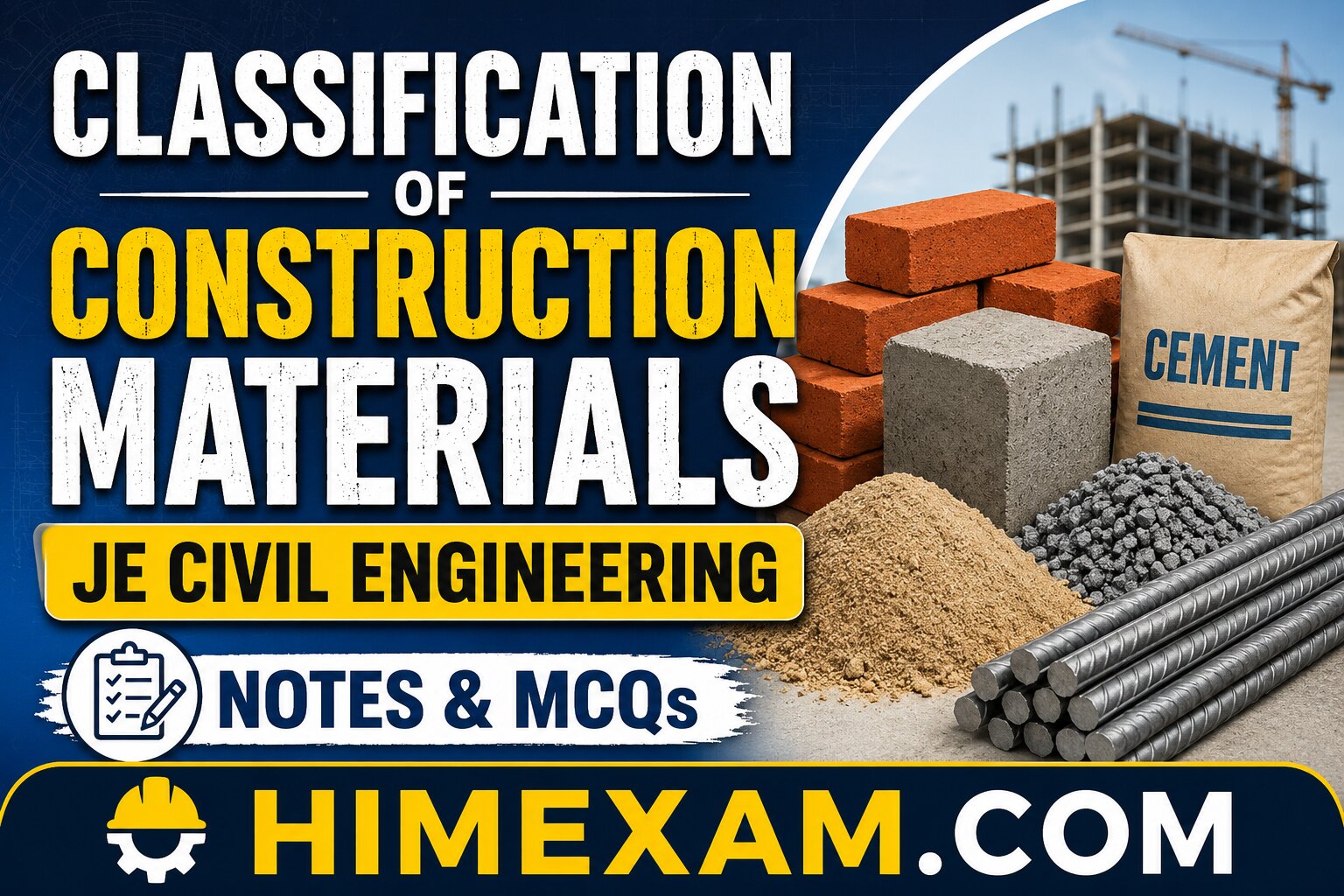


Classification of Construction Materials – JE Civil Engineering Notes & MCQs
Master the Classification of Construction Materials for HPPSC JE Civil, HPRCA JE, SSC JE, RRB JE, and other State JE Exams. This bilingual study material covers Natural, Artificial, Special, Finishing, and Recycled Materials with concise theory, important facts, and exam-oriented MCQs for quick revision and better exam preparation.


HPRCA JE CIVIL TEST SERIES:- CLICK HERE
Classification of Construction Materials – JE Civil Engineering Notes & MCQs
1. Construction Material (निर्माण सामग्री)
Construction materials are the materials used for constructing buildings, roads, bridges, dams, tunnels, and other civil engineering structures.
निर्माण सामग्री वे पदार्थ हैं जिनका उपयोग भवन, सड़क, पुल, बाँध, सुरंग तथा अन्य सिविल इंजीनियरिंग संरचनाओं के निर्माण में किया जाता है।
Classification of Construction Materials
निर्माण सामग्री का वर्गीकरण
Construction materials are mainly classified into:
- Natural Materials (प्राकृतिक सामग्री)
- Artificial Materials (कृत्रिम सामग्री)
- Special Materials (विशेष सामग्री)
- Finishing Materials (फिनिशिंग सामग्री)
- Recycled Materials (पुनर्चक्रित सामग्री)
2. Natural Construction Materials
प्राकृतिक निर्माण सामग्री
Definition
Natural materials are obtained directly from nature and require little or no processing before use.
प्राकृतिक सामग्री वे हैं जो सीधे प्रकृति से प्राप्त होती हैं तथा उपयोग से पहले बहुत कम प्रसंस्करण की आवश्यकता होती है।
Characteristics
- Eco-friendly
- Naturally available
- Economical
- Durable
- Renewable (some materials)
विशेषताएँ
- पर्यावरण के अनुकूल
- प्राकृतिक रूप से उपलब्ध
- किफायती
- टिकाऊ
- कुछ सामग्री नवीकरणीय होती हैं
Examples
|
English |
हिन्दी |
|
Stone |
पत्थर |
|
Sand |
रेत |
|
Clay |
चिकनी मिट्टी |
|
Timber |
लकड़ी |
|
Bamboo |
बाँस |
|
Gravel |
बजरी |
Uses
Stone → Foundations, masonry, retaining walls
Sand → Concrete, mortar, plaster
Timber → Doors, windows, roofing, formwork
Clay → Bricks, tiles
Advantages
✔ Easily available
✔ Low processing cost
✔ Environment friendly
Disadvantages
✔ Quality varies
✔ Limited strength in some materials
✔ Weathering effects
3. Artificial Construction Materials
कृत्रिम निर्माण सामग्री
Definition
Artificial materials are manufactured by processing natural raw materials.
कृत्रिम सामग्री प्राकृतिक कच्चे पदार्थों को प्रसंस्कृत करके बनाई जाती है।
Characteristics
- Factory manufactured
- Uniform quality
- High strength
- Better durability
- Controlled properties
Examples
|
English |
हिन्दी |
|
Brick |
ईंट |
|
Cement |
सीमेंट |
|
Concrete |
कंक्रीट |
|
Steel |
इस्पात |
|
Glass |
काँच |
|
Aluminium |
एल्युमिनियम |
|
Plastic |
प्लास्टिक |
Uses
Cement → Binder
Concrete → Structural members
Steel → Reinforcement
Brick → Walls
Glass → Windows
Advantages
✔ Uniform quality
✔ High compressive strength
✔ Easy mass production
Disadvantages
✔ Energy-intensive manufacturing
✔ Environmental pollution
✔ Higher production cost
4. Special Construction Materials
विशेष निर्माण सामग्री
Definition
Special materials possess unique properties for specific engineering applications.
विशेष निर्माण सामग्री वे होती हैं जिनमें विशेष गुण होते हैं और जिनका उपयोग विशेष परिस्थितियों में किया जाता है।
Types
Fire Resistant Materials
अग्निरोधी सामग्री
Examples
- Fire bricks
- Gypsum board
- Vermiculite board
Waterproofing Materials
जलरोधी सामग्री
Examples
- Bitumen
- APP Membrane
- PVC Membrane
- Liquid Waterproof Coating
Thermal Insulation Materials
ऊष्मा रोधन सामग्री
Examples
- Glass Wool
- Rock Wool
- Expanded Polystyrene (EPS)
- Polyurethane Foam (PUF)
Sound Insulation Materials
ध्वनि रोधन सामग्री
Examples
- Acoustic Panels
- Mineral Wool
- Cork Sheets
Chemical Resistant Materials
रासायनिक प्रतिरोधी सामग्री
Examples
- Epoxy Coating
- Acid Resistant Bricks
High Performance Materials
Examples
- Fiber Reinforced Concrete (FRC)
- Self Compacting Concrete (SCC)
- High Strength Concrete (HSC)
- Geotextiles
- Carbon Fiber Reinforced Polymer (CFRP)
Advantages
✔ High performance
✔ Long service life
✔ Special protection
Disadvantages
✔ Expensive
✔ Skilled installation required
5. Finishing Materials
फिनिशिंग सामग्री
Definition
Finishing materials improve appearance, durability, protection, and comfort.
फिनिशिंग सामग्री भवन की सुंदरता, सुरक्षा तथा टिकाऊपन बढ़ाने के लिए उपयोग की जाती हैं।
Examples
Wall Finishing
- Paint
- Distemper
- Whitewash
- Texture Paint
- Wallpaper
Floor Finishing
- Ceramic Tiles
- Marble
- Granite
- Vitrified Tiles
- Wooden Flooring
- Vinyl Flooring
Ceiling Finishing
- POP
- Gypsum Board
- False Ceiling
Exterior Finishing
- Exterior Paint
- Cladding
- ACP Sheets
- Stone Veneer
Purpose
✔ Decoration
✔ Weather protection
✔ Moisture resistance
✔ Easy cleaning
✔ Long life
6. Recycled Construction Materials
पुनर्चक्रित निर्माण सामग्री
Definition
Recycled materials are produced from construction and demolition waste or recycled industrial products.
पुनर्चक्रित सामग्री निर्माण एवं विध्वंस अपशिष्ट या पुनर्चक्रित औद्योगिक उत्पादों से बनाई जाती है।
Examples
|
English |
हिन्दी |
|
Recycled Aggregate |
पुनर्चक्रित एग्रीगेट |
|
Recycled Concrete |
पुनर्चक्रित कंक्रीट |
|
Fly Ash Bricks |
फ्लाई ऐश ईंट |
|
Recycled Steel |
पुनर्चक्रित इस्पात |
|
Recycled Plastic |
पुनर्चक्रित प्लास्टिक |
|
Crumb Rubber |
क्रम्ब रबर |
Uses
Road construction
Pavement
Concrete
Drainage layers
Backfilling
Blocks
Advantages
✔ Reduces landfill waste
✔ Conserves natural resources
✔ Cost effective
✔ Sustainable construction
✔ Lower carbon footprint
Limitations
✔ Quality variation
✔ Additional processing required
✔ Limited applications in structural works (depending on standards)
Comparison Table
|
Type |
Source |
Examples |
Main Feature |
|
Natural |
Nature |
Stone, Sand, Timber |
Naturally available |
|
Artificial |
Factory |
Cement, Brick, Steel |
Manufactured |
|
Special |
Engineered |
FRC, SCC, Bitumen, Geotextile |
Special properties |
|
Finishing |
Decorative |
Paint, Tiles, Marble |
Appearance & Protection |
|
Recycled |
Waste Materials |
Fly Ash Brick, Recycled Aggregate |
Sustainable |
Important JE Civil Exam Facts (One-Liners)
- Construction materials are broadly classified into Natural, Artificial, Special, Finishing, and Recycled materials.
- Stone is one of the oldest natural construction materials.
- Cement is an artificial binding material.
- Concrete is a composite material made of cement, fine aggregate, coarse aggregate, and water.
- Steel has high tensile strength and is widely used as reinforcement.
- Bitumen is mainly used for waterproofing and road construction.
- Gypsum board is commonly used for fire-resistant partitions and false ceilings.
- Glass wool and rock wool are thermal and sound insulation materials.
- Epoxy provides excellent chemical resistance and strong bonding.
- Geotextiles are permeable synthetic fabrics used for separation, filtration, drainage, reinforcement, and erosion control in geotechnical engineering.
- Fly ash bricks are manufactured using fly ash, cement/lime, gypsum, and sand/stone dust.
- Recycled aggregates are obtained by crushing construction and demolition (C&D) waste.
- Marble and granite are premium floor and wall finishing materials.
- Ceramic and vitrified tiles are popular flooring materials due to durability and low water absorption.
- ACP (Aluminium Composite Panel) is commonly used for exterior cladding.
- Using recycled materials helps achieve sustainable construction and reduces environmental impact.
Classification of Construction Materials – Important MCQs
Question 1.
Construction materials are mainly classified into how many categories?
निर्माण सामग्री को मुख्यतः कितनी श्रेणियों में वर्गीकृत किया जाता है?
(A) 3
(B) 4
(C) 5
(D) 6
Answer: (C) 5
Question 2.
Which of the following is a natural construction material?
निम्नलिखित में से कौन–सी प्राकृतिक निर्माण सामग्री है?
(A) Cement
(B) Brick
(C) Stone
(D) Glass
Answer: (C) Stone
Question 3.
Which of the following is an artificial construction material?
निम्नलिखित में से कौन–सी कृत्रिम निर्माण सामग्री है?
(A) Timber
(B) Sand
(C) Cement
(D) Gravel
Answer: (C) Cement
Question 4.
Timber is classified as which type of construction material?
लकड़ी (Timber) किस प्रकार की निर्माण सामग्री है?
(A) Artificial
(B) Natural
(C) Recycled
(D) Finishing
Answer: (B) Natural
Question 5.
Which material acts as a binding material in construction?
निर्माण कार्य में बाइंडिंग सामग्री के रूप में कौन–सी सामग्री कार्य करती है?
(A) Sand
(B) Cement
(C) Stone
(D) Gravel
Answer: (B) Cement
Question 6.
Concrete is an example of:
कंक्रीट किसका उदाहरण है?
(A) Natural material
(B) Artificial material
(C) Recycled material
(D) Finishing material
Answer: (B) Artificial material
Question 7.
Which of the following is mainly used for reinforcement in RCC?
RCC में मुख्य रूप से सुदृढ़ीकरण (Reinforcement) के लिए किसका उपयोग किया जाता है?
(A) Timber
(B) Steel
(C) Brick
(D) Stone
Answer: (B) Steel
Question 8.
Bitumen is mainly used for:
बिटुमेन का मुख्य उपयोग किस लिए किया जाता है?
(A) Thermal insulation
(B) Waterproofing
(C) Flooring
(D) Plastering
Answer: (B) Waterproofing
Question 9.
Which material is commonly used for waterproofing?
जलरोधन (Waterproofing) के लिए सामान्यतः किस सामग्री का उपयोग किया जाता है?
(A) Bitumen
(B) Clay
(C) Sand
(D) Lime
Answer: (A) Bitumen
Question 10.
Glass wool is mainly used for:
ग्लास वूल का मुख्य उपयोग किसके लिए किया जाता है?
(A) Waterproofing
(B) Thermal insulation
(C) Foundation work
(D) Masonry
Answer: (B) Thermal insulation
Question 11.
Rock wool is mainly used as:
रॉक वूल का मुख्य उपयोग किस रूप में किया जाता है?
(A) Insulation material
(B) Aggregate
(C) Cement replacement
(D) Flooring material
Answer: (A) Insulation material
Question 12.
Which of the following is a fire-resistant material?
निम्नलिखित में से कौन–सी अग्निरोधी सामग्री है?
(A) Fire Brick
(B) Timber
(C) Plastic
(D) Bamboo
Answer: (A) Fire Brick
Question 13.
Gypsum board is mainly used for:
जिप्सम बोर्ड का मुख्य उपयोग किसके लिए किया जाता है?
(A) Reinforcement
(B) False ceiling
(C) Foundation
(D) Road construction
Answer: (B) False ceiling
Question 14.
Which material is used for sound insulation?
ध्वनि रोधन (Sound Insulation) के लिए कौन–सी सामग्री उपयोग की जाती है?
(A) Mineral Wool
(B) Gravel
(C) Sand
(D) Cement
Answer: (A) Mineral Wool
Question 15.
Epoxy coating is mainly used because of its:
एपॉक्सी कोटिंग का मुख्य उपयोग किस गुण के कारण किया जाता है?
(A) Low strength
(B) Chemical resistance
(C) Low density
(D) Water absorption
Answer: (B) Chemical resistance
Question 16.
Fiber Reinforced Concrete (FRC) belongs to:
फाइबर रिइन्फोर्स्ड कंक्रीट (FRC) किस श्रेणी में आता है?
(A) Natural material
(B) Artificial material
(C) Special material
(D) Finishing material
Answer: (C) Special material
Question 17.
Self-Compacting Concrete (SCC) is classified as:
सेल्फ–कम्पैक्टिंग कंक्रीट (SCC) किस श्रेणी की सामग्री है?
(A) Recycled
(B) Special
(C) Natural
(D) Finishing
Answer: (B) Special
Question 18.
Which of the following is a finishing material?
निम्नलिखित में से कौन–सी फिनिशिंग सामग्री है?
(A) Paint
(B) Cement
(C) Sand
(D) Aggregate
Answer: (A) Paint
Question 19.
Marble is commonly used as:
मार्बल का सामान्य उपयोग किस रूप में किया जाता है?
(A) Reinforcement
(B) Floor finishing
(C) Aggregate
(D) Binder
Answer: (B) Floor finishing
Question 20.
Granite is mainly used for:
ग्रेनाइट का मुख्य उपयोग किसके लिए किया जाता है?
(A) Floor and wall finishing
(B) Reinforcement
(C) Waterproofing
(D) Formwork
Answer: (A) Floor and wall finishing
Question 21.
Ceramic tiles are generally used for:
सिरेमिक टाइल्स का उपयोग सामान्यतः किसके लिए किया जाता है?
(A) Flooring
(B) Foundation
(C) Beam reinforcement
(D) Roofing truss
Answer: (A) Flooring
Question 22.
Which of the following is a recycled construction material?
निम्नलिखित में से कौन–सी पुनर्चक्रित निर्माण सामग्री है?
(A) Fly Ash Brick
(B) Timber
(C) Clay
(D) Stone
Answer: (A) Fly Ash Brick
Question 23.
Recycled aggregate is produced from:
पुनर्चक्रित एग्रीगेट किससे प्राप्त किया जाता है?
(A) River sand
(B) Construction and demolition waste
(C) Clay
(D) Limestone
Answer: (B) Construction and demolition waste
Question 24.
The major advantage of recycled construction materials is:
पुनर्चक्रित निर्माण सामग्री का प्रमुख लाभ क्या है?
(A) Increases pollution
(B) Conserves natural resources
(C) Higher water absorption
(D) Lower durability
Answer: (B) Conserves natural resources
Question 25.
Which construction material classification promotes sustainable construction?
कौन–सी निर्माण सामग्री की श्रेणी सतत (Sustainable) निर्माण को बढ़ावा देती है?
(A) Natural
(B) Artificial
(C) Recycled
(D) Finishing
Answer: (C) Recycled
Question 26.
Which of the following is NOT a natural construction material?
निम्नलिखित में से कौन–सी प्राकृतिक निर्माण सामग्री नहीं है?
(A) Sand
(B) Stone
(C) Brick
(D) Timber
Answer: (C) Brick
Question 27.
Which material is manufactured by processing natural raw materials?
प्राकृतिक कच्चे पदार्थों को प्रसंस्कृत करके कौन–सी सामग्री बनाई जाती है?
(A) Natural material
(B) Artificial material
(C) Recycled material
(D) Finishing material
Answer: (B) Artificial material
Question 28.
Which one of the following is an exterior finishing material?
निम्नलिखित में से कौन–सी बाहरी फिनिशिंग सामग्री है?
(A) ACP Sheet
(B) Sand
(C) Cement
(D) Brick
Answer: (A) ACP Sheet
Question 29.
Geotextiles are mainly used in:
जियोटेक्सटाइल्स का मुख्य उपयोग किसमें किया जाता है?
(A) Geotechnical engineering
(B) Masonry
(C) Carpentry
(D) Plumbing
Answer: (A) Geotechnical engineering
Question 30.
Which of the following statements is correct?
निम्नलिखित में से कौन–सा कथन सही है?
(A) Cement is a natural material.
(B) Timber is an artificial material.
(C) Steel is commonly used as reinforcement in RCC.
(D) Fly ash bricks are natural materials.
Answer: (C) Steel is commonly used as reinforcement in RCC.
हमारे बारे में – Himexam.com
Himexam.com हिमाचल प्रदेश व अखिल भारतीय प्रतियोगी परीक्षाओं के लिए एक विश्वसनीय पोर्टल है। यहाँ आपको नवीनतम HP Govt Jobs, All India Jobs, HP GK, करेंट अफेयर्स, वन लाइनर प्रश्न, जिलेवार GK और पिछले वर्षों के प्रश्न पत्र की जानकारी एक ही जगह मिलती है। हमारी कोशिश है कि हर अभ्यर्थी को सही और समय पर अध्ययन सामग्री मिले।
 WhatsApp
 Facebook
 Telegram
 Instagram