
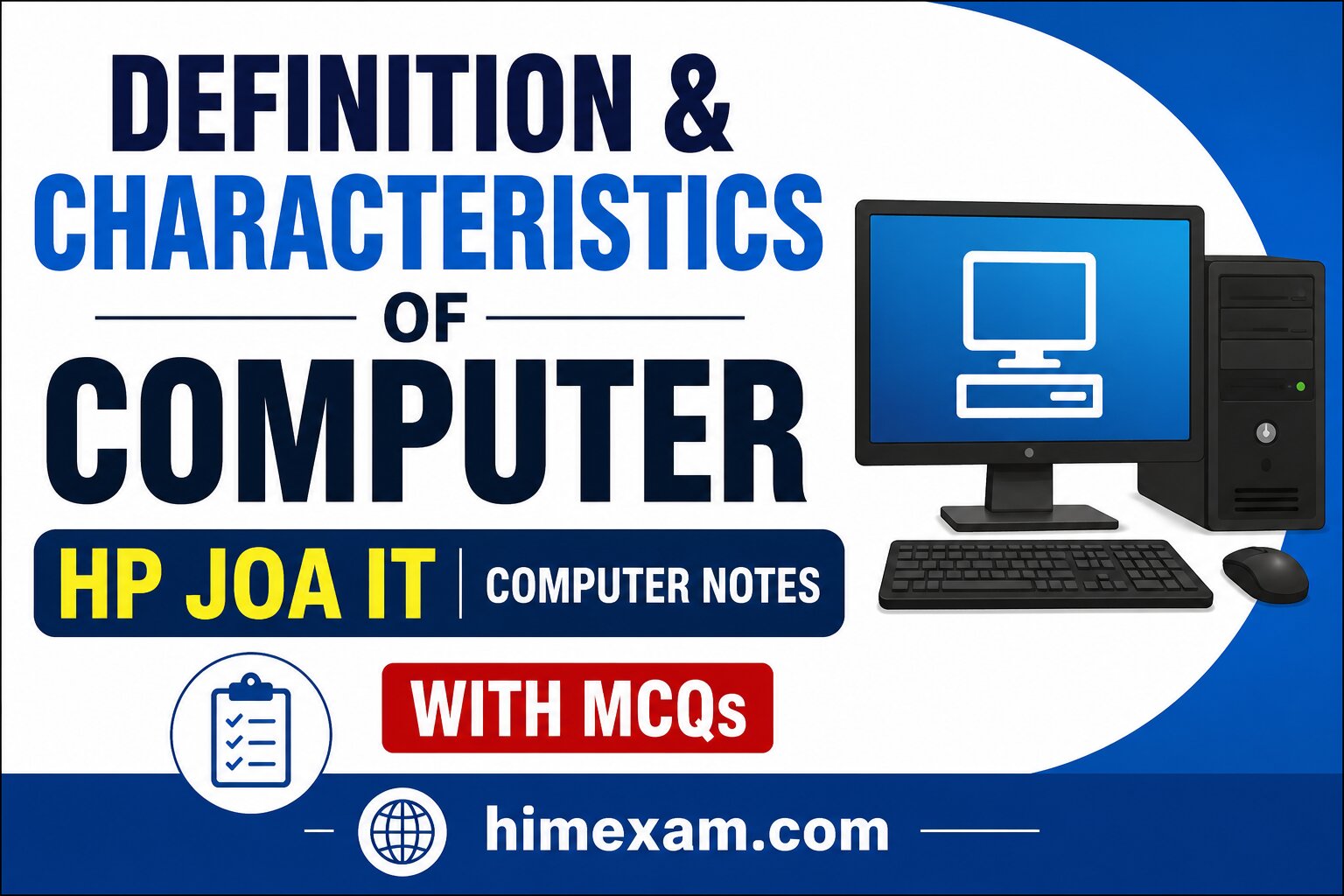


Definition & Characteristics of Computer | HP JOA IT Computer Notes with MCQs
Master Definition & Characteristics of Computer with these comprehensive HP JOA IT Notes in Hindi & English (Bilingual). Learn the computer definition, IPO cycle, data vs information, characteristics, limitations, advantages, applications, important abbreviations, exam facts, and practice the most expected MCQs. These notes are specially designed according to the latest HP JOA IT, HP Govt Exams, HPRCA, HPSSC, and other competitive exams syllabus for quick revision and maximum score.


HPRCA JOA IT TEST SERIES:- CLICK HERE
Definition & Characteristics of Computer | HP JOA IT Computer Notes with MCQs
Definition & Characteristics of Computer (कंप्यूटर की परिभाषा एवं विशेषताएँ) For HPRCA JOA IT EXAM By www.himexam.com
1. Definition of Computer (कंप्यूटर की परिभाषा)
A Computer is an electronic programmable device that accepts data as input, processes it according to a set of instructions (program), stores it, and produces meaningful information as output.
कंप्यूटर एक इलेक्ट्रॉनिक एवं प्रोग्राम योग्य मशीन है जो डेटा (Input) को स्वीकार करती है, दिए गए निर्देशों (Program) के अनुसार उसका प्रसंस्करण (Processing) करती है, उसे संग्रहित (Storage) करती है तथा उपयोगी सूचना (Output) प्रदान करती है।
Simple Formula
Input → Processing → Storage → Output
इनपुट → प्रोसेसिंग → स्टोरेज → आउटपुट
2. Computer शब्द की उत्पत्ति
- The word Computer is derived from the Latin word Computare.
- “Computare” means To Calculate.
- Computer शब्द लैटिन भाषा के Computare शब्द से बना है।
- Computare का अर्थ है गणना करना।
Exam Fact
Computare = To Calculate (गणना करना)
3. Computer Definitions by Famous Authors
Charles Babbage
Father of Computer
Designed the Analytical Engine, the first general-purpose mechanical computer.
चार्ल्स बैबेज
कंप्यूटर के जनक (Father of Computer)
Oxford Dictionary Definition
“A computer is an electronic machine that can store, organize and process data.”
4. Data and Information
Data (डेटा)
Raw facts and figures.
Example
45, 67, Rahul, 2026
अव्यवस्थित तथ्य एवं आंकड़े।
Information (सूचना)
Processed and meaningful data.
Example
Rahul scored 67 marks.
प्रसंस्कृत एवं उपयोगी डेटा।
Difference Between Data and Information
|
Data (डेटा) |
Information (सूचना) |
|
Raw facts |
Processed data |
|
No meaning |
Meaningful |
|
Input |
Output |
|
Unorganized |
Organized |
5. IPO Cycle of Computer
I – Input
Entering data.
Examples
Keyboard
Mouse
Scanner
Microphone
P – Processing
CPU processes data.
O – Output
Displays result.
Examples
Monitor
Printer
Speaker
6. Basic Block Diagram
Input Devices
↓
CPU
┌─────────────┐
│ ALU │ CU │ MU│
└─────────────┘
↓
Output Devices
↑
Secondary Storage
7. Characteristics of Computer (कंप्यूटर की विशेषताएँ)
1. Speed (गति)
Computer performs millions, billions or trillions of operations per second.
Units
- Millisecond (ms)
- Microsecond (μs)
- Nanosecond (ns)
- Picosecond (ps)
कंप्यूटर अत्यधिक तेज गति से कार्य करता है।
2. Accuracy (शुद्धता)
Produces accurate results if correct data and instructions are provided.
Important Point
Wrong Input → Wrong Output
This is called
GIGO (Garbage In Garbage Out)
गलत डेटा देने पर परिणाम भी गलत होगा।
3. Diligence (परिश्रमशीलता)
Computer never gets tired.
Works continuously.
4. Reliability (विश्वसनीयता)
Produces consistent results every time.
5. Storage Capacity (भंडारण क्षमता)
Stores huge amounts of data.
Examples
Hard Disk
SSD
Cloud Storage
6. Automation (स्वचालन)
Works automatically after receiving instructions.
7. Versatility (बहुउपयोगिता)
Performs different types of tasks.
Examples
- Banking
- Education
- Gaming
- Medical
- Research
8. Multitasking (बहुकार्य क्षमता)
Can perform multiple tasks simultaneously.
Example
- Playing music
- Downloading files
- Typing documents
9. Consistency (समानता)
Produces same result repeatedly.
10. Communication (संचार)
Shares data through networks.
Example
Internet
LAN
Wi-Fi
11. Memory (स्मृति)
Stores instructions and data.
Types
- Primary Memory
- Secondary Memory
12. Programmable (प्रोग्राम योग्य)
Works according to programs written by users.
8. Limitations of Computer (कंप्यूटर की सीमाएँ)
1. No Intelligence
Cannot think on its own.
2. No Decision Making
Cannot make decisions without instructions.
3. No Feelings
Has no emotions.
4. Dependent on Electricity
Needs power supply.
5. GIGO Principle
Wrong input always gives wrong output.
9. Advantages of Computer
- High speed
- High accuracy
- Large storage
- Automation
- Multitasking
- Reliability
- Connectivity
- Paperless work
- Online services
10. Applications of Computer
Education
Smart Classes
Online Exams
Digital Library
Banking
ATM
Net Banking
UPI
Online Transactions
Business
Payroll
Inventory
Billing
Medical
MRI
CT Scan
Patient Records
Hospital Management
Railway
Reservation
Ticket Booking
Tracking
Government
Digital India
e-Governance
Online Portals
Defence
Missile Control
Radar
Satellite
Entertainment
Movies
Gaming
Music
OTT Platforms
Agriculture
Weather Forecasting
Soil Analysis
Smart Farming
Research
ISRO
DRDO
Scientific Simulation
11. Human vs Computer
|
Human |
Computer |
|
Has emotions |
No emotions |
|
Can think |
Cannot think |
|
Can learn naturally |
Learns through programming |
|
Can make decisions |
Depends on instructions |
|
Can get tired |
Never gets tired |
12. Important Abbreviations
|
Full Form |
Meaning |
|
CPU |
Central Processing Unit |
|
ALU |
Arithmetic Logic Unit |
|
CU |
Control Unit |
|
MU |
Memory Unit |
|
IPO |
Input Process Output |
|
GIGO |
Garbage In Garbage Out |
|
PC |
Personal Computer |
|
IT |
Information Technology |
|
ICT |
Information and Communication Technology |
13. HP JOA IT One-Liner Facts (Exam Booster)
- Computer is an electronic programmable machine.
- Computer word is derived from Computare (Latin).
- Charles Babbage is known as the Father of Computer.
- IPO Cycle = Input → Process → Output.
- CPU is called the Brain of the Computer.
- ALU performs arithmetic and logical operations.
- CU controls all operations of the computer.
- Memory Unit (MU) stores data and instructions.
- GIGO = Garbage In, Garbage Out.
- A computer cannot think or take decisions independently.
- A computer has no IQ, emotions, or common sense.
- Computers are known for Speed, Accuracy, Diligence, Reliability, Storage, Automation, Versatility, and Multitasking.
- Primary memory is volatile (except ROM), while secondary memory is non-volatile.
- A computer processes data to produce information.
- A computer works only according to the instructions (programs) provided by the user.
HP JOA IT Exam Facts
✅ Father of Computer → Charles Babbage
✅ Father of Modern Computer → Alan Turing
✅ Computer derives from → Computare (Latin)
✅ Computer is an → Electronic Programmable Device
✅ Brain of Computer → CPU
✅ Arithmetic calculations → ALU
✅ Controls operations → Control Unit (CU)
✅ Data + Processing = Information
✅ Wrong Input → Wrong Output = GIGO
✅ IPO Cycle → Input → Process → Output
✅ Computer’s biggest strength → Speed and Accuracy
✅ Computer’s biggest limitation → No intelligence, no independent decision-making
Definition & Characteristics of Computer – Important MCQs For HP JOA IT Exam |
Question 1.
Computer शब्द किस लैटिन शब्द से बना है?
The word “Computer” is derived from which Latin word?
(A) Compute
(B) Computare
(C) Computeria
(D) Calculator
Answer: (B) Computare
Question 2.
Computare का अर्थ क्या है?
What is the meaning of “Computare”?
(A) To Program
(B) To Process
(C) To Calculate
(D) To Store
Answer: (C) To Calculate
Question 3.
कंप्यूटर क्या है?
What is a computer?
(A) Mechanical device
(B) Electronic programmable device
(C) Electrical device
(D) Optical device
Answer: (B) Electronic programmable device
Question 4.
कंप्यूटर के जनक (Father of Computer) किसे कहा जाता है?
Who is known as the Father of Computer?
(A) Alan Turing
(B) John von Neumann
(C) Charles Babbage
(D) Bill Gates
Answer: (C) Charles Babbage
Question 5.
Father of Modern Computer किसे कहा जाता है?
Who is known as the Father of Modern Computer?
(A) Charles Babbage
(B) Alan Turing
(C) Blaise Pascal
(D) Herman Hollerith
Answer: (B) Alan Turing
Question 6.
कंप्यूटर के कार्य करने का सही क्रम क्या है?
What is the correct working cycle of a computer?
(A) Output → Input → Process
(B) Input → Process → Output
(C) Process → Output → Input
(D) Input → Output → Process
Answer: (B) Input → Process → Output
Question 7.
IPO का पूर्ण रूप क्या है?
What is the full form of IPO?
(A) Input Program Output
(B) Input Process Output
(C) Information Process Output
(D) Internal Processing Operation
Answer: (B) Input Process Output
Question 8.
कंप्यूटर का मस्तिष्क (Brain of Computer) किसे कहा जाता है?
Which is known as the Brain of the Computer?
(A) RAM
(B) ROM
(C) CPU
(D) Hard Disk
Answer: (C) CPU
Question 9.
CPU का पूर्ण रूप क्या है?
What is the full form of CPU?
(A) Central Program Unit
(B) Central Processing Unit
(C) Central Processor Utility
(D) Computer Processing Unit
Answer: (B) Central Processing Unit
Question 10.
ALU का मुख्य कार्य क्या है?
What is the primary function of ALU?
(A) Data Storage
(B) Arithmetic and Logical Operations
(C) Input Operations
(D) Output Operations
Answer: (B) Arithmetic and Logical Operations
Question 11.
CU का मुख्य कार्य क्या है?
What is the primary function of Control Unit (CU)?
(A) Data Storage
(B) Controlling all computer operations
(C) Printing
(D) Internet Access
Answer: (B) Controlling all computer operations
Question 12.
Memory Unit (MU) का कार्य क्या है?
What is the function of Memory Unit (MU)?
(A) Printing
(B) Data Transmission
(C) Storing data and instructions
(D) Scanning
Answer: (C) Storing data and instructions
Question 13.
डेटा (Data) क्या होता है?
What is Data?
(A) Processed Information
(B) Raw Facts and Figures
(C) Printed Output
(D) Program
Answer: (B) Raw Facts and Figures
Question 14.
सूचना (Information) क्या होती है?
What is Information?
(A) Raw Data
(B) Processed and Meaningful Data
(C) Temporary Memory
(D) Program
Answer: (B) Processed and Meaningful Data
Question 15.
कौन–सा कथन सही है?
Which statement is correct?
(A) Data is processed Information
(B) Information is processed Data
(C) Both are same
(D) None of these
Answer: (B) Information is processed Data
Question 16.
GIGO का पूर्ण रूप क्या है?
What is the full form of GIGO?
(A) Good Input Good Output
(B) Garbage In Garbage Out
(C) Great Input Great Output
(D) General Input General Output
Answer: (B) Garbage In Garbage Out
Question 17.
GIGO का सिद्धांत क्या बताता है?
What does the GIGO principle state?
(A) Good Output Always
(B) Wrong Input gives Wrong Output
(C) Computer never makes mistakes
(D) Output depends on monitor
Answer: (B) Wrong Input gives Wrong Output
Question 18.
कंप्यूटर की सबसे प्रमुख विशेषता कौन–सी है?
Which is the most important characteristic of a computer?
(A) Emotions
(B) Speed
(C) Smell
(D) Taste
Answer: (B) Speed
Question 19.
कंप्यूटर की कौन–सी विशेषता सही परिणाम प्रदान करती है?
Which characteristic ensures correct results?
(A) Automation
(B) Accuracy
(C) Storage
(D) Communication
Answer: (B) Accuracy
Question 20.
कंप्यूटर बिना थके लगातार कार्य कर सकता है। यह किस विशेषता को दर्शाता है?
A computer can work continuously without getting tired. This characteristic is called:
(A) Reliability
(B) Diligence
(C) Automation
(D) Memory
Answer: (B) Diligence
Question 21.
कंप्यूटर की किस विशेषता के कारण वह एक ही कार्य बार–बार समान परिणाम के साथ कर सकता है?
Which characteristic enables a computer to produce the same result repeatedly?
(A) Accuracy
(B) Consistency
(C) Communication
(D) Versatility
Answer: (B) Consistency
Question 22.
कंप्यूटर की किस विशेषता के कारण वह विभिन्न प्रकार के कार्य कर सकता है?
Which characteristic allows a computer to perform different types of tasks?
(A) Versatility
(B) Accuracy
(C) Speed
(D) Memory
Answer: (A) Versatility
Question 23.
एक साथ कई कार्य करने की क्षमता को क्या कहते हैं?
The ability to perform multiple tasks simultaneously is called:
(A) Reliability
(B) Automation
(C) Multitasking
(D) Storage
Answer: (C) Multitasking
Question 24.
कंप्यूटर में बड़ी मात्रा में डेटा संग्रहित करने की क्षमता को क्या कहते हैं?
The ability to store a large amount of data is known as:
(A) Automation
(B) Storage Capacity
(C) Speed
(D) Diligence
Answer: (B) Storage Capacity
Question 25.
कंप्यूटर निर्देश मिलने के बाद स्वतः कार्य करता है। इसे क्या कहते हैं?
A computer works automatically after receiving instructions. This is called:
(A) Accuracy
(B) Automation
(C) Communication
(D) Reliability
Answer: (B) Automation
Question 26.
निम्नलिखित में से कंप्यूटर की सीमा (Limitation) क्या है?
Which of the following is a limitation of a computer?
(A) High Speed
(B) Large Storage
(C) No Intelligence
(D) Accuracy
Answer: (C) No Intelligence
Question 27.
कंप्यूटर किसके बिना निर्णय नहीं ले सकता?
A computer cannot make decisions without:
(A) Internet
(B) Electricity
(C) Instructions/Program
(D) Printer
Answer: (C) Instructions/Program
Question 28.
कंप्यूटर में भावनाएँ (Emotions) होती हैं।
A computer has emotions.
(A) True
(B) False
Answer: (B) False
Question 29.
निम्नलिखित में से कौन Input Device है?
Which of the following is an Input Device?
(A) Monitor
(B) Printer
(C) Keyboard
(D) Speaker
Answer: (C) Keyboard
Question 30.
निम्नलिखित में से कौन Output Device है?
Which of the following is an Output Device?
(A) Mouse
(B) Scanner
(C) Monitor
(D) Joystick
Answer: (C) Monitor
Question 31.
कंप्यूटर किस प्रकार की मशीन है?
A computer is which type of machine?
(A) Mechanical only
(B) Electronic
(C) Hydraulic
(D) Pneumatic
Answer: (B) Electronic
Question 32.
कंप्यूटर का कार्य किस पर निर्भर करता है?
The functioning of a computer depends on:
(A) Guesswork
(B) Instructions (Program)
(C) Emotions
(D) Intelligence
Answer: (B) Instructions (Program)
Question 33.
निम्नलिखित में से कौन कंप्यूटर का लाभ (Advantage) है?
Which of the following is an advantage of a computer?
(A) Gets tired quickly
(B) High Accuracy
(C) Has emotions
(D) Independent thinking
Answer: (B) High Accuracy
Question 34.
निम्नलिखित में से कौन कंप्यूटर का अनुप्रयोग (Application) नहीं है?
Which of the following is NOT an application of computers?
(A) Banking
(B) Education
(C) Healthcare
(D) Natural Breathing
Answer: (D) Natural Breathing
Question 35.
कंप्यूटर की विश्वसनीयता (Reliability) का अर्थ है—
Reliability of a computer means:
(A) It gets tired.
(B) It produces consistent and dependable results.
(C) It has emotions.
(D) It works without electricity.
Answer: (B) It produces consistent and dependable results.
HP JOA IT Exam Quick Revision Facts
- Computer → Electronic Programmable Device (इलेक्ट्रॉनिक प्रोग्राम योग्य मशीन)
- Latin Word → Computare (गणना करना)
- Father of Computer → Charles Babbage
- Father of Modern Computer → Alan Turing
- Brain of Computer → CPU
- IPO Cycle → Input → Process → Output
- ALU → Arithmetic & Logical Operations
- CU → Controls all operations
- MU → Stores data and instructions
- Data → Raw facts and figures
- Information → Processed and meaningful data
- GIGO → Garbage In, Garbage Out
- Main Characteristics → Speed, Accuracy, Diligence, Reliability, Automation, Versatility, Multitasking, Consistency, Storage Capacity, Communication
- Main Limitations → No Intelligence, No Emotions, No Independent Decision Making, Dependent on Instructions and Electricity
हमारे बारे में – Himexam.com
Himexam.com हिमाचल प्रदेश व अखिल भारतीय प्रतियोगी परीक्षाओं के लिए एक विश्वसनीय पोर्टल है। यहाँ आपको नवीनतम HP Govt Jobs, All India Jobs, HP GK, करेंट अफेयर्स, वन लाइनर प्रश्न, जिलेवार GK और पिछले वर्षों के प्रश्न पत्र की जानकारी एक ही जगह मिलती है। हमारी कोशिश है कि हर अभ्यर्थी को सही और समय पर अध्ययन सामग्री मिले।
 WhatsApp
 Facebook
 Telegram
 Instagram