

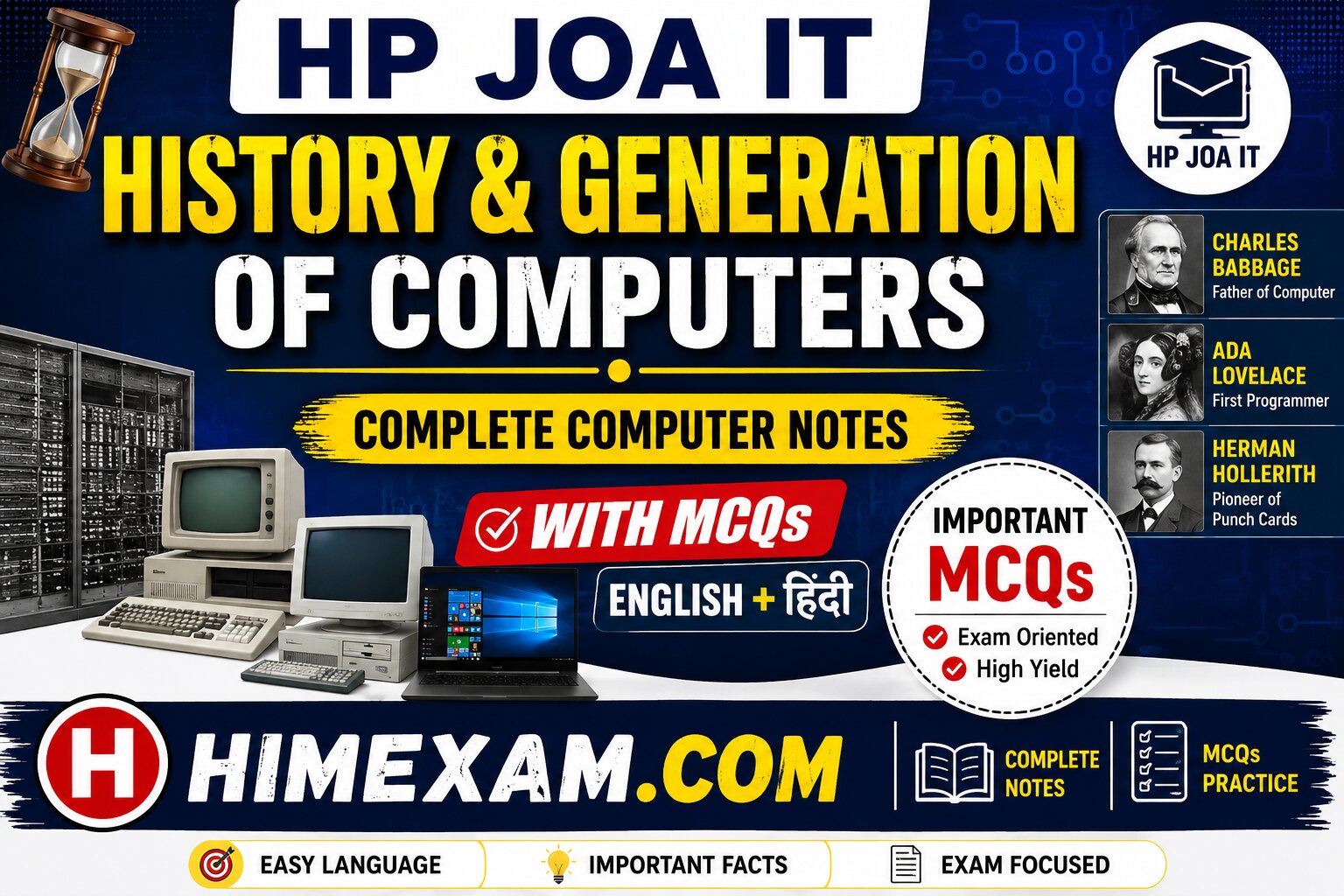


History & Generation of Computers| HP JOA IT Computer Notes with MCQs
Master History & Generation of Computers with these comprehensive HP JOA IT Notes in Hindi & English (Bilingual). Learn the computer definition, IPO cycle, data vs information, characteristics, limitations, advantages, applications, important abbreviations, exam facts, and practice the most expected MCQs. These notes are specially designed according to the latest HP JOA IT, HP Govt Exams, HPRCA, HPSSC, and other competitive exams syllabus for quick revision and maximum score.


HPRCA JOA IT TEST SERIES:- CLICK HERE
History & Generation of Computers | HP JOA IT Computer Notes with MCQs
History & Generation of Computers (कंप्यूटर का इतिहास एवं पीढ़ियाँ)||HP JOA IT Exam Notes
1. Introduction to Computer (कंप्यूटर का परिचय)
Computer is an electronic programmable device that accepts Input, processes it according to instructions, stores data, and produces Output.
कंप्यूटर एक इलेक्ट्रॉनिक प्रोग्राम योग्य मशीन है जो इनपुट प्राप्त करती है, निर्देशों के अनुसार उसे प्रोसेस करती है, स्टोर करती है तथा आउटपुट प्रदान करती है।
Computer Cycle (IPO Cycle)
- Input (इनपुट)
- Processing (प्रसंस्करण)
- Output (आउटपुट)
- Storage (संग्रहण)
2. History of Computers (कंप्यूटर का इतिहास)
(A) Abacus (अबेकस)
- Invented around 3000 BC
- Developed in China
- First calculating device.
- Used for addition and subtraction.
मुख्य तथ्य
- लगभग 3000 ईसा पूर्व
- चीन में विकसित
- पहला गणना उपकरण
- जोड़ एवं घटाव के लिए प्रयोग
(B) Napier’s Bones (नेपियर बोन्स)
- Invented by John Napier
- Year: 1617
- Used for multiplication and division.
मुख्य तथ्य
- आविष्कारक : जॉन नेपियर
- वर्ष : 1617
- गुणा एवं भाग के लिए
(C) Slide Rule (स्लाइड रूल)
- Invented by William Oughtred
- Year: 1622
- Used for logarithmic calculations.
(D) Pascaline (पास्कलाइन)
- Invented by Blaise Pascal
- Year: 1642
- First mechanical calculator.
(E) Stepped Reckoner
- Invented by Gottfried Wilhelm Leibniz
- Year: 1673
- Could perform multiplication and division.
(F) Jacquard Loom (जैक्वार्ड लूम)
- Invented by Joseph Marie Jacquard
- Year: 1801
- Used Punch Cards
- Inspired computer programming.
(G) Difference Engine
- Invented by Charles Babbage
- Year: 1822
- Automatic mathematical calculations.
(H) Analytical Engine
- Invented by Charles Babbage
- Year: 1837
- Considered the first concept of a modern computer.
Features
- Input
- Output
- Memory
- Processor
- Control Unit
Important
- Charles Babbage = Father of Computer
- चार्ल्स बैबेज = कंप्यूटर के जनक
(I) Ada Lovelace
- First Computer Programmer.
- Wrote the first algorithm for Analytical Engine.
एडा लवलेस
- विश्व की प्रथम कंप्यूटर प्रोग्रामर।
(J) Hollerith Tabulating Machine
- Invented by Herman Hollerith
- Year: 1890
- Used Punch Cards.
- Used in US Census.
(K) Mark-I
- Year: 1944
- Developed by Howard Aiken
- Electromechanical computer.
(L) ENIAC
- Full Form:
Electronic Numerical Integrator and Computer - Year: 1946
- Invented by
- J. Presper Eckert
- John W. Mauchly
Features
- First General Purpose Electronic Digital Computer.
- Used Vacuum Tubes.
(M) EDVAC
- Full Form:
Electronic Discrete Variable Automatic Computer - First stored program computer.
(N) EDSAC
- Full Form:
Electronic Delay Storage Automatic Calculator - First practical stored-program computer.
(O) UNIVAC-I
- Full Form:
Universal Automatic Computer - First Commercial Computer.
- Year: 1951
3. Father of Computer (कंप्यूटर के जनक)
|
English |
हिन्दी |
|
Charles Babbage |
कंप्यूटर के जनक |
|
Ada Lovelace |
प्रथम प्रोग्रामर |
|
Herman Hollerith |
पंच कार्ड के जनक |
|
John von Neumann |
Stored Program Concept |
4. Generations of Computers (कंप्यूटर की पीढ़ियाँ)
First Generation (1946–1959)
पहली पीढ़ी
Main Technology
Vacuum Tubes
Languages
Machine Language
Memory
Magnetic Drum
Characteristics
- Very Large
- Expensive
- High Electricity Consumption
- Produced Heat
- Slow Speed
- Low Reliability
Examples
- ENIAC
- EDVAC
- EDSAC
- UNIVAC-I
Second Generation (1959–1965)
दूसरी पीढ़ी
Technology
Transistor
Language
Assembly Language
Features
- Smaller
- Faster
- Less Heat
- More Reliable
- Lower Power Consumption
Examples
- IBM 1401
- IBM 7094
- CDC 1604
Third Generation (1965–1971)
तीसरी पीढ़ी
Technology
Integrated Circuit (IC)
Features
- High Speed
- Small Size
- Multiprogramming
- Operating System Introduced
- More Reliable
Languages
High Level Languages
Examples
- IBM System/360
- PDP-8
Fourth Generation (1971–Present)
Technology
Microprocessor (VLSI)
Features
- Personal Computer
- GUI
- Networking
- High Storage
- Portable
- Low Cost
Examples
- IBM PC
- Apple Macintosh
- Desktop
- Laptop
Fifth Generation (Present & Future)
Technology
- Artificial Intelligence (AI)
- ULSI
- Parallel Processing
- Machine Learning
- Robotics
- Natural Language Processing
Features
- Expert Systems
- Voice Recognition
- Intelligent Systems
- Supercomputers
5. Generation-wise Technologies
|
Generation |
Technology |
हिन्दी |
|
First |
Vacuum Tube |
वैक्यूम ट्यूब |
|
Second |
Transistor |
ट्रांजिस्टर |
|
Third |
Integrated Circuit (IC) |
एकीकृत परिपथ |
|
Fourth |
Microprocessor (VLSI) |
माइक्रोप्रोसेसर |
|
Fifth |
AI & ULSI |
कृत्रिम बुद्धिमत्ता |
6. Important Inventors (महत्वपूर्ण आविष्कारक)
|
Device |
Inventor |
|
Abacus |
China |
|
Napier Bones |
John Napier |
|
Pascaline |
Blaise Pascal |
|
Stepped Reckoner |
Leibniz |
|
Jacquard Loom |
Joseph Jacquard |
|
Difference Engine |
Charles Babbage |
|
Analytical Engine |
Charles Babbage |
|
Mark-I |
Howard Aiken |
|
ENIAC |
Eckert & Mauchly |
|
UNIVAC |
Eckert & Mauchly |
7. Important Full Forms (महत्वपूर्ण फुल फॉर्म)
- ENIAC – Electronic Numerical Integrator and Computer
- EDVAC – Electronic Discrete Variable Automatic Computer
- EDSAC – Electronic Delay Storage Automatic Calculator
- UNIVAC – Universal Automatic Computer
- IC – Integrated Circuit
- VLSI – Very Large Scale Integration
- ULSI – Ultra Large Scale Integration
- AI – Artificial Intelligence
- CPU – Central Processing Unit
- ALU – Arithmetic Logic Unit
- CU – Control Unit
8. HP JOA IT One-Liner Facts (Exam Booster)
- Charles Babbage is called the Father of Computer.
- Ada Lovelace is the First Computer Programmer.
- John von Neumann introduced the Stored Program Concept.
- Abacus is the first known calculating device.
- Pascaline is the first mechanical calculator.
- Analytical Engine is regarded as the first concept of a modern computer.
- ENIAC was the first general-purpose electronic digital computer.
- UNIVAC-I was the first commercial computer.
- Vacuum Tubes were used in the First Generation.
- Transistors replaced vacuum tubes in the Second Generation.
- Integrated Circuits (ICs) were introduced in the Third Generation.
- Microprocessors were introduced in the Fourth Generation.
- Artificial Intelligence (AI) is the basis of the Fifth Generation.
- Machine Language was used in the first generation.
- Assembly Language became common in the second generation.
- High-Level Languages gained popularity from the third generation onwards.
- IBM System/360 belongs to the third generation.
- Apple Macintosh and IBM PC are fourth-generation computers.
- Punch Cards were first used in the Jacquard Loom and later by Herman Hollerith.
- Stored Program Computer examples include EDVAC and EDSAC.
History & Generation of Computers MCQs}||HP JOA IT Exam | Most Important MCQs
Question 1
The first known calculating device is:
प्रथम ज्ञात गणना उपकरण कौन–सा है?
(A) Calculator / कैलकुलेटर
(B) Abacus / अबेकस
(C) Pascaline / पास्कलाइन
(D) ENIAC / एनिएक
Answer: (B) Abacus / अबेकस
Question 2
Abacus was developed in:
अबेकस का विकास किस देश में हुआ था?
(A) India / भारत
(B) China / चीन
(C) Japan / जापान
(D) Greece / ग्रीस
Answer: (B) China / चीन
Question 3
Who invented Napier’s Bones?
नेपियर बोन्स का आविष्कार किसने किया?
(A) Charles Babbage
(B) Blaise Pascal
(C) John Napier
(D) Leibniz
Answer: (C) John Napier
Question 4
Napier’s Bones were invented in:
नेपियर बोन्स का आविष्कार किस वर्ष हुआ?
(A) 1617
(B) 1642
(C) 1673
(D) 1801
Answer: (A) 1617
Question 5
Who invented the Slide Rule?
स्लाइड रूल का आविष्कार किसने किया?
(A) William Oughtred
(B) John Napier
(C) Pascal
(D) Leibniz
Answer: (A) William Oughtred
Question 6
Pascaline was invented by:
पास्कलाइन का आविष्कार किसने किया?
(A) Charles Babbage
(B) Blaise Pascal
(C) Herman Hollerith
(D) Howard Aiken
Answer: (B) Blaise Pascal
Question 7
Pascaline was the first:
पास्कलाइन क्या थी?
(A) Electronic Computer
(B) Mechanical Calculator
(C) Digital Computer
(D) Super Computer
Answer: (B) Mechanical Calculator
Question 8
Who invented the Stepped Reckoner?
स्टेप्ड रेकनर का आविष्कार किसने किया?
(A) Leibniz
(B) Pascal
(C) Babbage
(D) Napier
Answer: (A) Leibniz
Question 9
Jacquard Loom used:
जैक्वार्ड लूम में किसका प्रयोग किया गया?
(A) IC
(B) Vacuum Tube
(C) Punch Cards
(D) Microprocessor
Answer: (C) Punch Cards
Question 10
Who invented the Jacquard Loom?
जैक्वार्ड लूम का आविष्कार किसने किया?
(A) Joseph Jacquard
(B) Charles Babbage
(C) Herman Hollerith
(D) John von Neumann
Answer: (A) Joseph Jacquard
Question 11
Who invented the Difference Engine?
डिफरेंस इंजन का आविष्कार किसने किया?
(A) Charles Babbage
(B) Pascal
(C) Leibniz
(D) Hollerith
Answer: (A) Charles Babbage
Question 12
Who is known as the Father of Computer?
कंप्यूटर के जनक किसे कहा जाता है?
(A) John von Neumann
(B) Charles Babbage
(C) Ada Lovelace
(D) Herman Hollerith
Answer: (B) Charles Babbage
Question 13
Analytical Engine was invented in:
एनालिटिकल इंजन का आविष्कार किस वर्ष हुआ?
(A) 1822
(B) 1837
(C) 1845
(D) 1890
Answer: (B) 1837
Question 14
The first computer programmer was:
विश्व की प्रथम कंप्यूटर प्रोग्रामर कौन थीं?
(A) Grace Hopper
(B) Ada Lovelace
(C) Blaise Pascal
(D) Lady Augusta
Answer: (B) Ada Lovelace
Question 15
Herman Hollerith invented:
हरमन होलेरिथ ने किसका आविष्कार किया?
(A) ENIAC
(B) Tabulating Machine
(C) UNIVAC
(D) EDVAC
Answer: (B) Tabulating Machine
Question 16
The Tabulating Machine was used in:
टैबुलेटिंग मशीन का उपयोग किसमें किया गया?
(A) Banking
(B) Census
(C) Railways
(D) Education
Answer: (B) Census
Question 17
Mark-I was developed by:
मार्क-I का विकास किसने किया?
(A) Charles Babbage
(B) Howard Aiken
(C) John Mauchly
(D) Eckert
Answer: (B) Howard Aiken
Question 18
ENIAC stands for:
ENIAC का पूर्ण रूप क्या है?
(A) Electronic Numerical Integrator and Computer
(B) Electronic National Integrated Automatic Computer
(C) Electronic Numeric Information and Computer
(D) None of these
Answer: (A)
Question 19
ENIAC was introduced in:
ENIAC किस वर्ष विकसित हुआ?
(A) 1944
(B) 1945
(C) 1946
(D) 1951
Answer: (C) 1946
Question 20
ENIAC used:
ENIAC में किस तकनीक का प्रयोग हुआ?
(A) Transistor
(B) IC
(C) Vacuum Tube
(D) Microprocessor
Answer: (C) Vacuum Tube
Question 21
Who developed ENIAC?
ENIAC का विकास किसने किया?
(A) Eckert & Mauchly
(B) Babbage
(C) Howard Aiken
(D) Von Neumann
Answer: (A)
Question 22
EDVAC is known as:
EDVAC किसके लिए प्रसिद्ध है?
(A) First Supercomputer
(B) Stored Program Computer
(C) First Laptop
(D) First PC
Answer: (B)
Question 23
EDSAC stands for:
EDSAC का पूर्ण रूप क्या है?
(A) Electronic Delay Storage Automatic Calculator
(B) Electronic Digital Storage Automatic Computer
(C) Electronic Data System Automatic Calculator
(D) None
Answer: (A)
Question 24
UNIVAC-I was:
UNIVAC-I क्या था?
(A) First Personal Computer
(B) First Commercial Computer
(C) First Laptop
(D) First Tablet
Answer: (B)
Question 25
UNIVAC stands for:
UNIVAC का पूर्ण रूप क्या है?
(A) Universal Automatic Computer
(B) United Automatic Computer
(C) Universal Advanced Computer
(D) Universal Analog Computer
Answer: (A)
Question 26
The Stored Program Concept was proposed by:
स्टोर्ड प्रोग्राम अवधारणा किसने दी?
(A) John von Neumann
(B) Charles Babbage
(C) Howard Aiken
(D) Herman Hollerith
Answer: (A)
Question 27
First Generation Computers used:
प्रथम पीढ़ी के कंप्यूटरों में किसका प्रयोग होता था?
(A) IC
(B) Transistor
(C) Vacuum Tube
(D) Microprocessor
Answer: (C)
Question 28
The period of First Generation Computers is:
प्रथम पीढ़ी का समयकाल है:
(A) 1946–1959
(B) 1959–1965
(C) 1965–1971
(D) 1971–Present
Answer: (A)
Question 29
Second Generation Computers used:
दूसरी पीढ़ी के कंप्यूटरों में किस तकनीक का उपयोग हुआ?
(A) IC
(B) Transistor
(C) Vacuum Tube
(D) Microprocessor
Answer: (B)
Question 30
Third Generation Computers used:
तीसरी पीढ़ी के कंप्यूटरों में किस तकनीक का प्रयोग हुआ?
(A) Microprocessor
(B) IC
(C) Vacuum Tube
(D) AI
Answer: (B)
Question 31
Fourth Generation Computers are based on:
चौथी पीढ़ी के कंप्यूटर किस पर आधारित हैं?
(A) IC
(B) Transistor
(C) Microprocessor
(D) Vacuum Tube
Answer: (C)
Question 32
Fifth Generation Computers are mainly based on:
पाँचवीं पीढ़ी के कंप्यूटर मुख्यतः किस पर आधारित हैं?
(A) Vacuum Tube
(B) IC
(C) AI
(D) Transistor
Answer: (C)
Question 33
Machine Language was mainly used in:
मशीन भाषा का मुख्य उपयोग किस पीढ़ी में हुआ?
(A) First
(B) Second
(C) Third
(D) Fourth
Answer: (A)
Question 34
Assembly Language became popular in:
असेंबली भाषा किस पीढ़ी में प्रमुख हुई?
(A) First
(B) Second
(C) Third
(D) Fourth
Answer: (B)
Question 35
High-Level Languages became common from:
हाई लेवल भाषाओं का व्यापक उपयोग किस पीढ़ी से हुआ?
(A) First
(B) Second
(C) Third
(D) Fourth
Answer: (C)
Question 36
IBM System/360 belongs to:
IBM System/360 किस पीढ़ी का कंप्यूटर है?
(A) First
(B) Second
(C) Third
(D) Fourth
Answer: (C)
Question 37
IBM PC belongs to:
IBM PC किस पीढ़ी का उदाहरण है?
(A) First
(B) Second
(C) Third
(D) Fourth
Answer: (D)
Question 38
Apple Macintosh belongs to:
Apple Macintosh किस पीढ़ी का उदाहरण है?
(A) Second
(B) Third
(C) Fourth
(D) Fifth
Answer: (C)
Question 39
VLSI stands for:
VLSI का पूर्ण रूप क्या है?
(A) Very Large Scale Integration
(B) Very Long System Integration
(C) Virtual Large Scale Integration
(D) Variable Large Scale Integration
Answer: (A)
Question 40
ULSI stands for:
ULSI का पूर्ण रूप क्या है?
(A) Ultra Large Scale Integration
(B) Universal Large Scale Integration
(C) Ultra Long Scale Integration
(D) United Large Scale Integration
Answer: (A)
Question 41
AI stands for:
AI का पूर्ण रूप क्या है?
(A) Artificial Intelligence
(B) Automatic Information
(C) Artificial Interface
(D) Automatic Intelligence
Answer: (A)
Question 42
Which generation introduced microprocessors?
माइक्रोप्रोसेसर किस पीढ़ी में प्रस्तुत किए गए?
(A) First
(B) Second
(C) Third
(D) Fourth
Answer: (D)
Question 43
Which generation introduced Integrated Circuits (ICs)?
इंटीग्रेटेड सर्किट (IC) किस पीढ़ी में आए?
(A) First
(B) Second
(C) Third
(D) Fourth
Answer: (C)
Question 44
Which generation is associated with Artificial Intelligence?
कौन–सी पीढ़ी कृत्रिम बुद्धिमत्ता (AI) से संबंधित है?
(A) Third
(B) Fourth
(C) Fifth
(D) Second
Answer: (C)
Question 45
Which of the following is the correct chronological order?
निम्नलिखित में से सही कालानुक्रमिक क्रम कौन–सा है?
(A) Abacus → Pascaline → Difference Engine → Analytical Engine → ENIAC
(B) Pascaline → Abacus → ENIAC → Analytical Engine → UNIVAC
(C) Difference Engine → Abacus → Pascaline → ENIAC → Analytical Engine
(D) ENIAC → Abacus → Pascaline → Difference Engine → UNIVAC
Answer: (A)
हमारे बारे में – Himexam.com
Himexam.com हिमाचल प्रदेश व अखिल भारतीय प्रतियोगी परीक्षाओं के लिए एक विश्वसनीय पोर्टल है। यहाँ आपको नवीनतम HP Govt Jobs, All India Jobs, HP GK, करेंट अफेयर्स, वन लाइनर प्रश्न, जिलेवार GK और पिछले वर्षों के प्रश्न पत्र की जानकारी एक ही जगह मिलती है। हमारी कोशिश है कि हर अभ्यर्थी को सही और समय पर अध्ययन सामग्री मिले।
 WhatsApp
 Facebook
 Telegram
 Instagram








![Ghatna Chakra General Hindi Notes 2024 [Hindi Medium] PDF](https://himexam.com/wp-content/uploads/2026/10/General-Hindi-Notes-2024-Download-Poster-300x169.jpg)
