
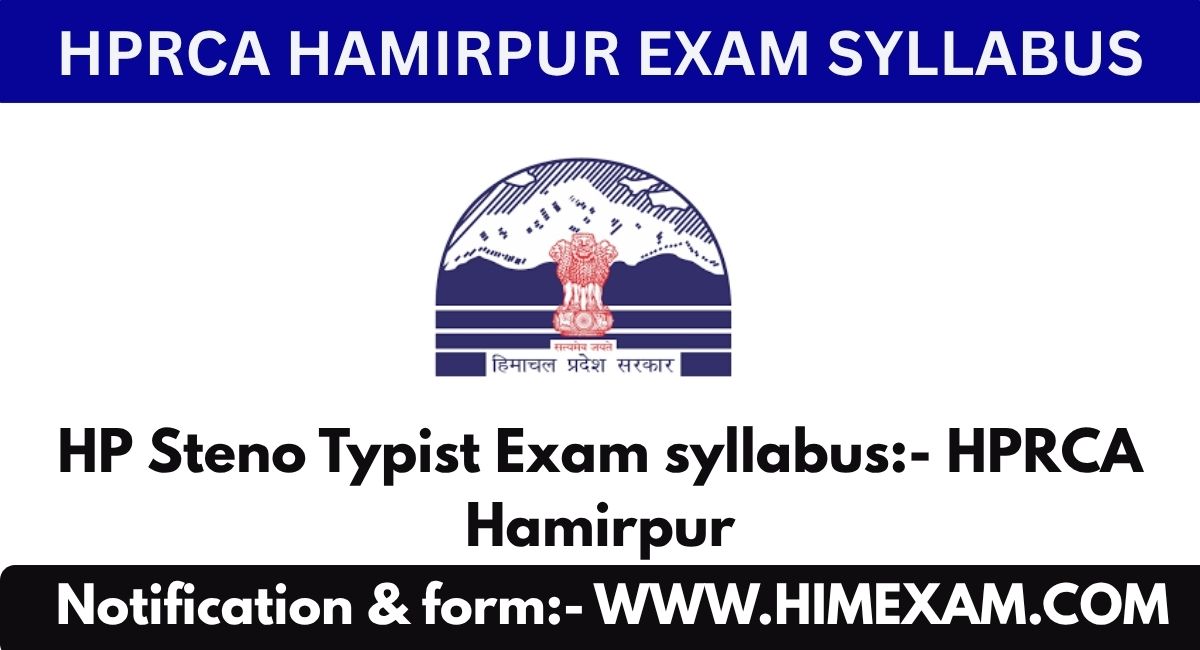


HP Steno Typist Exam syllabus:- HPRCA Hamirpur
Exam Pattern


| Total MCQ | 120 |
| Total Question | 120 |
| Time Period | 90 Minute |
HP Steno Typist Exam syllabus:- HPRCA Hamirpur
1. HISTORY
i. Indian History:-
(a) Ancient Indian History :The earliest Societies-Hunting & gathering as a way of life, its implications; introduction to stone tools and their use; Prehistory and Human Civilization: Paleolithic Age, Mesolithic Age and Neolithic Age; The Copper age, The Bronze Age and The Iron Age; The Indus Valley Civilization: Principal archaeological sites, urban planning, external and internal trade, artistic achievements, industries and crafts, social stratification. Pre-Vedic and Vedic Culture; Religious Movements; Mauryan Empire; The Shakas, The Kushanas, The Satavahanas; Sangam Age : – The Cholas, The Pandya, The Cheras; The Guptas Age; The PostGuptas Age : The Harshavardhana
(b) History of Medieval India : Turkish invasion in India: -Muhammad bin Qasim, Mahmud of Ghazni, and Muhammad Ghori; The Delhi Sultanate : – The Mamluk (Slave), Khilji, Tughlaq, Sayyad, and Lodi dynasties; Religious Movements: -Sufi movement, Chishti order; The Bhakti Movement: – Shankara, Ramanujacharya, Madhvacharya, Namdev, Gnyaneshwar, Kabir, Guru Nanak, Ravidas, Tulsidas, Surdas, Mirabai and Chaitanya; Mughal Empire; Maratha Empire; Rise of Sikh Empire.
(c) History of Modern India: Arrival of European Companies in India; Governor Generals of Bengal; Viceroys of India; Provincial Autonomous States of India and their conflicts with European trading companies; Economic impact of British rule in India; Land settlement during British rule; Revolt of 1857; Social and Religious Reform Movements; National Freedom Movement : – Indian National Congress, Partition of Bengal, Swadeshi and Swaraj, Muslim League, Partition in Congress, Lucknow Pact, Home Rule League, Champaran Movement, Montague August Declaration, Kheda Satyagraha, Ahmadabad Satyagraha, Rowlett Act, Jallianwala Bagh Massacre, The Khilafat Movement, Non-Cooperation Movement, Swaraj party, Simon Commission, Nehru Report, Zinna Formula, Bardoli Satyagraha, Congress Lahore Session, Dandi March and eleven Demands of Gandhiji, Civil Disobedience Movement, Round-table Conferences, Gandhi-Irvin Pact, Communal Award, Poona Pact, Revolutionary Nationalist Movements of Bhagat Singh, Chandrashekhar Azad, and Subhas Chandra Bose etc., Provincial elections in British India, August Proposal, Demand for a Separate Pakistan, Kripps Mission, Quit India Movement, C. Rajgopalachari Formula, Wavell Plan, Shimla Conference, Cabinet Mission, Mountbatten Plan; Constitutional Development in India: – Regulating Act 1773, Pitt’s India Act 1784, Charter Act of 1793, Charter Act of 1813, Charter Act of 1833, Charter Act of 1853, Government of India Act 1858, Indian Councils Act 1861, Indian Councils Act 1892, Indian Councils Act, 1909 – Morley-Minto Reforms, Government of India Act 1935, Cripps Mission – 1942, Cabinet Mission – 1946, Indian Independence Act – 1947
2. GEOGRAPHY: India – Size and Location, India & the world, India’s neighbors,; Physical Features of India: majors Physiographic divisionsHimalayan, mountains, northern plains, peninsular plateau Indian desert, coastal plains, Islands; Drainage: concept, drainage system in India, The Himalayan Rivers- Ganga & Brahmaputra River system, the Peninsular Rivers- Narmada Basin, Tapti Basin, Godavari Basin, Mahanadi basin, Krishna basin, Kaveri basin; Climate: Concept, Climatic Controls, Factors influencing India’s climate – Latitude, Altitude, Pressure and Winds (excluding Jet Streams and Western Cyclonic Disturbances and related figures),The Seasons – Cold Weather Season, Hot Weather Season, advancing Monsoon, Retreating/Post Monsoons, Distribution of Rainfall, Monsoon as a Unifying Bond; Natural Vegetation – Types of Vegetation – Tropical Evergreen Forests, Tropical Deciduous Forests, Thorn Forests and Shrubs, Mountain Forests, Mangrove Forests, and Wildlife; PopulationPopulation Size and Distribution – India’s Population Size and Distribution by Numbers, India’s Population Distribution by Density, Population Growth and Processes of Population Change. India’s physical environment, resources, and economy: Resources and Development, Forest and Wildlife Resources, Water Resources, Agriculture, Minerals and Energy Resources, Manufacturing Industries, Lifelines of the National Economy, multipurpose river projects.Universe and Solar System; Lithosphere and Rocks; Rocks and their types; Volcano; Earthquake; Landforms (Mountains, Plateaus, and Plains); Agriculture and Food Crops; cropping pattern; Forests and Types of Forests; Minerals; Sources of Power/Energy; Industries and Occupations; Transport and Communication; rain water harvesting; land use pattern in India; land degradation and conservation measures; Types of farming: primitive, subsistence, intensive subsistence, commercial.
3. POLITICAL SCIENCE: What is Democracy? Why Democracy? : feature & broader meaning; Constitutional Design: democratic constitution in South Africa ; guiding values of the Indian Constitution & its need; Electoral Politics: our system of election, what makes elections in India democratic; Working of Institutions: how major policy decision taken, Parliament, Political executive, the Judiciary ; Democratic Rights: life without rights, rights in a democracy, rights in Indian Constitution, expanding scope of rights. Constituent assembly; Preamble of Indian Constitution; Fundamental Rights and Duties; Directive Principles of state policy; Parliament and its two houses; Prime Minister and Council of Ministers; Judiciary at National Level, State and local level; President, Appointment and Powers; Vice-President Appointment and Powers; State Legislative Assemblies; Chief Minister; Chief Minister, Council of Ministers and Powers; Governor, Appointment and Powers; Citizenship; Centre state relations; Emergency provisions; Major Constitutional Amendments. (From 1951 onwards); Budget; Election commission of India; Local selfgovernments:- Panchayats and Municipalities; Political parties ; Finance Commission; Comptroller and Auditor General of India; Attorney General of India; Anti- defection Law; Official language; Central Bureau of Investigation (CBI); Caste; Patriarchy; Planned Economy; Social Movements. Democratic Politics: Power Sharing-Belgium & Sri Lanka, majoritarianism in Sri Lanka, Accommodation in Belgium, why power sharing is desirable, forms of power sharing , Federalism- what is federalism, what makes India a Federal country, how is federalism practiced, decentralization in India , Gender, Religion and Caste: gender & politics- , Political Parties, Outcomes of Democracy
MATHEMATICS: Number System, Profit & Loss, Simplification, Simple & Compound Interest, Percentage, Time & Work, Ratio & Proportion, Time, Speed & Distance, Average, Data Interpretation, Algebra, Mensuration
SCIENCE: Components of food:– What do different food items contain? Test for starch, protein and fats. What do various nutrients do for our body? Balanced diet, Deficiency diseases. Sorting materials into groups:– Objects around us, Properties of materials (Appearance. Hardness. Soluble. Insoluble) . Objects may float or sink in water, Transparency. Separation of substances:– Methods of separation (Hand picking. Winnowing, sieving, sedimentation, decantation and filtration) ,Evaporation. Getting to know plants:– (Herbs, shrubs and trees), Stem, leaves, Root, Flower. Body movements:– Human body and its movements, Ball and socket joints, Pivot joints, Hinge joints. Fixed joints, Skeleton, Gait of animals(Earthworm, snail,Cockroach, birds, Fish). How do snakes move? The living organisms, characteristics, and habitat:–Organisms and the surroundings, where they live, Habitat and adaptation , A journey through different habitats, Some terrestrial habitats ,Some aquatic habitats ,Characteristics of organisms. Motion and measurement of distances:–Story of transport, How wide is this desk? Some measurements, Standard units of measurements, Correct measurement of length, Measuring the length of a curved line, Moving things around us, Types of motion. Lights, shadows, and reflections:– Transparent, Opaque and translucent objects, What exactly are shadows? Pin hole camera, Mirrors and reflections. Electricity and circuits:– Electric cell, A bulb connected to an electric cell, An electric circuit, Electric switch., Electric conductors and insulators. Fun with magnets:–How magnets were discovered?, Magnetic and non magnetic materials ,Poles of magnet, Finding directions, Make your own magnet, Attraction and repulsion between magnets, A few cautions. Air around us:– Is air present everywhere around us? What is air made up of? How does oxygen become available to animals and plants living in water and soil? How is the oxygen in the atmosphere replaced? Nutrition in plants:– Mode of nutrition in plants ( Photosynthesis and other modes ) , How nutrients are replenished in the soil. Nutrition in animals:– Different ways of taking food, Digestion in human , grass eating animals, amoeba. Heat:– Hot and cold, Measuring temperature, Transfer of heat, Kinds of clothes we wear in summer and winter. Acids, Bases and Salts:– Acids and Bases, Natural indicators around us ( litmus, turmeric ,china rose), Neutralisation ( In everyday life Indigestion, ant bite, soil treatment , factory waste). Physical and Chemical Changes:– Physical change, Chemical change, Rusting of iron, Crystallisation. Respiration in Organisms:– Why do we respire? , Breathing, How do we breathe? , What do we breathe out? , Breathing in other animals (Cockroach, Earthworm), Breathing under water, Do plants also respire? Reproduction in Plants:–Seed Dispersal Motion and Time:– Slow or Fast, Speed, Measurement of time, Measuring speed, DistanceTime Graph. Electric Current and its Effects:– Symbols of Electric Components, Heating Effect of Electric Current, Magnetic Effect of Electric Current, Electromagnet, Electric Bell. Light:- Light travels along a Straight Line, Reflection of Light, Spherical Mirrors, Lenses, Sunlight- White or coloured? Forests: Our Lifeline, Waste Water Story, Water our lifeline, What is sewage, Water freshens Up- An Eventful Journey, Waste water Treatment Plant, Better Housekeeping Practices, Sanitation and Disease, Alternative Arrangement for Sewage Disposal, Sanitation at public places. Crop Production and Management:– Agricultural Practices ( Preparation of soil, Sowing, Adding manure and Fertilisers, Irrigation, Protecting from weeds, Harvesting, Storage). Microorganisms: Friend and Foe:– Microorganisms, Where do microorganisms live? , Microorganisms and us , Friendly microorganisms, Harmful microorganisms, Food preservation, Nitrogen fixation, Nitrogen cycle. Coal and Petroleum:– Natural resources ( Exhaustible and Inexhaustible) , Story of Coal, Petroleum, Refining of petroleum, natural gas. Combustion and Flame:– What is combustion?, How do we control fire ? , Types of combustion, Flame, Structure of a flame, What is the fuel? , Fuel efficiency, Burning of fuel leads to harmful products ( Global warming, Acid rain , Incomplete combustion, Deforestation). Conservation of Plants and Animals:–Deforestation , its causes and consequences, Conservation of forest and wildlife, National Park, Wildlife Sanctuary, Biosphere Reserve, Flora and fauna, Endemic species, Red Data book, Migration, Recycling of paper, Reforestation. Reproduction in Animals:– Modes of reproduction, ( Sexual and Asexual), Story of Dolly, the clone, Oviparous and viviparous animals, Metamorphosis, IVF. Reaching the age of Adolescence:– Adolescence and puberty, Changes at puberty, Secondary Sexual characters, Role of hormones, Reproductive phase of life in humans, How is the sex of baby determined? , Reproductive health, Say no to drugs. Force and Pressure:– Forces are due to an interaction, Exploring forces, Contact forces ( Muscular , friction) ,Non contact forces (Magnetic, electrostatic, gravitational ), Pressure exerted by liquids and gasses, Atmospheric pressure. Friction:– Factors affecting friction, Friction : A necessary Evil, Increasing and reducing friction, Fluid friction, Static, sliding and rotating friction. Sound: Production of sound, Sound needs a medium for propagation, Song produced by Humans, Human ear, Amplitude, time period and frequency of a vibration, Loudness and pitch, Audible and inaudible sounds, Noise and music, noise pollution. Harms of noise pollution , Measures to limit noise pollution ,Hearing impairment. Chemical Effects of Electric Current:– Do liquids conduct electricity? , Electroplating. Some Natural Phenomena: Lightning, The sparks that the Greeks knew about, Charging by rubbing, Types of charges and their interaction, Transfer of charge, The story of Lightning, Lightning safety. Earthquake, Protection against earthquake. Light: What makes things visible?, Laws of reflection, Regular and Diffused reflection, Reflected light can be reflected again, Multiple images, Kaleidoscope, sunlight, white or coloured , what is inside our eyes, Care of the eyes, Visually impaired persons can read and write, What is the Braille system?. Matter in Our Surroundings: States and properties of matter; Elements, compounds, mixtures, and solutions; Atoms and Molecules: Laws of chemical combination, chemical formulae, and atomic masses; Structure of the Atom: Subatomic particles, atomic models, and isotopes; The Fundamental Unit of Life: Cell structure, organelles, and cell division; Tissues: Plant and animal tissues and their functions; Improvement in Food Resources: Crop and animal farming methods for better yield and quality. Motion: Distance, displacement, speed, velocity, and graphs of motion; Force and Laws of Motion: Newton’s laws, inertia, and momentum; Gravitation: Universal Law of Gravitation, mass, weight, and Archimedes’ Principle; Work and Energy: Work, kinetic energy, potential energy, and the Law of Conservation of Energy; Sound :Production, propagation, characteristics, and reflection of sound. Chemical Reactions and Equations, Acids, Bases, and Salts, Metals and Non-Metals, Carbon and Its Compounds; Life Processes, Control and Coordination, Reproduction in Organisms, Heredity and Evolution, Light – Reflection and Refraction, The Human Eye and the Colourful World , Electricity, Magnetic Effects of Electric Current, our environment.
IV. ENGLISH : Reading Comprehension Word Power, The Sentence, Subject And Predicates , Articles, Number, Gender, Punctuation, Comprehension, Noun, Pronoun, Verb, Finite and Non-finite Verb, Adverb, Adjective, Preposition, Conjunction, Interjection , Error Correction, Sentence Rearrangement, Vocabulary, Antonyms, Synonyms, Tenses, Subject-Verb Agreement, Idioms, Modals, Active Voice & Passive Voice, Change the narration: Direct and Indirect, Phrases and a Clauses , One word substitution, Transformation of Sentences, Cloze Test, Fill in the blanks
हिन्दी भाषा-व्याकरण एवं लिपि का परिचयः वर्ण विचार एवं आक्षरिक खण्डः शब्द विचार (क) परिभाषा के आधार पर (तत्सम्, तद्भव, देशज, विदेशी), रचना के आधार पर, प्रयोग के आधार पर. अर्थ के आधार पर। (ख) विकारी संज्ञा, सर्वनाम, किया, विशेषण, अविकारी किया विशेषण, सम्बन्ध बोधक, समुच्चय बोधक, विस्मयादि बोधक पद परिचय शब्द शक्तियां शब्द रूपान्तर लिंग, वचन, कारक, काल, वाच्य संधि, समासः उपसर्गः प्रत्यय वाक्य विचार, अर्थ विचार (पर्याय, विलोम, वाक्यांश के लिए एक शब्द, समानार्थी); विराम चिन्हः शुद्धिकरण (शब्द शुद्धि, वाक्य शुद्धि) मुहावरे एवं लोकोक्तियां: अलंकार।
COMPUTER : Basics of Computers, Internet & Networking, Computer Hardware, Input & Output Devices, Computer Software, Memory & Storage, Operating System, Computer Abbreviations & Keyboard Shortcuts, MS Office (Word, Excel, PowerPoint, MS Access) Cyber Security Basics.
2. GENERAL AWARENESS.
i. General knowledge: General Knowledge including General knowledge of Himachal Pradesh.
ii. Current Affairs .
iii. Everyday Science .
iv. Logical Reasoning .
More Pages:-
हेलो दोस्तों ,आपका हमारी वेबसाइट Himexam.com पर स्वागत है। जैसा की आपको पता है हमारी वेबसाइट Himexam.com आपको समय-समय पर सभी HP Govt Jobs & All India Govt Jobs की Notifications प्रदान करवाती है। साथ ही साथ Himachal Pradesh Exam Previous Paper और Himachal Pradesh GK ,Himachal Pradesh & National +International Current Affairs के सभी नोट्स मुफ्त उपलब्ध करवाते है। हमारी वेबसाइट के अलग अलग प्लेटफार्म पर pages & Group बने है जैसे की facebook ,Telegram और Instagram .. अगर आप हिमाचल के किसी भी पेपर की तैयारी कर रहे हो तो जल्दी से इन groups के साथ जुड़ जाएं इनके लिंक नीचे table में दिए गए है।
Join Us:-
| Like Our Facebook Page | Click here |
| Join Us oN Telegram | Click here |
| Join Us On Instagram | Click Here |