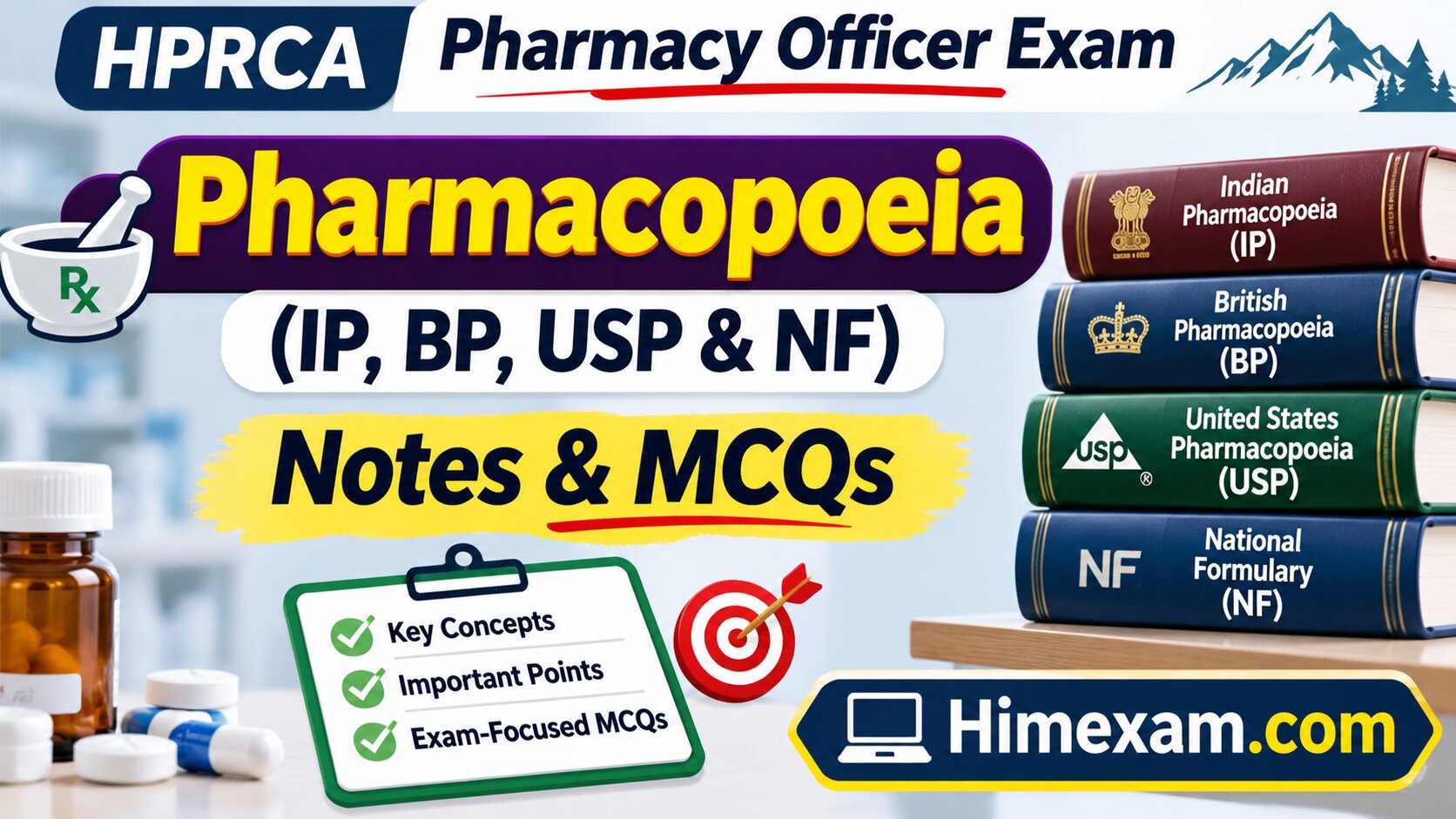
HPRCA Pharmacy Officer Preparation
PHARMACOPOEIA
Indian Pharmacopoeia (IP), British Pharmacopoeia (BP), United States Pharmacopeia (USP), National Formulary (NF) and Extra Pharmacopoeia
Advertisement

Download Himexam.com Android App
Himexam.com
Topics covered in this chapter
- Introduction and meaning of Pharmacopoeia
- History and development of Pharmacopoeias
- Indian Pharmacopoeia (IP)
- British Pharmacopoeia (BP)
- United States Pharmacopeia (USP)
- National Formulary (NF)
- Extra Pharmacopoeia / Martindale
- Pharmacopoeial monographs and general chapters
- Important technical terms and reference standards
- Comparative tables, examination facts and MCQs
1. Introduction to Pharmacopoeia
A Pharmacopoeia is an official or authoritative reference publication that contains standards for the identity, purity, strength and quality of drugs and pharmaceutical substances. It provides approved specifications, analytical procedures and tests used to evaluate pharmaceutical materials and finished dosage forms.
In simple words, a pharmacopoeia tells us what quality a medicine must have and how that quality should be tested.
Meaning and origin of the word
- The word Pharmacopoeia is derived from Greek words.
- Pharmakon: Drug or medicine.
- Poiein: To make or prepare.
- Thus, Pharmacopoeia broadly refers to the preparation or making of medicines.
Objectives of Pharmacopoeia
- Standardisation: Establishes uniform standards for medicines.
- Identification: Provides tests to confirm the identity of a drug.
- Purity: Establishes acceptable limits for impurities and contaminants.
- Strength: Ensures that the drug contains the required amount of active ingredient.
- Quality control: Provides analytical procedures for testing raw materials and finished products.
- Safety and efficacy support: Helps ensure consistent pharmaceutical quality, which is essential for patient safety and reliable therapeutic performance.
- Regulatory compliance: Provides legally recognised standards where adopted by the relevant legislation.
IDENTITYIs it the correct drug?
PURITYIs it free from unacceptable impurities?
STRENGTHDoes it contain the required amount?
QUALITYDoes it meet prescribed standards?
Importance in Pharmacy
- Used in pharmaceutical manufacturing.
- Used in quality assurance (QA) and quality control (QC).
- Useful in drug testing laboratories.
- Helps regulatory authorities inspect the quality of medicines.
- Provides standard analytical methods for pharmacists and pharmaceutical scientists.
- Helps maintain consistency between different batches of a medicine.
Important examination point: A pharmacopoeia is primarily a book of drug quality standards. It is not simply a book of prescriptions, treatment guidelines or drug dosages.
2. Important Pharmacopoeias of the World
Several countries and regions publish pharmacopoeias to establish official standards for medicines. The most important publications for this examination are IP, BP, USP and NF.
| Abbreviation | Full Name | Country / Region |
|---|
| IP | Indian Pharmacopoeia | India |
| BP | British Pharmacopoeia | United Kingdom |
| USP | United States Pharmacopeia | United States |
| NF | National Formulary | United States |
| Ph. Eur. | European Pharmacopoeia | Europe |
| JP | Japanese Pharmacopoeia | Japan |
| Int. Ph. | International Pharmacopoeia | World Health Organization |
3. Indian Pharmacopoeia (IP)
The Indian Pharmacopoeia (IP) is the official book of standards for drugs manufactured and/or marketed in India. It is published by the Indian Pharmacopoeia Commission (IPC) on behalf of the Ministry of Health and Family Welfare, Government of India.
It contains authoritative specifications and analytical procedures for determining the identity, purity and strength of pharmaceutical substances and preparations.
3.1 Indian Pharmacopoeia Commission (IPC)
- Full name: Indian Pharmacopoeia Commission.
- Administrative ministry: Ministry of Health and Family Welfare, Government of India.
- Headquarters: Ghaziabad, Uttar Pradesh, India.
- Nature: Autonomous institution of the Government of India.
- Major function: Preparation, revision and publication of the Indian Pharmacopoeia.
- Other functions: Development of reference substances, publication of the National Formulary of India and training on pharmacopoeial standards.
Remember: IPC = Indian Pharmacopoeia Commission. IP = Indian Pharmacopoeia. These are not the same thing.
3.2 History of Indian Pharmacopoeia
The development of Indian pharmacopoeial standards started during the British period and continued after India’s independence.
1833
A committee of the East India Company’s Dispensary recommended the publication of a pharmacopoeia.
1844
Bengal Pharmacopoeia and General Conspectus of Medicinal Plants was published, covering commonly used indigenous remedies.
1868
Indian Pharmacopoeia was published, covering drugs from the British Pharmacopoeia 1867 and indigenous drugs used in India.
1869
A supplement to the 1868 publication was issued, incorporating vernacular names of indigenous drugs and plants.
1885
British Pharmacopoeia became officially recognised in India.
1927
The Drugs Enquiry Committee recommended publication of a National Pharmacopoeia.
1948
Indian Pharmacopoeia Committee was constituted after independence.
1955
First official edition of Indian Pharmacopoeia was published.
1960
Supplement to the first edition was published.
1966
Second edition of IP was published.
1975
Supplement to the second edition was published.
1985
Third edition of IP was published.
1996
Fourth edition of IP was published.
2005
Indian Pharmacopoeia Commission was established as an autonomous institution by the Ministry of Health and Family Welfare.
2007
Fifth edition of IP was published.
2009
IPC became fully operational as an autonomous body on 1 January 2009.
2010
Sixth edition of IP was published.
2014
Seventh edition of IP was published.
2018
Eighth edition of IP was published.
2022
Ninth edition of IP was published and became effective from 1 December 2022.
2026
Tenth edition of Indian Pharmacopoeia was published, superseding IP 2022.
3.3 Editions of Indian Pharmacopoeia – Quick Revision Table
| Edition | Year | Important Supplement / Addendum |
|---|
| First | 1955 | Supplement 1960 |
| Second | 1966 | Supplement 1975 |
| Third | 1985 | Addenda 1989 and 1991 |
| Fourth | 1996 | Addenda 2000, 2002 and 2005; Veterinary Supplement 2000 |
| Fifth | 2007 | Addendum 2008 |
| Sixth | 2010 | Addendum 2012 |
| Seventh | 2014 | Addenda 2015 and 2016 |
| Eighth | 2018 | Addenda 2019 and 2021 |
| Ninth | 2022 | Amendment lists issued subsequently |
| Tenth | 2026 | Amendments and updates as officially issued |
3.4 Legal Status of Indian Pharmacopoeia
- IP is recognised as the official book of drug standards in India.
- It is published in accordance with the Drugs and Cosmetics Act, 1940 and Drugs and Cosmetics Rules, 1945.
- Its standards are legally recognised and enforced by regulatory authorities.
- The Second Schedule of the Drugs and Cosmetics Act, 1940 deals with standards for drugs.
- IP standards are used for quality assessment and may be relied upon in legal disputes concerning drug quality.
3.5 Contents of Indian Pharmacopoeia
Indian Pharmacopoeia contains general information, general notices, general chapters, monographs and reference information related to pharmaceutical quality.
Major categories include:
- Drug substances (active pharmaceutical ingredients).
- Dosage forms and pharmaceutical preparations.
- Pharmaceutical aids and excipients.
- Antibiotics and antimicrobial substances.
- Vaccines and immunological products.
- Blood and blood-related products.
- Biotechnology-derived therapeutic products.
- Herbal drugs and herbal products.
- Phytopharmaceuticals.
- Radiopharmaceutical preparations.
- Veterinary medicines.
- General tests, analytical procedures and reference data.
3.6 IP 2026 – Important Structural Facts
The tenth edition, IP 2026, is presented in four volumes.
Volume INotices, introduction, general notices, general chapters, reference data and index
Volume IIGeneral monographs and drug substances, dosage forms and pharmaceutical aids (A–M)
Volume IIIDrug substances, dosage forms and pharmaceutical aids (N–Z), vitamins, minerals, herbs, vaccines and other specialised products
Volume IVGeneral notices, notices, veterinary monographs and index
3.7 IP Reference Substances (IPRS)
Indian Pharmacopoeia Reference Substances are official reference materials used for identification, testing and assay of pharmaceutical substances according to the requirements of IP.
- They are used as comparison standards in analytical procedures.
- They help verify the identity of a drug.
- They support the determination of purity and strength.
- They are used in quality-control laboratories.
- They provide reliable analytical reference material for pharmacopoeial testing.
Remember: IP Reference Substances are analytical reference materials, not medicines for administration to patients.
3.8 National Formulary of India (NFI)
The National Formulary of India is published by the Indian Pharmacopoeia Commission. It is intended to promote rational use of medicines by providing information on drugs, their indications, dosage, precautions and appropriate use.
| Indian Pharmacopoeia (IP) | National Formulary of India (NFI) |
|---|
| Primarily establishes official quality standards. | Primarily provides information to support rational prescribing and use of medicines. |
| Contains monographs and analytical tests. | Contains therapeutic and prescribing information. |
| Used extensively in quality control and regulation. | Used by healthcare professionals for rational medicine use. |
4. British Pharmacopoeia (BP)
The British Pharmacopoeia (BP) is the official pharmacopoeia of the United Kingdom. It provides authoritative standards for pharmaceutical substances, medicinal products and preparations used in the UK.
4.1 Important Facts about BP
- Abbreviation: BP.
- Full name: British Pharmacopoeia.
- First published: 1864.
- Publishing authority: British Pharmacopoeia Commission, through the Medicines and Healthcare products Regulatory Agency (MHRA).
- Country: United Kingdom.
- Publication frequency: Annually.
- Usual publication time: August.
- Effective date: 1 January of the following year.
4.2 History of British Pharmacopoeia
- Before 1864, separate pharmacopoeias existed for London, Edinburgh and Dublin.
- The British Pharmacopoeia was first published in 1864.
- It aimed to establish uniform standards for medicines across the United Kingdom.
- The first edition brought together standards that had previously been published separately.
- The BP has been revised regularly to accommodate scientific and pharmaceutical developments.
Examination fact: The first edition of the British Pharmacopoeia was published in 1864.
4.3 British Pharmacopoeia Commission
The British Pharmacopoeia Commission is responsible for preparing and maintaining the British Pharmacopoeia with scientific and expert input. The MHRA publishes and maintains the BP.
4.4 Contents of BP
- General notices.
- General monographs.
- Specific monographs for drug substances.
- Monographs for excipients.
- Monographs for formulated preparations.
- Herbal drugs and herbal medicinal products.
- Blood-related products.
- Immunological products.
- Radiopharmaceutical preparations.
- Appendices and supplementary chapters.
- Infrared reference spectra and other reference information.
4.5 Relationship between BP and European Pharmacopoeia
The British Pharmacopoeia incorporates all monographs and texts of the European Pharmacopoeia (Ph. Eur.), along with national BP standards.
European Pharmacopoeia (Ph. Eur.)
+
National BP Standards
=
British Pharmacopoeia (BP)
4.6 BP 2026 and BP 2027 – Current Facts
- BP 2026: Legally effective from 1 January 2026 to 31 December 2026.
- BP 2027: Published on 1 August 2026 and scheduled to become effective on 1 January 2027.
- BP 2026 contains approximately 4,000 monographs.
- BP 2026 incorporates the relevant European Pharmacopoeia texts and national standards.
Exam alert: The latest published edition and the currently effective edition are not necessarily the same. In November 2026, BP 2027 has been published, but BP 2026 remains the legally effective edition until 31 December 2026.
5. United States Pharmacopeia (USP)
The United States Pharmacopeia is a compendium of official quality standards for medicines and their ingredients in the United States. It is developed and published by the United States Pharmacopeial Convention, an independent, scientific, non-profit organisation.
5.1 Important Facts about USP
- Full name: United States Pharmacopeia.
- Abbreviation: USP.
- First published: 1820.
- Country: United States of America.
- Publishing organisation: United States Pharmacopeial Convention.
- Nature: Independent, scientific, non-profit organisation.
- Purpose: Establishes public standards for the identity, strength, quality and purity of medicines and their ingredients.
5.2 History of USP
- In 1820, a group of physicians in the United States came together to address problems relating to inconsistent medicine quality.
- The first edition of USP was published in 1820.
- The aim was to establish uniform standards for medicinal substances and preparations.
- USP standards later received recognition under US federal drug legislation.
- The Federal Food, Drug, and Cosmetic Act of 1938 gave statutory recognition to official compendia including USP and NF.
Important year to remember: USP – 1820.
5.3 Functions of USP
- Develops standards for pharmaceutical substances and products.
- Provides monographs for active pharmaceutical ingredients and finished dosage forms.
- Develops standards for pharmaceutical excipients.
- Provides general chapters containing analytical procedures and quality requirements.
- Develops reference standards used in laboratory testing.
- Supports global medicine quality and patient safety.
5.4 Main Contents of USP
- Monographs for drug substances.
- Monographs for finished drug products.
- Monographs for compounded preparations.
- Dietary supplement and ingredient standards.
- General chapters.
- General notices and requirements.
- Reference standards.
5.5 USP General Chapters
General chapters provide standard analytical methods, procedures, tests and technical requirements that may apply to multiple monographs.
In the USP-NF system, chapter numbering is important:
<1–999>Generally mandatory when applicable or referenced under the General Notices.
<1000–1999>Generally informational, unless made applicable by a specific requirement.
For example, USP General Chapter <711> deals with Dissolution and <701> deals with Disintegration.
Advanced point: Do not assume that every chapter below 1000 applies to every product automatically. The General Notices and the relevant monograph determine applicability.
6. National Formulary (NF)
The National Formulary is an American pharmaceutical compendium that historically focused on preparations and pharmaceutical ingredients not adequately covered by the USP.
6.1 Important Facts about NF
- Full name: National Formulary.
- First published: 1888.
- Original publisher: American Pharmaceutical Association (APhA).
- Original title: National Formulary of Unofficial Preparations.
- 1975: USP acquired NF and the two publications were combined under one cover.
- Current combined publication: United States Pharmacopeia–National Formulary (USP-NF).
6.2 USP and NF – Relationship
Historically, USP and NF were separate publications. USP mainly covered recognised medicinal substances and preparations, while NF initially covered unofficial preparations and later became particularly important for excipient standards.
USP
Drug substances and products
+
NF
Especially excipients
=
USP-NF
Combined compendium
6.3 What is USP-NF?
USP-NF is the combined publication of the United States Pharmacopeia and the National Formulary. Although they are published together and share general notices and requirements, USP and NF remain separate compendia.
| USP | NF |
|---|
| Standards for drug substances. | Particularly important for excipient standards. |
| Standards for dosage forms and drug products. | Standards for inactive pharmaceutical ingredients. |
| Includes standards for compounded preparations and dietary supplement ingredients. | Contains monographs for many pharmaceutical excipients. |
6.4 Examples of Pharmaceutical Excipients
- Lactose – diluent or filler.
- Starch – binder or disintegrant, depending on formulation.
- Magnesium stearate – lubricant.
- Talc – glidant or anti-adherent.
- Microcrystalline cellulose – diluent and binder.
- Carbomer – thickening and gelling agent.
- Sodium carboxymethylcellulose – thickening and suspending agent.
- Polysorbate 80 – surfactant.
Important MCQ fact: The first edition of NF was published in 1888 by the American Pharmaceutical Association. USP and NF were combined in 1975.
7. Extra Pharmacopoeia – Martindale
The Extra Pharmacopoeia was a pharmaceutical reference publication that provided information on drugs, preparations and substances, including many that were not included in the British Pharmacopoeia.
It was developed by William Martindale and became an important reference source for pharmacists and medical professionals.
7.1 Important Historical Facts
- Author: William Martindale.
- First edition: 1883.
- Original title: The Extra Pharmacopoeia of Unofficial Drugs and Chemical and Pharmaceutical Preparations.
- Co-author of first edition: Dr. W. Wynn Westcott.
- First edition length: 313 pages.
- 1972: Renamed Martindale: The Extra Pharmacopoeia.
- 1999: Renamed Martindale: The Complete Drug Reference.
- Current publisher: Pharmaceutical Press, the knowledge business of the Royal College of Pharmacy.
7.2 Why Was It Called Extra Pharmacopoeia?
In its early editions, the word “Extra” referred to its coverage of drugs and substances that were not included in the British Pharmacopoeia.
7.3 Contents of Martindale
- Drug information and monographs.
- Therapeutic uses and indications.
- Pharmacological actions.
- Adverse effects.
- Drug interactions.
- Contraindications and precautions.
- Dosage and administration information.
- Information about pharmaceutical preparations available in different countries.
- Information on herbal medicines and other medicinal substances.
7.4 Importance of Extra Pharmacopoeia
- Provides detailed drug information beyond official pharmacopoeial specifications.
- Useful for pharmacists, physicians and pharmaceutical professionals.
- Helps in understanding drug uses, adverse reactions and interactions.
- Useful for comparing medicinal preparations available in different countries.
Important distinction: Martindale is a drug reference work, not an official statutory pharmacopoeia like IP or BP. It should not be confused with an official book of legally enforceable drug standards.
7.5 Important Timeline
1883
First edition of The Extra Pharmacopoeia.
1972
Renamed Martindale: The Extra Pharmacopoeia.
1984
Martindale Online launched.
1999
Renamed Martindale: The Complete Drug Reference.
2004
Online access through MedicinesComplete was introduced.
2024
The 41st edition became the final print edition. The reference continues online.
8. Pharmacopoeial Monographs
A monograph is an official document that describes the quality requirements and testing procedures for a particular pharmaceutical substance, preparation or other article.
It defines the tests and acceptance criteria that an article must satisfy to comply with the relevant pharmacopoeial standard.
8.1 Main Components of a Monograph
- Official title: Name of the substance or preparation.
- Definition: Describes the substance or preparation and its required composition or content.
- Category or use: May provide relevant classification or use information.
- Description: Physical appearance or characteristics.
- Identification: Tests to confirm the identity of the substance.
- Tests: Quality-control tests such as pH, clarity, disintegration or dissolution, where applicable.
- Impurities: Limits and tests for specified impurities.
- Assay: Quantitative determination of the active substance.
- Storage: Storage conditions, where specified.
- Labelling: Additional labelling requirements, where applicable.
8.2 Types of Monographs
API MonographStandards for active pharmaceutical ingredients.
Excipient MonographStandards for inactive formulation ingredients.
Dosage Form MonographStandards for tablets, capsules, injections and other preparations.
Biological MonographStandards for relevant biological medicinal products.
8.3 Example of a Drug Monograph
Consider a hypothetical tablet containing a specified quantity of a drug substance.
Example: Tablet Monograph (Illustrative)
- Official name: Drug X Tablets.
- Definition: Tablets containing the specified amount of Drug X.
- Identification: Tests confirming the presence of Drug X.
- Uniformity: Compliance with applicable dosage-unit requirements.
- Dissolution: Compliance with the specified dissolution requirements.
- Assay: Drug content within the prescribed acceptance limits.
This is a teaching example, not an actual official monograph or a substitute for a pharmacopoeial specification.
9. General Notices and General Chapters
9.1 General Notices
General Notices explain the rules, definitions and conditions used to interpret and apply the standards in a pharmacopoeia.
They provide instructions on how monographs, tests, assays and other requirements should be understood.
Important points:
- They apply broadly to the pharmacopoeia.
- They explain the meaning of official terms.
- They provide rules for interpreting monographs.
- They clarify the application of tests and acceptance criteria.
- Specific monograph requirements may take precedence when the General Notices permit or indicate this.
9.2 General Chapters
General chapters contain methods and procedures that may apply to multiple pharmaceutical substances and preparations.
Examples include:
- Dissolution test.
- Disintegration test.
- Uniformity of dosage units.
- Microbial limit tests.
- Sterility testing.
- Bacterial endotoxins test.
- Chromatographic procedures.
- Tests for particulate matter.
- Container and packaging requirements.
10. Important Quality Control Tests in Pharmacopoeia
10.1 Identification Test
Identification tests establish whether a given substance is the substance claimed. Common techniques include chemical reactions, infrared spectroscopy and chromatographic comparison.
10.2 Assay
An assay is a quantitative analytical procedure used to determine the amount or potency of the active ingredient in a pharmaceutical substance or preparation.
10.3 Limit Test
A limit test is a test designed to determine whether a particular impurity or contaminant is within the prescribed limit.
10.4 Dissolution Test
The dissolution test measures the rate and/or extent to which a drug substance goes into solution from a dosage form under specified conditions.
10.5 Disintegration Test
The disintegration test determines whether a tablet or capsule breaks down into smaller particles under specified experimental conditions.
10.6 Uniformity of Dosage Units
This test ensures that individual dosage units contain a consistent amount of drug within prescribed limits.
10.7 Sterility Test
The sterility test is used to determine whether a product complies with the pharmacopoeial requirements for absence of viable microorganisms under the specified test conditions.
10.8 Bacterial Endotoxins Test
This test detects or quantifies bacterial endotoxins in pharmaceutical products. It is particularly important for parenteral products.
| Test | What it checks |
|---|
| Identification | Correct identity of drug. |
| Assay | Amount or potency of drug. |
| Limit test | Specified impurity limit. |
| Dissolution | Release of drug into solution. |
| Disintegration | Breakdown of dosage form. |
| Uniformity of dosage units | Consistency between individual units. |
| Sterility | Compliance with sterility requirements. |
| Endotoxins | Bacterial endotoxin contamination. |
11. Important Pharmacopoeial Technical Terms
11.1 Official Drug
An official drug is an article included in an official pharmacopoeia and subject to its applicable standards.
11.2 Impurity
An impurity is an unwanted component present in a pharmaceutical substance or preparation apart from the intended substance and permitted formulation components.
11.3 Reference Standard
A reference standard is a well-characterised material used as a comparison material in analytical procedures to establish the identity, strength, quality or purity of a substance.
11.4 Primary Reference Standard
A primary reference standard is a reference material whose assigned characteristics are established without requiring comparison to another reference standard of the same type.
11.5 Secondary Reference Standard
A secondary reference standard is established or qualified by comparison with an appropriate primary reference standard and is used for routine analytical work when suitably qualified.
11.6 Reagent
A reagent is a chemical or material used in a chemical reaction or analytical test.
11.7 Assay versus Identification
| Identification | Assay |
|---|
| Confirms what the substance is. | Determines how much of the substance is present. |
| Primarily qualitative. | Quantitative. |
| Answers: Is it the correct drug? | Answers: Is the quantity or potency correct? |
12. Comparison of IP, BP, USP, NF and Extra Pharmacopoeia
| Feature | IP | BP | USP | NF | Extra Pharmacopoeia |
|---|
| Full name | Indian Pharmacopoeia | British Pharmacopoeia | United States Pharmacopeia | National Formulary | Martindale: The Complete Drug Reference |
| Country | India | UK | USA | USA | International reference work |
| First publication | 1955 (official first edition) | 1864 | 1820 | 1888 | 1883 |
| Publisher / authority | IPC | MHRA / BP Commission | USP Convention | USP Convention (current) | Pharmaceutical Press |
| Main purpose | Drug quality standards in India | Drug quality standards in UK | Drug quality standards in USA | Especially excipient standards | Comprehensive drug information |
| Legal nature | Official standards in India | Official standards in UK | Official compendium in USA | Official compendium in USA | Reference publication, not a statutory pharmacopoeia |
13. Important Differences: Pharmacopoeia vs Formulary
| Pharmacopoeia | Formulary |
|---|
| Primarily concerned with official quality standards. | Primarily provides information on medicines and their appropriate use. |
| Contains specifications and analytical tests. | May include indications, dosage, precautions and prescribing information. |
| Used in drug quality assessment and regulation. | Used to guide rational prescribing and medicine use. |
| Example: IP, BP, USP. | Example: National Formulary of India. |
14. International Pharmacopoeia and Other Pharmacopoeias
14.1 International Pharmacopoeia
- Published by the World Health Organization (WHO).
- First published in 1951.
- Provides recommended quality specifications and analytical methods for pharmaceutical substances and dosage forms.
- Promotes international harmonisation and access to quality medicines.
- It is not automatically a legally binding national pharmacopoeia in every country; legal effect depends on national adoption.
14.2 European Pharmacopoeia (Ph. Eur.)
- Developed under the European Pharmacopoeia Convention.
- Published by the European Directorate for the Quality of Medicines & HealthCare (EDQM).
- Provides common quality standards for medicines and pharmaceutical substances in its member states and other participating countries.
- It is incorporated into the British Pharmacopoeia.
14.3 Japanese Pharmacopoeia (JP)
- Official pharmacopoeia of Japan.
- Published under the authority of the Ministry of Health, Labour and Welfare (MHLW).
- Provides standards for the quality of medicines used in Japan.
15. Important Examination Facts – One-Liner Revision
- First official edition of Indian Pharmacopoeia – 1955.
- First edition of British Pharmacopoeia – 1864.
- First edition of United States Pharmacopeia – 1820.
- First edition of National Formulary – 1888.
- First edition of Extra Pharmacopoeia – 1883.
- Original publisher of NF – American Pharmaceutical Association.
- Author of Extra Pharmacopoeia – William Martindale.
- Co-author of first Extra Pharmacopoeia – Dr. W. Wynn Westcott.
- Indian Pharmacopoeia Commission – Ghaziabad, Uttar Pradesh.
- IPC operates under – Ministry of Health and Family Welfare.
- IP is published by – Indian Pharmacopoeia Commission.
- IP 2022 – Ninth edition.
- IP 2026 – Tenth edition.
- First edition of IP was followed by supplement in – 1960.
- Second edition of IP – 1966.
- Third edition of IP – 1985.
- Fourth edition of IP – 1996.
- Fifth edition of IP – 2007.
- Sixth edition of IP – 2010.
- Seventh edition of IP – 2014.
- Eighth edition of IP – 2018.
- Ninth edition of IP – 2022.
- Tenth edition of IP – 2026.
- IP 2022 became effective – 1 December 2022.
- BP is generally published – Annually.
- BP is usually published in – August.
- BP becomes effective – 1 January of the following year.
- NF and USP combined under one cover – 1975.
- Current name of Extra Pharmacopoeia – Martindale: The Complete Drug Reference.
- Current online platform for Martindale – MedicinesComplete.
- Pharmacopoeia primarily establishes – Identity, purity, strength and quality.
HPRCA Pharmacy Officer – Online CBT Mock Test Series
10 CBT Tests with Answer Key
Practise exam-oriented questions and assess your preparation with Himexam.com.
START MOCK TEST NOW
HPRCA Pharmacy Officer Mock Test Series – 10 CBT Tests with Answer Key
HPRCA Pharmacy Officer Examination
PHARMACOPOEIA – IMPORTANT MCQs
IP | BP | USP | NF | Extra Pharmacopoeia
Himexam.com
Section A – Basic and Important Factual MCQs
Question 1
Which of the following best describes a pharmacopoeia?
- A book containing only prescriptions and therapeutic guidelines
- An official or authoritative compendium containing standards for the quality of pharmaceutical substances and preparations
- A book dealing exclusively with drug manufacturing machinery
- A catalogue containing only brand names of medicines
Correct Answer: B – An official or authoritative compendium containing standards for pharmaceutical quality.
Explanation: A pharmacopoeia provides standards and analytical procedures for the identity, purity, strength and quality of pharmaceutical substances and preparations. It is an important reference for quality control and regulatory compliance.
Question 2
The first official edition of the Indian Pharmacopoeia was published in which year?
- 1948
- 1960
- 1955
- 1966
Correct Answer: C – 1955.
Explanation: The first official edition of Indian Pharmacopoeia was published in 1955. It established national standards for pharmaceutical substances and preparations in India.
Question 3
Which organisation is responsible for publishing the Indian Pharmacopoeia?
- Indian Pharmacopoeia Commission
- Pharmacy Council of India
- World Health Organization
- Medical Council of India
Correct Answer: A – Indian Pharmacopoeia Commission.
Explanation: The Indian Pharmacopoeia Commission (IPC) publishes the Indian Pharmacopoeia on behalf of the Ministry of Health and Family Welfare, Government of India.
Question 4
The headquarters of the Indian Pharmacopoeia Commission is located at:
- Mumbai, Maharashtra
- New Delhi
- Hyderabad, Telangana
- Ghaziabad, Uttar Pradesh
Correct Answer: D – Ghaziabad, Uttar Pradesh.
Explanation: IPC is headquartered at Ghaziabad, Uttar Pradesh. It is an autonomous institution under the Ministry of Health and Family Welfare.
Question 5
The first edition of the British Pharmacopoeia was published in:
- 1820
- 1864
- 1883
- 1888
Correct Answer: B – 1864.
Explanation: The British Pharmacopoeia was first published in 1864 to establish uniform standards for medicinal substances and preparations in the United Kingdom.
Question 6
The first edition of the United States Pharmacopeia (USP) was published in:
- 1888
- 1864
- 1820
- 1955
Correct Answer: C – 1820.
Explanation: USP was first published in 1820. It was developed to establish uniform standards for medicines in the United States.
Question 7
The first edition of the National Formulary (NF) was published in which year?
- 1888
- 1820
- 1864
- 1900
Correct Answer: A – 1888.
Explanation: The first edition of NF was published in 1888 by the American Pharmaceutical Association. Its original title was National Formulary of Unofficial Preparations.
Question 8
Who is associated with the publication of the first edition of Extra Pharmacopoeia?
- John Snow
- Louis Pasteur
- Edward Jenner
- William Martindale
Correct Answer: D – William Martindale.
Explanation: William Martindale published the first edition of Extra Pharmacopoeia in 1883. Dr. W. Wynn Westcott was his co-author of the first edition.
Question 9
Which of the following publications is now known as Martindale: The Complete Drug Reference?
- National Formulary
- Extra Pharmacopoeia
- Indian Pharmacopoeia
- International Pharmacopoeia
Correct Answer: B – Extra Pharmacopoeia.
Explanation: The publication originally appeared as Extra Pharmacopoeia in 1883. It was renamed Martindale: The Extra Pharmacopoeia in 1972 and Martindale: The Complete Drug Reference in 1999.
Question 10
The National Formulary was originally published by which organisation?
- United States Pharmacopeial Convention
- World Health Organization
- American Pharmaceutical Association
- Food and Drug Administration
Correct Answer: C – American Pharmaceutical Association.
Explanation: The American Pharmaceutical Association (APhA) published the first NF in 1888. USP acquired NF in 1975, and the two publications were combined under one cover.
Section B – Indian Pharmacopoeia and Its History
Question 11
Which edition of Indian Pharmacopoeia was published in 1966?
- First edition
- Third edition
- Fourth edition
- Second edition
Correct Answer: D – Second edition.
Explanation: The second edition of IP was published in 1966. It was preceded by the first edition in 1955, followed by the third edition in 1985.
Question 12
Which of the following correctly represents the third and fourth editions of Indian Pharmacopoeia?
- 1985 and 1996
- 1980 and 1990
- 1990 and 2000
- 1985 and 2000
Correct Answer: A – 1985 and 1996.
Explanation: The third edition of IP was published in 1985, while the fourth edition was published in 1996.
Question 13
The Indian Pharmacopoeia Commission was established in which year?
- 1996
- 2005
- 2009
- 2010
Correct Answer: B – 2005.
Explanation: IPC was established as an autonomous institution in 2005 by the Ministry of Health and Family Welfare. It became fully operational on 1 January 2009.
Question 14
When did the Indian Pharmacopoeia Commission become fully operational?
- 1 January 2005
- 1 December 2007
- 1 January 2009
- 1 January 2010
Correct Answer: C – 1 January 2009.
Explanation: IPC was established in 2005 but became fully operational on 1 January 2009. Do not confuse its establishment year with its operational date.
Question 15
Which of the following is the correct chronological sequence of Indian Pharmacopoeia editions?
- 1955 → 1966 → 1985 → 1996
- 1955 → 1985 → 1966 → 1996
- 1966 → 1955 → 1996 → 1985
- 1955 → 1960 → 1975 → 1985
Correct Answer: A – 1955 → 1966 → 1985 → 1996.
Explanation: The first four official editions were published in 1955, 1966, 1985 and 1996, respectively.
Question 16
Which edition of Indian Pharmacopoeia was published in 2018?
- Sixth edition
- Seventh edition
- Ninth edition
- Eighth edition
Correct Answer: D – Eighth edition.
Explanation: IP 2018 was the eighth edition. The seventh edition was published in 2014 and the ninth edition in 2022.
Question 17
Indian Pharmacopoeia 2022 represents which edition?
- Seventh
- Ninth
- Eighth
- Tenth
Correct Answer: B – Ninth edition.
Explanation: IP 2022 is the ninth edition. It was followed by IP 2026, the tenth edition.
Question 18
As of November 2026, which is the latest edition of Indian Pharmacopoeia?
- IP 2018
- IP 2022
- IP 2026
- IP 2024
Correct Answer: C – IP 2026.
Explanation: IP 2026 is the tenth edition of the Indian Pharmacopoeia. It was released on 2 January 2026 and supersedes IP 2022, subject to the continued official status of preceding monographs as specified in the relevant legal provisions.
Question 19
According to the official introduction of IP 2026, the edition is presented in how many volumes?
- Four
- Two
- Three
- Five
Correct Answer: A – Four.
Explanation: IP 2026 is presented in four volumes. The volumes cover general notices, chapters, monographs, reference data, specialised pharmaceutical products and other material.
Question 20
Which statement correctly describes the status of IP 2022 monographs that are not included in IP 2026?
- All such monographs automatically become invalid.
- They become recommendations only.
- They are transferred automatically to BP.
- They continue to be official as stipulated in the Second Schedule of the Drugs and Cosmetics Act, 1940.
Correct Answer: D – They continue to be official as stipulated in the Second Schedule.
Explanation: The official introduction to IP 2026 specifically states that monographs from the immediately preceding edition, IP 2022, that are not included in IP 2026 continue to be official under the Second Schedule of the Drugs and Cosmetics Act, 1940.
Section C – BP, USP and NF
Question 21
Which organisation is responsible for publishing and maintaining the British Pharmacopoeia?
- Indian Pharmacopoeia Commission
- United States Pharmacopeial Convention
- Medicines and Healthcare products Regulatory Agency
- World Health Organization
Correct Answer: C – Medicines and Healthcare products Regulatory Agency (MHRA).
Explanation: The MHRA publishes and maintains the British Pharmacopoeia with the work of the British Pharmacopoeia Commission and scientific experts.
Question 22
The British Pharmacopoeia is generally published in which month?
- January
- August
- March
- December
Correct Answer: B – August.
Explanation: BP is published annually, usually in August, and becomes effective on 1 January of the following year.
Question 23
BP 2027 was published in August 2026. When is it scheduled to become effective?
- 1 January 2027
- 1 August 2026
- 1 December 2026
- 1 January 2028
Correct Answer: A – 1 January 2027.
Explanation: The BP is normally published in August and becomes legally effective on 1 January of the following year. BP 2027 is therefore scheduled to take effect on 1 January 2027.
Question 24
Which statement about BP 2026 is correct as of November 2026?
- It was published in January 2027.
- It has no legal status in the UK.
- It became effective on 1 January 2025.
- It remains the current legally effective edition through 31 December 2026.
Correct Answer: D – It remains effective through 31 December 2026.
Explanation: BP 2026 is the current legally effective standard in November 2026. BP 2027 has been published but is scheduled to become effective on 1 January 2027.
Question 25
The British Pharmacopoeia incorporates all monographs and texts of which publication?
- Indian Pharmacopoeia
- National Formulary
- European Pharmacopoeia
- Japanese Pharmacopoeia
Correct Answer: C – European Pharmacopoeia.
Explanation: BP incorporates the monographs and texts of the European Pharmacopoeia (Ph. Eur.) along with national BP material.
Question 26
The USP is developed and published by which organisation?
- United States Pharmacopeial Convention
- Food and Drug Administration
- American Medical Association
- World Health Organization
Correct Answer: A – United States Pharmacopeial Convention.
Explanation: USP is developed and published by the United States Pharmacopeial Convention, an independent scientific non-profit organisation. FDA is a regulatory agency and is not the publisher of USP.
Question 27
In which year did USP acquire the National Formulary?
- 1888
- 1938
- 1960
- 1975
Correct Answer: D – 1975.
Explanation: USP acquired NF in 1975. The two publications were combined under one cover as the United States Pharmacopeia–National Formulary (USP-NF).
Question 28
Which of the following best describes the USP-NF publication?
- A publication containing only herbal medicines
- A combined publication containing USP and NF standards
- A WHO publication for developing countries
- A publication containing only clinical treatment protocols
Correct Answer: B – A combined publication containing USP and NF standards.
Explanation: USP-NF combines the United States Pharmacopeia and National Formulary under one publication. USP and NF nevertheless remain distinct compendia within the combined publication.
Question 29
Which part of USP-NF is particularly important for standards of pharmaceutical excipients?
- NF
- BP
- IP
- International Pharmacopoeia
Correct Answer: A – NF.
Explanation: NF contains monographs for many pharmaceutical excipients. These include ingredients used as diluents, binders, lubricants, preservatives and other formulation aids.
Question 30
Under the US Federal Food, Drug, and Cosmetic Act of 1938, official compendia recognised include:
- Only the British Pharmacopoeia
- Only the National Formulary
- United States Pharmacopeia and National Formulary
- Indian Pharmacopoeia and European Pharmacopoeia
Correct Answer: C – USP and NF.
Explanation: The US Federal Food, Drug, and Cosmetic Act of 1938 gave statutory recognition to official compendia including USP and NF. Their standards have regulatory significance in the United States.
Section D – Extra Pharmacopoeia and International Publications
Question 31
The first edition of Extra Pharmacopoeia was published in which year?
- 1864
- 1883
- 1888
- 1900
Correct Answer: B – 1883.
Explanation: William Martindale published the first edition in July 1883. The original work contained information on drugs and pharmaceutical preparations beyond those covered by the British Pharmacopoeia.
Question 32
In which year was the title changed to Martindale: The Complete Drug Reference?
- 1972
- 1984
- 1995
- 1999
Correct Answer: D – 1999.
Explanation: The publication was renamed Martindale: The Extra Pharmacopoeia in 1972. In 1999, its name became Martindale: The Complete Drug Reference.
Question 33
Which was the final printed edition of Martindale: The Complete Drug Reference?
- 41st edition, 2024
- 40th edition, 2020
- 42nd edition, 2025
- 39th edition, 2018
Correct Answer: A – 41st edition, 2024.
Explanation: The 41st edition was released in 2024 and was announced as the final print edition. Future updates are available online through MedicinesComplete.
Question 34
Which of the following is the primary purpose of Martindale?
- To establish legally binding national impurity limits for all drugs
- To provide only official drug assay methods
- To provide comprehensive evaluated information about drugs and medicines
- To prescribe manufacturing licences
Correct Answer: C – To provide comprehensive evaluated drug information.
Explanation: Martindale provides extensive information about drugs, therapeutic uses, pharmacology, adverse effects, interactions and preparations available internationally. It is a reference work rather than a statutory pharmacopoeia.
Question 35
The International Pharmacopoeia is published by:
- MHRA
- WHO
- FDA
- IPC
Correct Answer: B – World Health Organization.
Explanation: WHO publishes the International Pharmacopoeia. Its first volume was published in 1951. It provides internationally recommended quality specifications and analytical methods.
Question 36
The European Pharmacopoeia is published by which organisation?
- WHO
- MHRA
- FDA
- European Directorate for the Quality of Medicines & HealthCare
Correct Answer: D – European Directorate for the Quality of Medicines & HealthCare (EDQM).
Explanation: EDQM is responsible for publishing the European Pharmacopoeia, which provides common quality standards for medicines and pharmaceutical substances.
Question 37
The Japanese Pharmacopoeia is published under the authority of which body?
- Ministry of Health, Labour and Welfare, Japan
- World Health Organization
- United States Pharmacopeial Convention
- European Medicines Agency
Correct Answer: A – Ministry of Health, Labour and Welfare.
Explanation: The Japanese Pharmacopoeia is published under the authority of Japan’s Ministry of Health, Labour and Welfare (MHLW).
Section E – Monographs, Tests and Technical Concepts
Question 38
A pharmacopoeial monograph is best described as:
- A list of all pharmaceutical companies
- A clinical case history of a patient
- A document containing quality specifications and applicable testing requirements for a particular article
- A document containing only the market price of a medicine
Correct Answer: C – A document containing quality specifications and testing requirements.
Explanation: A monograph specifies the requirements an article must meet, including identification, tests, impurity limits and assay, as applicable. It is an essential component of a pharmacopoeia.
Question 39
Which part of a monograph primarily confirms the identity of a pharmaceutical substance?
- Storage
- Identification
- Labelling
- Assay
Correct Answer: B – Identification.
Explanation: Identification tests establish whether the material is the correct substance. Methods may include chemical reactions, spectroscopy and chromatographic comparisons.
Question 40
Which test is primarily used to determine the quantitative content of an active pharmaceutical ingredient?
- Disintegration
- Identification
- Sterility
- Assay
Correct Answer: D – Assay.
Explanation: An assay is a quantitative analytical procedure that determines the amount or potency of the active ingredient in a pharmaceutical substance or preparation.
Question 41
A limit test is primarily designed to:
- Determine whether a specified impurity is within the prescribed limit
- Determine the exact therapeutic dose
- Measure the dissolution rate of every drug
- Identify the manufacturing equipment
Correct Answer: A – Determine whether a specified impurity is within the prescribed limit.
Explanation: A limit test is generally designed to detect or control a particular impurity by determining whether its level complies with the specified acceptance limit.
Question 42
Which test measures the rate and/or extent to which a drug is released into solution from a dosage form?
- Uniformity of dosage units
- Disintegration
- Dissolution
- Identification
Correct Answer: C – Dissolution.
Explanation: Dissolution testing measures the rate and/or extent of drug release into a specified dissolution medium under controlled experimental conditions.
Question 43
The disintegration test is primarily concerned with:
- Determining the drug’s chemical structure
- Determining whether the dosage form breaks down into smaller particles under specified conditions
- Measuring the exact amount of active ingredient
- Detecting bacterial endotoxins
Correct Answer: B – Breakdown of the dosage form.
Explanation: Disintegration testing checks whether a tablet or capsule breaks down within the specified time under prescribed test conditions. Disintegration is not the same as dissolution.
Question 44
Which of the following tests is particularly important for assessing compliance with sterility requirements for parenteral preparations?
- Friability test
- Disintegration test
- Hardness test
- Sterility test
Correct Answer: D – Sterility test.
Explanation: The sterility test evaluates whether a product complies with pharmacopoeial sterility requirements. It is particularly important for sterile preparations such as injections and ophthalmic preparations required to be sterile.
Question 45
Bacterial endotoxins testing is particularly important for which category of pharmaceutical products?
- Parenteral preparations
- Ordinary oral tablets only
- Topical powders only
- Non-sterile oral syrups only
Correct Answer: A – Parenteral preparations.
Explanation: Bacterial endotoxins can cause serious pyrogenic reactions. Their control is particularly important for parenteral products. The applicable test and acceptance criteria depend on the relevant monograph and product requirements.
Question 46
Which statement correctly distinguishes dissolution from disintegration?
- Both tests measure exactly the same property.
- Disintegration determines drug potency, while dissolution determines microbial contamination.
- Disintegration measures breakdown of the dosage form, whereas dissolution measures drug release into solution.
- Dissolution is performed only for sterile products.
Correct Answer: C – Disintegration measures breakdown; dissolution measures drug release into solution.
Explanation: Disintegration assesses physical breakdown of the dosage form. Dissolution assesses the amount or rate of drug entering solution. A dosage form may disintegrate without the drug necessarily dissolving completely.
Question 47
Which of the following is the best example of a primary analytical purpose of a reference standard?
- To determine the retail price of a drug
- To act as a comparison material in an analytical procedure
- To replace the manufacturing licence
- To provide the patient’s clinical history
Correct Answer: B – To act as a comparison material.
Explanation: Pharmacopoeial reference standards are characterised materials used in analytical procedures for identification, assay and other quality evaluations.
Question 48
A secondary reference standard is generally qualified by comparison with:
- A placebo
- A commercial advertisement
- A finished product label
- An appropriate primary reference standard
Correct Answer: D – An appropriate primary reference standard.
Explanation: A secondary reference standard is established or qualified through comparison with a suitable primary reference standard. It can then be used for routine testing when appropriately qualified and maintained.
Question 49
Which statement best explains the function of general notices in a pharmacopoeia?
- They provide general rules and instructions for interpreting and applying pharmacopoeial requirements.
- They contain only the history of medicines.
- They list only the prices of pharmaceutical ingredients.
- They replace every individual monograph.
Correct Answer: A – General rules for interpretation and application.
Explanation: General notices explain definitions, conventions and rules that apply to the interpretation of pharmacopoeial texts. They should be read along with the relevant monographs and general chapters.
Question 50
Which of the following is an example of a pharmaceutical excipient?
- Only an active antibiotic ingredient
- Only a therapeutic vaccine
- Magnesium stearate
- Only an active anticancer ingredient
Correct Answer: C – Magnesium stearate.
Explanation: Magnesium stearate is commonly used as a lubricant in tablet manufacturing. Other excipients include lactose, starch, talc and microcrystalline cellulose.
Section F – Statement-Based and Advanced MCQs
Question 51 Statement Based
Consider the following statements regarding the Indian Pharmacopoeia Commission:
- IPC is an autonomous institution under the Ministry of Health and Family Welfare.
- Its headquarters is located at Ghaziabad, Uttar Pradesh.
- It publishes the Indian Pharmacopoeia.
- It is the regulatory authority responsible for issuing all manufacturing licences in India.
Which of the statements given above are correct?
- 1, 2 and 4 only
- 1, 2 and 3 only
- 2, 3 and 4 only
- 1, 3 and 4 only
Correct Answer: B – 1, 2 and 3 only.
Explanation: Statements 1, 2 and 3 are correct. IPC is an autonomous institution, headquartered in Ghaziabad, and publishes IP. Statement 4 is incorrect because manufacturing licences are issued by the competent drug licensing authorities, not IPC.
Question 52 Statement Based
Consider the following statements about the Indian Pharmacopoeia:
- The first official edition was published in 1955.
- The second edition was published in 1966.
- The third edition was published in 1985.
- The fourth edition was published in 2007.
Which of the statements are correct?
- 1 and 4 only
- 2 and 4 only
- 1, 2 and 4 only
- 1, 2 and 3 only
Correct Answer: D – 1, 2 and 3 only.
Explanation: The first, second and third editions were published in 1955, 1966 and 1985, respectively. The fourth edition was published in 1996, not 2007. The fifth edition was published in 2007.
Question 53 Statement Based
With reference to the British Pharmacopoeia, consider the following statements:
- BP was first published in 1864.
- BP is published annually.
- BP normally becomes effective on 1 January of the following year.
- BP excludes all European Pharmacopoeia texts.
Which of the above statements are correct?
- 1, 2 and 3 only
- 1 and 4 only
- 2, 3 and 4 only
- 1, 2, 3 and 4
Correct Answer: A – 1, 2 and 3 only.
Explanation: BP was first published in 1864, is updated annually and becomes effective on 1 January of the following year. Statement 4 is incorrect because BP incorporates the monographs and texts of the European Pharmacopoeia.
Question 54 Statement Based
Consider the following statements regarding USP and NF:
- USP was first published in 1820.
- NF was first published in 1888.
- USP acquired NF in 1975.
- NF was originally published by WHO.
Which of the following is correct?
- 1 and 4 only
- 2 and 3 only
- 1, 2 and 3 only
- 1, 2, 3 and 4
Correct Answer: C – 1, 2 and 3 only.
Explanation: USP dates to 1820, NF dates to 1888 and USP acquired NF in 1975. NF was originally published by the American Pharmaceutical Association, not WHO.
Question 55 Statement Based
Consider the following statements about Martindale:
- The first edition was published in 1883.
- William Martindale was associated with its first edition.
- Its 41st edition in 2024 was announced as the final print edition.
- It is a statutory pharmacopoeia of India.
Which statements are correct?
- 1 and 4 only
- 1, 2 and 3 only
- 2, 3 and 4 only
- 1, 2, 3 and 4
Correct Answer: B – 1, 2 and 3 only.
Explanation: Martindale originated in 1883 and is associated with William Martindale. The 41st edition, published in 2024, was the final print edition. It is a drug reference work, not India’s statutory pharmacopoeia.
Question 56 Statement Based
Consider the following statements about pharmacopoeial quality tests:
- Assay determines the quantity or potency of a drug.
- Identification tests help confirm the identity of a substance.
- Dissolution measures drug release into solution under specified conditions.
- Disintegration and dissolution are identical tests.
Which statements are correct?
- 1, 2 and 3 only
- 1 and 4 only
- 2 and 4 only
- 1, 2, 3 and 4
Correct Answer: A – 1, 2 and 3 only.
Explanation: The first three statements are correct. Disintegration and dissolution are different tests. Disintegration measures breakdown of the dosage form, whereas dissolution measures drug release into solution.
Question 57 Statement Based
With reference to pharmacopoeial reference standards, consider the following statements:
- Reference standards are used in analytical procedures.
- They can be used for identification and assay.
- A secondary reference standard is generally qualified against a primary reference standard.
- Reference standards are intended to be administered to patients.
Which statements are correct?
- 1 and 4 only
- 2 and 3 only
- 1, 2, 3 and 4
- 1, 2 and 3 only
Correct Answer: D – 1, 2 and 3 only.
Explanation: Reference standards are laboratory comparison materials. They are used for analytical purposes and are not medicines intended for patient administration.
Question 58 Match the Following
Match List I with List II.
List I – Publication
- Indian Pharmacopoeia
- British Pharmacopoeia
- United States Pharmacopeia
- National Formulary
List II – First Publication Year
- 1820
- 1888
- 1955
- 1864
- 1-d, 2-c, 3-b, 4-a
- 1-c, 2-d, 3-a, 4-b
- 1-a, 2-b, 3-c, 4-d
- 1-b, 2-a, 3-d, 4-c
Correct Answer: B – 1-c, 2-d, 3-a, 4-b.
Explanation: IP – 1955; BP – 1864; USP – 1820; NF – 1888. These publication years are frequently tested in pharmacy competitive examinations.
Question 59 Match the Following
Match the analytical test with its principal purpose.
List I – Test
- Assay
- Disintegration
- Dissolution
- Identification
List II – Purpose
- Confirmation of chemical identity
- Measurement of drug content or potency
- Breakdown of dosage form
- Drug release into solution
- 1-b, 2-c, 3-d, 4-a
- 1-a, 2-d, 3-b, 4-c
- 1-c, 2-a, 3-d, 4-b
- 1-d, 2-b, 3-a, 4-c
Correct Answer: A – 1-b, 2-c, 3-d, 4-a.
Explanation: Assay measures content or potency; disintegration checks breakdown; dissolution measures release into solution; identification confirms the substance’s identity.
Question 60 Chronology Based
Arrange the following Indian Pharmacopoeia editions in chronological order:
- IP 2007
- IP 1985
- IP 2014
- IP 1996
- 1 → 2 → 4 → 3
- 2 → 1 → 4 → 3
- 2 → 4 → 1 → 3
- 4 → 2 → 3 → 1
Correct Answer: C – IP 1985 → IP 1996 → IP 2007 → IP 2014.
Explanation: The third edition was published in 1985, the fourth in 1996, the fifth in 2007 and the seventh in 2014. The sixth edition, IP 2010, falls between IP 2007 and IP 2014.
Question 61 Application Based
A quality-control analyst wants to determine whether a tablet contains the required quantity of active pharmaceutical ingredient. Which pharmacopoeial procedure is most appropriate?
- Disintegration test
- Sterility test
- Identification test only
- Assay
Correct Answer: D – Assay.
Explanation: An assay quantitatively determines the amount of active ingredient. Identification alone confirms identity but does not establish the quantitative content of the drug.
Question 62 Application Based
A pharmaceutical laboratory receives an unknown powder labelled as a particular drug substance. The analyst first needs to establish whether the material is actually the claimed substance. Which test should be selected?
- Identification test
- Dissolution test
- Uniformity of dosage units
- Disintegration test
Correct Answer: A – Identification test.
Explanation: Identification tests establish the identity of a pharmaceutical material using specified chemical, physical or instrumental procedures. Assay may be performed subsequently to determine its content.
Question 63 Application Based
A manufacturer wants to ensure that individual tablets from a batch contain consistent quantities of the active ingredient. Which pharmacopoeial requirement is most directly relevant?
- Sterility
- Uniformity of dosage units
- Identification of packaging
- Limit test for heavy metals only
Correct Answer: B – Uniformity of dosage units.
Explanation: Uniformity of dosage units evaluates consistency among individual dosage units. Depending on the applicable pharmacopoeial procedure, it may involve content uniformity or weight variation.
Question 64 Conceptual
Which statement correctly explains the difference between a pharmacopoeia and Martindale?
- Both are statutory pharmacopoeias of India.
- Martindale contains only analytical standards, while pharmacopoeias contain only clinical information.
- A pharmacopoeia establishes official quality standards, whereas Martindale is a comprehensive drug information reference.
- There is no difference between them.
Correct Answer: C – Pharmacopoeia establishes quality standards; Martindale provides drug information.
Explanation: Pharmacopoeias contain official quality requirements and analytical procedures. Martindale provides evaluated information about drugs, therapeutic uses, adverse effects, interactions and pharmaceutical preparations.
Question 65 Advanced Statement Based
Consider the following statements regarding pharmacopoeial standards:
- A pharmacopoeial monograph may contain identification requirements.
- An assay is a quantitative procedure.
- General chapters may provide analytical procedures applicable to multiple monographs.
- Every test mentioned in every pharmacopoeial chapter automatically applies to every drug product, regardless of the relevant monograph and general notices.
Which statements are correct?
- 1 and 4 only
- 2 and 4 only
- 1, 2, 3 and 4
- 1, 2 and 3 only
Correct Answer: D – 1, 2 and 3 only.
Explanation: Monographs contain identification requirements, assays are quantitative, and general chapters provide methods for use across applicable articles. The applicability of a chapter depends on the General Notices and the relevant monograph; not every test automatically applies to every product.
Question 66 Advanced Statement Based
Consider the following statements about the legal and regulatory significance of pharmacopoeias:
- IP is recognised as the official book of drug standards in India.
- BP and the European Pharmacopoeia have legal status within the UK.
- USP and NF have statutory recognition in the United States.
- Martindale is automatically a legally binding pharmacopoeia in every country.
Which statements are correct?
- 1, 2 and 3 only
- 1 and 4 only
- 2 and 4 only
- 1, 2, 3 and 4
Correct Answer: A – 1, 2 and 3 only.
Explanation: IP, BP, Ph. Eur., USP and NF have legal or regulatory recognition in their relevant jurisdictions under applicable law. Martindale is an authoritative reference publication but is not automatically a statutory pharmacopoeia.
Question 67 Advanced Conceptual
Which of the following best explains the purpose of pharmacopoeial general monographs?
- They provide the market prices of medicines.
- They contain only historical information about drugs.
- They provide requirements applicable to a defined group or category of pharmaceutical articles.
- They replace all analytical procedures in individual monographs.
Correct Answer: C – Requirements applicable to a defined group or category.
Explanation: General monographs provide requirements applicable to a class of substances or dosage forms. They must be read with the relevant specific monograph and general notices.
Question 68 Advanced Conceptual
Which of the following is the most appropriate use of a pharmacopoeial reference standard in chromatography?
- To determine the selling price of the drug
- To compare chromatographic behaviour or response with a suitable reference material
- To replace the chromatographic instrument
- To determine the patient’s therapeutic response directly
Correct Answer: B – To compare chromatographic behaviour or response.
Explanation: A suitable reference standard can be used in chromatographic procedures to support identification, system suitability or quantitative analysis as specified by the method.
Question 69 Statement Based
Consider the following statements about the National Formulary of India (NFI):
- NFI is published by the Indian Pharmacopoeia Commission.
- It supports rational use of medicines.
- It is primarily a compendium of analytical impurity limits for every drug.
- It provides useful information for healthcare professionals regarding medicines and their use.
Which statements are correct?
- 1 and 3 only
- 2 and 3 only
- 1, 2, 3 and 4
- 1, 2 and 4 only
Correct Answer: D – 1, 2 and 4 only.
Explanation: NFI is published by IPC and supports rational prescribing and medicine use. It is not primarily a compendium of analytical impurity limits; that is the function associated with pharmacopoeial quality standards.
Question 70 Advanced Application
A pharmacist is investigating whether an administered medicine may interact with another medicine and wants detailed information on adverse effects and therapeutic uses across different countries. Which reference is particularly suitable?
- Martindale: The Complete Drug Reference
- Only a tablet disintegration monograph
- Only an impurity limit test
- A packaging specification alone
Correct Answer: A – Martindale: The Complete Drug Reference.
Explanation: Martindale is a comprehensive drug information reference containing evaluated information about therapeutic uses, pharmacology, adverse effects, interactions and pharmaceutical preparations.
Important Final Revision
Remember the five major publication years:
USP – 1820 | BP – 1864 | Extra Pharmacopoeia – 1883 | NF – 1888 | First official IP – 1955.
Important current editions (November 2026):
IP 2026 – Tenth edition | BP 2027 – Published, effective from 1 January 2027 | BP 2026 – Current effective edition until 31 December 2026.
HPRCA Pharmacy Officer Online CBT Mock Test Series
10 CBT Tests with Answer Key
Practise exam-oriented questions and evaluate your preparation with Himexam.com.
START MOCK TEST NOW





 WhatsApp
 Facebook
 Telegram
 Instagram