
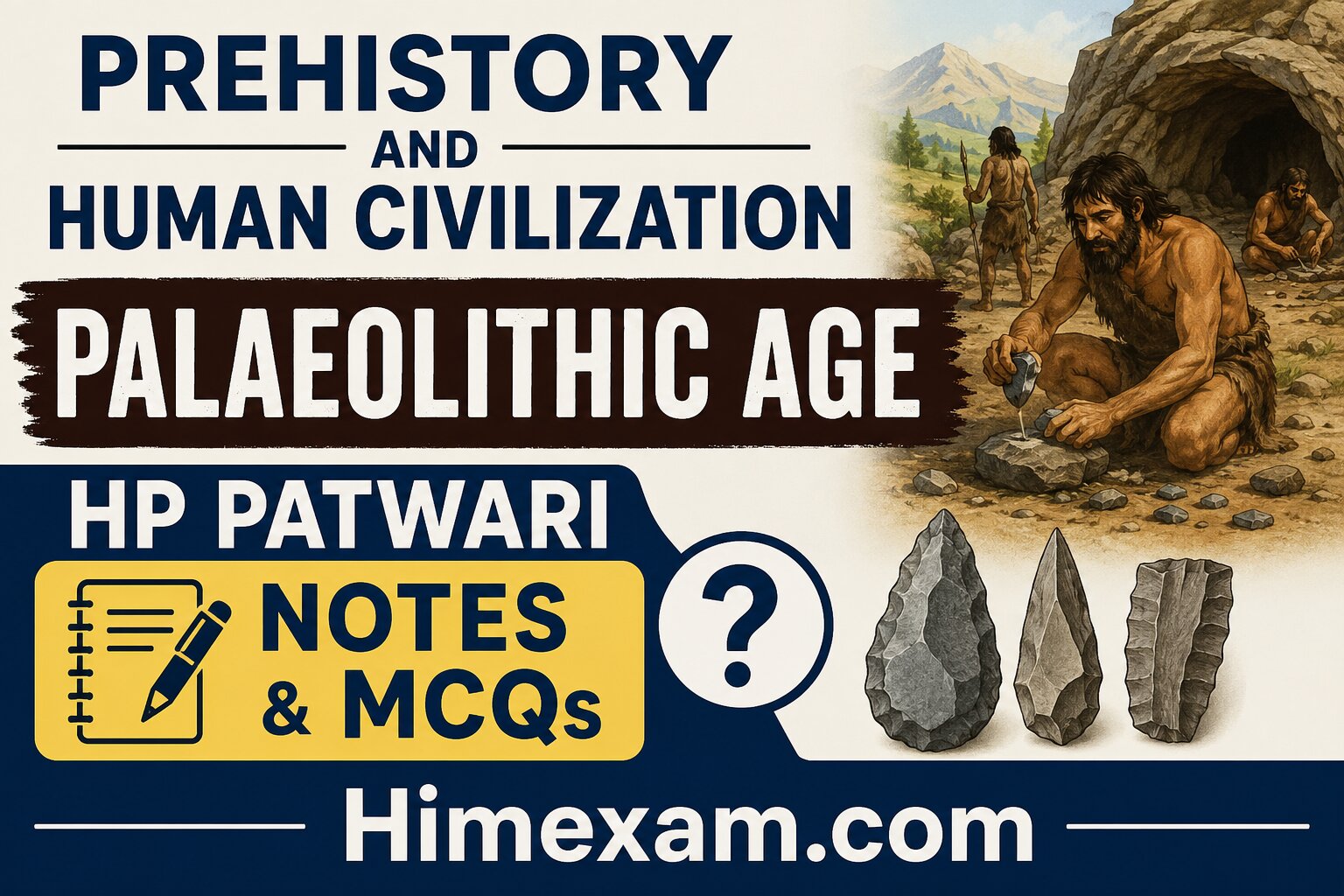


Prehistory and Human Civilization: Palaeolithic Age | HP Patwari Notes & MCQs
Prepare for the HP Patwari Exam with complete bilingual (Hindi & English) notes on Prehistory and Human Civilization: Palaeolithic Age. . The article also includes 20+ important bilingual MCQs based on the latest exam pattern to help you strengthen your History and General Knowledge preparation.


Join HP Patwari Exam Test Series(15 CBT Test With Answer Key):- CLICK HERE
Prehistory and Human Civilization: Palaeolithic Age | HP Patwari Notes & MCQs
प्रागैतिहासिक काल एवं मानव सभ्यता: पुरापाषाण काल
1. Meaning of Prehistory | प्रागैतिहासिक काल का अर्थPrehistory refers to the period of human history for which written records are not available. Our knowledge of this period is mainly based on archaeological remains such as stone tools, bones, fossils, caves and rock paintings.प्रागैतिहासिक काल मानव इतिहास का वह काल है जिसके बारे में लिखित अभिलेख उपलब्ध नहीं हैं। इस काल की जानकारी मुख्यतः पत्थर के औजारों, हड्डियों, जीवाश्मों, गुफाओं तथा शैलचित्रों जैसे पुरातात्त्विक साक्ष्यों से प्राप्त होती है।
Broad Classification | सामान्य वर्गीकरण
|
Period |
Hindi |
|
Palaeolithic Age |
पुरापाषाण काल |
|
Mesolithic Age |
मध्यपाषाण काल |
|
Neolithic Age |
नवपाषाण काल |
|
Chalcolithic Age |
ताम्रपाषाण काल |
Palaeolithic = Palaios (Old) + Lithos (Stone)
Therefore, Palaeolithic literally means Old Stone Age / पुराना पाषाण युग.
2. Palaeolithic Age | पुरापाषाण काल
The Palaeolithic Age represents the earliest and longest phase of the Stone Age.
पुरापाषाण काल पाषाण युग का सबसे प्राचीन तथा सबसे लंबा चरण है।
In the Indian subcontinent, it is generally studied from the earliest stone-tool evidence, extending back well over a million years, to roughly 10,000 BCE, although dates vary by region and archaeological sequence.
3. Division of Palaeolithic Age | पुरापाषाण काल का विभाजन
The Palaeolithic Age in India is broadly divided into three stages:
|
Stage |
Hindi |
Broad chronology |
|
Lower Palaeolithic |
निम्न पुरापाषाण |
Earliest phase to roughly 100,000 years ago |
|
Middle Palaeolithic |
मध्य पुरापाषाण |
Roughly 100,000–40,000 years ago |
|
Upper Palaeolithic |
उच्च पुरापाषाण |
Roughly 40,000–10,000 BCE |
Exam Note: Exact chronological boundaries differ among archaeological sites and scholars. For competitive examinations, the sequence and characteristic tools are more important than treating one date range as universally fixed.
4. Lower Palaeolithic Age | निम्न पुरापाषाण काल
It is the earliest stage of the Palaeolithic Age.
यह पुरापाषाण काल का सबसे प्रारंभिक चरण था।
Important Features | महत्वपूर्ण विशेषताएँ
Humans used comparatively large and heavy stone tools.
मनुष्य अपेक्षाकृत बड़े और भारी पत्थर के औजारों का प्रयोग करता था।
Major tools included:
- Handaxe – हस्तकुठार
- Cleaver – विदारणी/क्लीवर
- Chopper – चॉपर
- Chopping tools – काटने वाले औजार
The Acheulian tradition is particularly associated with handaxes and cleavers.
Raw Materials | कच्चा माल
Tools were manufactured from locally available stones such as quartzite, quartz and other suitable rocks.
भारत के अनेक पुरापाषाण स्थलों पर क्वार्टजाइट का व्यापक उपयोग हुआ।
5. Middle Palaeolithic Age | मध्य पुरापाषाण काल
During this phase, stone-tool technology increasingly emphasized flake-based tools.
इस काल में बड़े औजारों की तुलना में फ्लेक अर्थात पत्थर से निकाले गए टुकड़ों से बने औजारों का महत्व बढ़ा।
Important Tools
- Flakes – शल्क
- Scrapers – खुरचनी
- Points – नुकीले औजार
- Borers – छेदक
Tools generally became smaller and more specialized than many Lower Palaeolithic implements.
6. Upper Palaeolithic Age | उच्च पुरापाषाण काल
The Upper Palaeolithic represents the final stage of the Old Stone Age.
उच्च पुरापाषाण काल पुरापाषाण युग का अंतिम चरण था।
Main Features | प्रमुख विशेषताएँ
Blade and burin technology became important.
ब्लेड तथा ब्यूरिन प्रकार के औजारों का विकास हुआ।
Tools became increasingly specialized and refined.
औजार पहले की तुलना में अधिक विशिष्ट और परिष्कृत हुए।
This phase is associated with the spread of anatomically modern humans (Homo sapiens).
7. Life of Palaeolithic Humans | पुरापाषाण मानव का जीवन
Palaeolithic communities largely lived as hunter-gatherers.
पुरापाषाण काल के लोग मुख्यतः शिकारी एवं खाद्य–संग्राहक थे।
They depended on:
Hunting animals + gathering wild plants, fruits, roots, tubers, seeds and other naturally available food.
पशुओं का शिकार + जंगली फल, कंद–मूल, बीज एवं अन्य प्राकृतिक खाद्य पदार्थों का संग्रह।
Important Point
They did not practise settled agriculture during the Palaeolithic Age.
पुरापाषाण काल में व्यवस्थित कृषि आधारित स्थायी जीवन विकसित नहीं हुआ था।
8. Nomadic Life | घुमंतू जीवन
Palaeolithic people generally did not establish permanent villages.
पुरापाषाण मानव सामान्यतः स्थायी गाँवों में नहीं रहता था।
They moved according to:
- Availability of food / भोजन की उपलब्धता
- Availability of water / जल की उपलब्धता
- Animals for hunting / शिकार योग्य पशु
- Seasonal conditions / मौसमी परिस्थितियाँ
Therefore, their lifestyle was predominantly nomadic or semi-mobile.
9. Shelter | आश्रय
Humans used natural shelters such as:
- Caves / गुफाएँ
- Rock shelters / शैलाश्रय
- Areas near rivers and water sources / नदियों एवं जल स्रोतों के निकट क्षेत्र
Archaeological remains are therefore frequently found in river valleys, terraces and rock shelters.
10. Discovery and Use of Fire | आग का उपयोग
The controlled use of fire became an important development during human prehistory.
मानव प्रागैतिहास में आग पर नियंत्रण एक अत्यंत महत्वपूर्ण उपलब्धि थी।
Fire could be used for:
- Warmth / गर्मी
- Protection from wild animals / जंगली पशुओं से सुरक्षा
- Light / प्रकाश
- Cooking food / भोजन पकाना
Important caution: Archaeological evidence for controlled fire varies greatly by site and period, so it should not be assigned to one exact date throughout India.
11. Stone Tool Technology | पाषाण उपकरण तकनीक
Stone tools are among the most important sources for understanding Palaeolithic culture.
पुरापाषाण संस्कृति को समझने का सबसे महत्वपूर्ण स्रोत पाषाण उपकरण हैं।
Broad Development
Lower Palaeolithic → Handaxe, Cleaver, Chopper
Middle Palaeolithic → Flake, Scraper, Point
Upper Palaeolithic → Blade, Burin and increasingly specialized tools
Easy Memory Trick
Lower = Heavy → Middle = Flakes → Upper = Blades
निम्न = भारी औजार → मध्य = शल्क → उच्च = ब्लेड
12. Important Palaeolithic Sites in India | भारत के प्रमुख पुरापाषाण स्थल
Soan/Sohan Valley | सोहन घाटी
The Soan Valley is an important prehistoric region of the northwestern Indian subcontinent, now mainly in Pakistan.
It is associated with a stone-tool tradition traditionally called the Soanian culture.
Bhimbetka | भीमबेटका
Bhimbetka Rock Shelters is located in Madhya Pradesh.
भीमबेटका मध्य प्रदेश में स्थित है।
It contains extensive evidence of prehistoric human occupation and is famous for its rock shelters and paintings.
It is a UNESCO World Heritage Site.
Exam Fact: Bhimbetka was brought to archaeological attention by V. S. Wakankar in 1957.
Attirampakkam | अत्तिरमपक्कम
Located in Tamil Nadu.
यह तमिलनाडु में स्थित है।
It is one of India’s most important Lower and Middle Palaeolithic archaeological sites and has yielded very ancient stone tools.
Hunsgi-Baichbal Valley | हुंसगी–बैचबल घाटी
Located in Karnataka.
यह कर्नाटक में स्थित है।
It is an important region for studying Lower Palaeolithic settlement and stone-tool technology.
Didwana | डीडवाना
Located in Rajasthan.
यह राजस्थान में स्थित है और प्रागैतिहासिक पुरातत्त्व के लिए महत्वपूर्ण है।
Belan Valley | बेलन घाटी
Located mainly in Uttar Pradesh.
यह मुख्यतः उत्तर प्रदेश में स्थित है।
The valley preserves evidence representing a long sequence of prehistoric cultural development.
13. Robert Bruce Foote | रॉबर्ट ब्रूस फूट
Robert Bruce Foote is often called the:
“Father of Indian Prehistory” / “भारतीय प्रागैतिहास का जनक”
In 1863, he discovered a Palaeolithic stone tool at Pallavaram near Madras (present-day Chennai).
Very Important Exam Facts
Robert Bruce Foote → Pallavaram → 1863
रॉबर्ट ब्रूस फूट → पल्लावरम → 1863
This discovery played a major role in establishing the antiquity of human occupation in India.
14. Palaeolithic Age and Climate | पुरापाषाण काल एवं जलवायु
Much of the Palaeolithic Age falls within the geological Pleistocene Epoch.
पुरापाषाण काल का अधिकांश भाग भूवैज्ञानिक प्लीस्टोसीन युग (Pleistocene Epoch) से संबंधित है।
The Pleistocene experienced repeated climatic fluctuations, including glacial and interglacial phases.
प्लीस्टोसीन काल में जलवायु में बड़े परिवर्तन तथा हिमानी एवं अंतर–हिमानी अवस्थाएँ देखने को मिलीं।
Exam Association:
Palaeolithic Age → Pleistocene
15. Economy | अर्थव्यवस्था
The Palaeolithic economy was essentially based on:
Hunting + Gathering
शिकार + खाद्य संग्रह
There was no developed market economy, coinage or organized trade system comparable to historical civilizations.
Food-Producing Economy
Systematic agriculture and animal domestication became important in later prehistoric phases, especially the Neolithic Age.
इसलिए याद रखें:
Palaeolithic = Food Gathering
Neolithic = Food Production
16. Social Life | सामाजिक जीवन
Palaeolithic people probably lived in small mobile groups or bands.
पुरापाषाण मानव संभवतः छोटे घुमंतू समूहों में रहता था।
Cooperation would have been important for obtaining food, protection and survival.
भोजन प्राप्त करने, सुरक्षा और जीवित रहने के लिए सामूहिक सहयोग महत्वपूर्ण था।
There is no evidence of states, kingdoms or complex urban political institutions during this period.
17. Art | कला
Evidence for prehistoric artistic activity becomes especially prominent in later prehistoric contexts.
प्रागैतिहासिक कला के प्रमाण विशेष रूप से शैलचित्रों और उत्कीर्णनों के रूप में मिलते हैं।
Bhimbetka is particularly famous for prehistoric rock paintings, although the paintings at the site belong to multiple periods and should not all be treated as Palaeolithic.
18. Religion and Beliefs | धर्म एवं विश्वास
Because Palaeolithic people left no written texts, their religious beliefs cannot be reconstructed with certainty.
पुरापाषाण मानव के धार्मिक विश्वासों के बारे में लिखित स्रोत उपलब्ध नहीं हैं, इसलिए उनके बारे में निश्चित निष्कर्ष निकालना कठिन है।
Archaeologists use burials, art and other material remains to investigate possible symbolic behaviour.
19. Human Evolution | मानव विकास
Several human populations and species existed during the long Palaeolithic period.
पुरापाषाण काल की अत्यंत लंबी अवधि में मानव विकास के विभिन्न चरण देखने को मिले।
Homo erectus is associated with earlier phases of human evolution, while Homo sapiens became increasingly prominent in later Palaeolithic contexts.
Homo sapiens = Modern humans / आधुनिक मानव
20. Palaeolithic Evidence in Himachal Pradesh | हिमाचल प्रदेश में पुरापाषाण साक्ष्य
The Siwalik/Shivalik region and adjoining northwestern river systems are important for understanding prehistoric human activity.
हिमाचल प्रदेश का शिवालिक क्षेत्र प्रागैतिहासिक अध्ययन की दृष्टि से महत्वपूर्ण है।
Stone tools and prehistoric remains reported from the broader northwestern Himalayan foothill region help connect Himachal’s early history with the prehistoric cultures of the Soan river system and Siwalik zone.
Exam Focus
Remember the geographical association:
Himachal Pradesh → Shivalik foothills → Northwestern prehistoric cultural zone
हिमाचल प्रदेश → शिवालिक क्षेत्र → उत्तर–पश्चिमी प्रागैतिहासिक सांस्कृतिक क्षेत्र
21. Palaeolithic vs Neolithic | पुरापाषाण एवं नवपाषाण
|
Feature |
Palaeolithic / पुरापाषाण |
Neolithic / नवपाषाण |
|
Meaning |
Old Stone Age |
New Stone Age |
|
जीवन |
Mainly nomadic |
Increasingly settled |
|
Economy |
Hunting & gathering |
Agriculture & animal husbandry |
|
Tools |
Chipped/flaked stone tools |
Ground and polished stone tools important |
|
Agriculture |
Absent as established economy |
Major feature |
|
Permanent villages |
Generally absent |
Developed |
|
Food |
Food gathering |
Food production |
22. Most Important One-Liners | अति महत्वपूर्ण तथ्य
Palaeolithic Age = Old Stone Age / पुरापाषाण काल = पुराना पाषाण युग
Palaeolithic people were primarily hunter-gatherers. / पुरापाषाण मानव मुख्यतः शिकारी एवं खाद्य संग्राहक था।
Palaeolithic Age is broadly divided into Lower, Middle and Upper Palaeolithic. / पुरापाषाण काल को निम्न, मध्य और उच्च पुरापाषाण में बाँटा जाता है।
Lower Palaeolithic → Handaxe and Cleaver / निम्न पुरापाषाण → हस्तकुठार एवं क्लीवर
Middle Palaeolithic → Flake tools / मध्य पुरापाषाण → शल्क उपकरण
Upper Palaeolithic → Blade and Burin / उच्च पुरापाषाण → ब्लेड एवं ब्यूरिन
Robert Bruce Foote = Father of Indian Prehistory / रॉबर्ट ब्रूस फूट = भारतीय प्रागैतिहास का जनक
Pallavaram discovery → 1863
Bhimbetka → Madhya Pradesh / भीमबेटका → मध्य प्रदेश
Bhimbetka archaeological identification → V. S. Wakankar
Attirampakkam → Tamil Nadu / अत्तिरमपक्कम → तमिलनाडु
Hunsgi → Karnataka / हुंसगी → कर्नाटक
Didwana → Rajasthan / डीडवाना → राजस्थान
Belan Valley → Uttar Pradesh / बेलन घाटी → उत्तर प्रदेश
Soan Valley → Northwestern Indian subcontinent / सोहन घाटी → उत्तर–पश्चिमी भारतीय उपमहाद्वीप
Palaeolithic economy → Hunting and gathering / पुरापाषाण अर्थव्यवस्था → शिकार एवं खाद्य संग्रह
Palaeolithic → largely associated with Pleistocene Epoch / पुरापाषाण → मुख्यतः प्लीस्टोसीन युग
Palaeolithic → No established agriculture / पुरापाषाण → व्यवस्थित कृषि का अभाव
Homo sapiens → Modern human / होमो सेपियन्स → आधुनिक मानव
Palaeolithic Age MCQs for HP Patwari Exam
पुरापाषाण काल महत्वपूर्ण MCQs
Question 1. The term “Palaeolithic” literally means: / “Palaeolithic” शब्द का शाब्दिक अर्थ क्या है?
(A) New Stone Age / नव पाषाण युग
(B) Old Stone Age / पुराना पाषाण युग
(C) Middle Stone Age / मध्य पाषाण युग
(D) Copper Stone Age / ताम्र पाषाण युग
Correct Answer / सही उत्तर: (B) Old Stone Age / पुराना पाषाण युग
Question 2. The Palaeolithic Age is broadly divided into how many stages? / पुरापाषाण काल को सामान्यतः कितने चरणों में विभाजित किया जाता है?
(A) Two / दो
(B) Three / तीन
(C) Four / चार
(D) Five / पाँच
Correct Answer / सही उत्तर: (B) Three / तीन
Question 3. Which is the correct chronological sequence of the Palaeolithic stages? / पुरापाषाण काल के चरणों का सही कालानुक्रमिक क्रम कौन–सा है?
(A) Upper → Middle → Lower
(B) Middle → Lower → Upper
(C) Lower → Middle → Upper
(D) Lower → Upper → Middle
Correct Answer / सही उत्तर: (C) Lower → Middle → Upper / निम्न → मध्य → उच्च
Question 4. Handaxes and cleavers are characteristic tools of which phase? / हस्तकुठार और क्लीवर किस चरण के प्रमुख औजार हैं?
(A) Lower Palaeolithic / निम्न पुरापाषाण
(B) Middle Palaeolithic / मध्य पुरापाषाण
(C) Mesolithic / मध्यपाषाण
(D) Neolithic / नवपाषाण
Correct Answer / सही उत्तर: (A) Lower Palaeolithic / निम्न पुरापाषाण
Question 5. Flake-based tools became particularly important during which phase? / शल्क आधारित औजार किस चरण में विशेष रूप से महत्वपूर्ण हुए?
(A) Neolithic / नवपाषाण
(B) Middle Palaeolithic / मध्य पुरापाषाण
(C) Chalcolithic / ताम्रपाषाण
(D) Iron Age / लौह युग
Correct Answer / सही उत्तर: (B) Middle Palaeolithic / मध्य पुरापाषाण
Question 6. Blade and burin technology is especially associated with: / ब्लेड एवं ब्यूरिन तकनीक विशेष रूप से किससे संबंधित है?
(A) Lower Palaeolithic / निम्न पुरापाषाण
(B) Middle Palaeolithic / मध्य पुरापाषाण
(C) Upper Palaeolithic / उच्च पुरापाषाण
(D) Chalcolithic / ताम्रपाषाण
Correct Answer / सही उत्तर: (C) Upper Palaeolithic / उच्च पुरापाषाण
Question 7. The subsistence economy of Palaeolithic people was primarily based on: / पुरापाषाण मानव की जीविका मुख्यतः किस पर आधारित थी?
(A) Agriculture / कृषि
(B) Trade / व्यापार
(C) Hunting and gathering / शिकार एवं खाद्य संग्रह
(D) Industrial production / औद्योगिक उत्पादन
Correct Answer / सही उत्तर: (C) Hunting and gathering / शिकार एवं खाद्य संग्रह
Question 8. Which of the following was generally absent as an established economy in the Palaeolithic Age? / पुरापाषाण काल में निम्न में से कौन–सी स्थापित आर्थिक गतिविधि सामान्यतः अनुपस्थित थी?
(A) Hunting / शिकार
(B) Gathering / खाद्य संग्रह
(C) Agriculture / कृषि
(D) Use of stone tools / पाषाण उपकरणों का प्रयोग
Correct Answer / सही उत्तर: (C) Agriculture / कृषि
Question 9. Palaeolithic communities were predominantly: / पुरापाषाण समुदाय मुख्यतः कैसे थे?
(A) Urban / नगरीय
(B) Nomadic and mobile / घुमंतू एवं गतिशील
(C) Industrial / औद्योगिक
(D) Feudal / सामंती
Correct Answer / सही उत्तर: (B) Nomadic and mobile / घुमंतू एवं गतिशील
Question 10. Which geological epoch is most closely associated with much of the Palaeolithic Age? / पुरापाषाण काल का अधिकांश भाग किस भूवैज्ञानिक युग से संबंधित है?
(A) Pleistocene / प्लीस्टोसीन
(B) Miocene / मायोसीन
(C) Eocene / इयोसीन
(D) Jurassic / जुरासिक
Correct Answer / सही उत्तर: (A) Pleistocene / प्लीस्टोसीन
Question 11. Who is popularly known as the “Father of Indian Prehistory”? / “भारतीय प्रागैतिहास का जनक” किसे कहा जाता है?
(A) Alexander Cunningham / अलेक्जेंडर कनिंघम
(B) John Marshall / जॉन मार्शल
(C) Robert Bruce Foote / रॉबर्ट ब्रूस फूट
(D) Mortimer Wheeler / मॉर्टिमर व्हीलर
Correct Answer / सही उत्तर: (C) Robert Bruce Foote / रॉबर्ट ब्रूस फूट
Question 12. Robert Bruce Foote discovered a Palaeolithic stone tool at Pallavaram in: / रॉबर्ट ब्रूस फूट ने पल्लावरम में पुरापाषाण उपकरण किस वर्ष खोजा था?
(A) 1857
(B) 1861
(C) 1863
(D) 1872
Correct Answer / सही उत्तर: (C) 1863
Question 13. Pallavaram, an important site in the history of Indian prehistoric archaeology, is located near: / भारतीय प्रागैतिहासिक पुरातत्त्व का महत्वपूर्ण स्थल पल्लावरम किसके निकट स्थित है?
(A) Chennai / चेन्नई
(B) Mumbai / मुंबई
(C) Jaipur / जयपुर
(D) Lucknow / लखनऊ
Correct Answer / सही उत्तर: (A) Chennai / चेन्नई
Question 14. Bhimbetka Rock Shelters are located in which state? / भीमबेटका शैलाश्रय किस राज्य में स्थित हैं?
(A) Rajasthan / राजस्थान
(B) Madhya Pradesh / मध्य प्रदेश
(C) Maharashtra / महाराष्ट्र
(D) Karnataka / कर्नाटक
Correct Answer / सही उत्तर: (B) Madhya Pradesh / मध्य प्रदेश
Question 15. Which archaeologist is associated with bringing Bhimbetka to archaeological attention in 1957? / 1957 में भीमबेटका को पुरातात्त्विक जगत के ध्यान में लाने का श्रेय किसे दिया जाता है?
(A) V. S. Wakankar / वी. एस. वाकणकर
(B) R. D. Banerji / आर. डी. बनर्जी
(C) Daya Ram Sahni / दयाराम साहनी
(D) B. B. Lal / बी. बी. लाल
Correct Answer / सही उत्तर: (A) V. S. Wakankar / वी. एस. वाकणकर
Question 16. Attirampakkam, an important Palaeolithic site, is located in: / महत्वपूर्ण पुरापाषाण स्थल अत्तिरमपक्कम कहाँ स्थित है?
(A) Kerala / केरल
(B) Tamil Nadu / तमिलनाडु
(C) Karnataka / कर्नाटक
(D) Telangana / तेलंगाना
Correct Answer / सही उत्तर: (B) Tamil Nadu / तमिलनाडु
Question 17. Hunsgi-Baichbal Valley, known for Palaeolithic remains, is located in: / पुरापाषाण अवशेषों के लिए प्रसिद्ध हुंसगी–बैचबल घाटी कहाँ स्थित है?
(A) Karnataka / कर्नाटक
(B) Gujarat / गुजरात
(C) Bihar / बिहार
(D) Punjab / पंजाब
Correct Answer / सही उत्तर: (A) Karnataka / कर्नाटक
Question 18. Didwana, associated with prehistoric archaeology, is located in: / प्रागैतिहासिक पुरातत्त्व से संबंधित डीडवाना किस राज्य में स्थित है?
(A) Haryana / हरियाणा
(B) Rajasthan / राजस्थान
(C) Madhya Pradesh / मध्य प्रदेश
(D) Uttar Pradesh / उत्तर प्रदेश
Correct Answer / सही उत्तर: (B) Rajasthan / राजस्थान
Question 19. The Belan Valley, important for prehistoric studies, is mainly located in: / प्रागैतिहासिक अध्ययन के लिए महत्वपूर्ण बेलन घाटी मुख्यतः किस राज्य में स्थित है?
(A) Uttar Pradesh / उत्तर प्रदेश
(B) Odisha / ओडिशा
(C) Assam / असम
(D) Gujarat / गुजरात
Correct Answer / सही उत्तर: (A) Uttar Pradesh / उत्तर प्रदेश
Question 20. The Soanian stone-tool tradition takes its name from which river valley? / सोहनियन पाषाण–उपकरण परंपरा का नाम किस नदी घाटी से लिया गया है?
(A) Narmada / नर्मदा
(B) Soan / सोहन
(C) Godavari / गोदावरी
(D) Krishna / कृष्णा
Correct Answer / सही उत्तर: (B) Soan / सोहन
Question 21. The Soan Valley lies in which broad geographical region? / सोहन घाटी किस व्यापक भौगोलिक क्षेत्र में स्थित है?
(A) Northwestern Indian subcontinent / उत्तर–पश्चिमी भारतीय उपमहाद्वीप
(B) Eastern coastal India / पूर्वी तटीय भारत
(C) Deccan coast / दक्कन तट
(D) Brahmaputra delta / ब्रह्मपुत्र डेल्टा
Correct Answer / सही उत्तर: (A) Northwestern Indian subcontinent / उत्तर–पश्चिमी भारतीय उपमहाद्वीप
Question 22. Which of the following was commonly used as raw material for Palaeolithic tools at many Indian sites? / भारत के अनेक पुरापाषाण स्थलों पर औजार बनाने के लिए निम्न में से किसका सामान्यतः उपयोग किया गया?
(A) Quartzite / क्वार्टजाइट
(B) Iron / लोहा
(C) Bronze / कांसा
(D) Copper / तांबा
Correct Answer / सही उत्तर: (A) Quartzite / क्वार्टजाइट
Question 23. Which of the following is NOT a characteristic Lower Palaeolithic tool? / निम्नलिखित में से कौन–सा निम्न पुरापाषाण का विशिष्ट औजार नहीं है?
(A) Handaxe / हस्तकुठार
(B) Cleaver / क्लीवर
(C) Chopper / चॉपर
(D) Polished stone celt / पॉलिश किया हुआ पाषाण सेल्ट
Correct Answer / सही उत्तर: (D) Polished stone celt / पॉलिश किया हुआ पाषाण सेल्ट
Question 24. Scrapers and points are especially characteristic of which Indian Palaeolithic phase? / खुरचनी और नुकीले औजार भारतीय पुरापाषाण के किस चरण की प्रमुख विशेषता हैं?
(A) Middle Palaeolithic / मध्य पुरापाषाण
(B) Neolithic / नवपाषाण
(C) Chalcolithic / ताम्रपाषाण
(D) Iron Age / लौह युग
Correct Answer / सही उत्तर: (A) Middle Palaeolithic / मध्य पुरापाषाण
Question 25. The Acheulian stone-tool tradition is especially characterized by: / एश्यूलियन पाषाण–उपकरण परंपरा की प्रमुख विशेषता क्या है?
(A) Iron swords / लोहे की तलवारें
(B) Handaxes and cleavers / हस्तकुठार एवं क्लीवर
(C) Polished celts / पॉलिश किए हुए सेल्ट
(D) Copper axes / तांबे की कुल्हाड़ियाँ
Correct Answer / सही उत्तर: (B) Handaxes and cleavers / हस्तकुठार एवं क्लीवर
Question 26. Which statement best distinguishes Palaeolithic from Neolithic subsistence? / पुरापाषाण और नवपाषाण जीवन–निर्वाह के बीच मुख्य अंतर क्या था?
(A) Palaeolithic—food gathering; Neolithic—food production / पुरापाषाण—खाद्य संग्रह; नवपाषाण—खाद्य उत्पादन
(B) Palaeolithic—agriculture; Neolithic—hunting / पुरापाषाण—कृषि; नवपाषाण—शिकार
(C) Both were primarily urban / दोनों मुख्यतः नगरीय थे
(D) Both depended primarily on iron technology / दोनों मुख्यतः लौह तकनीक पर निर्भर थे
Correct Answer / सही उत्तर: (A) Palaeolithic—food gathering; Neolithic—food production / पुरापाषाण—खाद्य संग्रह; नवपाषाण—खाद्य उत्पादन
Question 27. Which type of shelter was commonly available to Palaeolithic humans? / पुरापाषाण मानव के लिए किस प्रकार का आश्रय सामान्यतः उपलब्ध था?
(A) Brick palaces / ईंटों के महल
(B) Rock shelters and caves / शैलाश्रय एवं गुफाएँ
(C) Fortified cities / किलाबंद नगर
(D) Stone temples / पत्थर के मंदिर
Correct Answer / सही उत्तर: (B) Rock shelters and caves / शैलाश्रय एवं गुफाएँ
Question 28. Controlled use of fire could help prehistoric humans primarily in: / आग के नियंत्रित उपयोग से प्रागैतिहासिक मानव को मुख्यतः किसमें सहायता मिलती थी?
(A) Minting coins / सिक्के बनाने में
(B) Warmth, protection and cooking / गर्मी, सुरक्षा एवं भोजन पकाने में
(C) Writing manuscripts / पांडुलिपियाँ लिखने में
(D) Irrigation farming / सिंचाई कृषि में
Correct Answer / सही उत्तर: (B) Warmth, protection and cooking / गर्मी, सुरक्षा एवं भोजन पकाने में
Question 29. Which of the following is the most important archaeological evidence for studying Palaeolithic technology? / पुरापाषाण तकनीक के अध्ययन के लिए निम्न में से सबसे महत्वपूर्ण पुरातात्त्विक साक्ष्य कौन–सा है?
(A) Coins / सिक्के
(B) Inscriptions / अभिलेख
(C) Stone tools / पाषाण उपकरण
(D) Written chronicles / लिखित इतिहास–ग्रंथ
Correct Answer / सही उत्तर: (C) Stone tools / पाषाण उपकरण
Question 30. Why is the Palaeolithic Age included in prehistory? / पुरापाषाण काल को प्रागैतिहास में क्यों रखा जाता है?
(A) Iron was unknown / लोहा अज्ञात था
(B) Written records are absent / लिखित अभिलेख उपलब्ध नहीं हैं
(C) Humans did not use tools / मानव औजारों का उपयोग नहीं करता था
(D) Humans lived only in India / मानव केवल भारत में रहता था
Correct Answer / सही उत्तर: (B) Written records are absent / लिखित अभिलेख उपलब्ध नहीं हैं
Question 31. Which of the following pairs is correctly matched? / निम्नलिखित में से कौन–सा युग्म सही सुमेलित है?
(A) Lower Palaeolithic — Polished celts / निम्न पुरापाषाण — पॉलिश सेल्ट
(B) Middle Palaeolithic — Flake tools / मध्य पुरापाषाण — शल्क उपकरण
(C) Upper Palaeolithic — Iron plough / उच्च पुरापाषाण — लोहे का हल
(D) Neolithic — Handaxe tradition only / नवपाषाण — केवल हस्तकुठार परंपरा
Correct Answer / सही उत्तर: (B) Middle Palaeolithic — Flake tools / मध्य पुरापाषाण — शल्क उपकरण
Question 32. Anatomically modern humans belong to which species? / शारीरिक रूप से आधुनिक मानव किस प्रजाति से संबंधित है?
(A) Homo sapiens
(B) Australopithecus
(C) Homo habilis
(D) Ramapithecus
Correct Answer / सही उत्तर: (A) Homo sapiens
Question 33. Which factor most strongly influenced the movement of Palaeolithic hunter-gatherers? / पुरापाषाण शिकारी–संग्राहकों के आवागमन को मुख्यतः कौन–सा कारक प्रभावित करता था?
(A) Availability of food and water / भोजन एवं जल की उपलब्धता
(B) Railway routes / रेलवे मार्ग
(C) Market centres / बाजार केंद्र
(D) Administrative capitals / प्रशासनिक राजधानियाँ
Correct Answer / सही उत्तर: (A) Availability of food and water / भोजन एवं जल की उपलब्धता
Question 34. Which site is particularly famous for its prehistoric rock shelters and paintings? / कौन–सा स्थल अपने प्रागैतिहासिक शैलाश्रयों एवं शैलचित्रों के लिए विशेष रूप से प्रसिद्ध है?
(A) Bhimbetka / भीमबेटका
(B) Pallavaram / पल्लावरम
(C) Didwana / डीडवाना
(D) Attirampakkam / अत्तिरमपक्कम
Correct Answer / सही उत्तर: (A) Bhimbetka / भीमबेटका
Question 35. Which statement regarding Bhimbetka paintings is most accurate? / भीमबेटका के शैलचित्रों के संबंध में कौन–सा कथन सर्वाधिक सही है?
(A) All paintings belong exclusively to the Lower Palaeolithic / सभी चित्र केवल निम्न पुरापाषाण काल के हैं
(B) Paintings at the site belong to multiple periods / स्थल के चित्र विभिन्न कालों से संबंधित हैं
(C) All paintings belong to the Harappan period / सभी चित्र हड़प्पा काल के हैं
(D) They were produced only in the historical period / वे केवल ऐतिहासिक काल में बनाए गए
Correct Answer / सही उत्तर: (B) Paintings at the site belong to multiple periods / स्थल के चित्र विभिन्न कालों से संबंधित हैं
Question 36. Which technological change broadly marks the progression from Lower to Middle Palaeolithic industries in India? / भारत में निम्न से मध्य पुरापाषाण की ओर विकास को व्यापक रूप से कौन–सा तकनीकी परिवर्तन दर्शाता है?
(A) Greater emphasis on flake tools / शल्क उपकरणों पर अधिक जोर
(B) Introduction of iron weapons / लौह हथियारों का आरंभ
(C) Introduction of bronze casting / कांस्य ढलाई का आरंभ
(D) Invention of writing / लेखन का आविष्कार
Correct Answer / सही उत्तर: (A) Greater emphasis on flake tools / शल्क उपकरणों पर अधिक जोर
Question 37. Which activity is most characteristic of a “food-gathering economy”? / “खाद्य–संग्रह अर्थव्यवस्था” की सबसे प्रमुख गतिविधि कौन–सी है?
(A) Cultivating permanent fields / स्थायी खेतों में कृषि
(B) Collecting naturally available food and hunting / प्राकृतिक खाद्य संग्रह एवं शिकार
(C) Manufacturing coins / सिक्का निर्माण
(D) Long-distance maritime commerce / समुद्री व्यापार
Correct Answer / सही उत्तर: (B) Collecting naturally available food and hunting / प्राकृतिक खाद्य संग्रह एवं शिकार
Question 38. Which development is more characteristic of the Neolithic than the Palaeolithic Age? / निम्न में से कौन–सा विकास पुरापाषाण की अपेक्षा नवपाषाण काल की अधिक प्रमुख विशेषता है?
(A) Hunting / शिकार
(B) Use of stone / पत्थर का उपयोग
(C) Settled agriculture / स्थायी कृषि
(D) Gathering wild plants / जंगली पौधों का संग्रह
Correct Answer / सही उत्तर: (C) Settled agriculture / स्थायी कृषि
Question 39. The term “prehistory” is primarily distinguished from “history” on the basis of: / “प्रागैतिहास” को “इतिहास” से मुख्यतः किस आधार पर अलग किया जाता है?
(A) Availability of written records / लिखित अभिलेखों की उपलब्धता
(B) Presence of rivers / नदियों की उपस्थिति
(C) Type of climate / जलवायु का प्रकार
(D) Presence of mountains / पर्वतों की उपस्थिति
Correct Answer / सही उत्तर: (A) Availability of written records / लिखित अभिलेखों की उपलब्धता
Question 40. Which sequence correctly represents a broad technological trend within the Palaeolithic Age? / पुरापाषाण काल में तकनीकी विकास की व्यापक प्रवृत्ति को कौन–सा क्रम सही दर्शाता है?
(A) Handaxe/Cleaver → Flake tools → Blade/Burin
(B) Blade/Burin → Handaxe → Iron tools
(C) Polished celt → Copper axe → Handaxe
(D) Iron sword → Flake → Handaxe
Correct Answer / सही उत्तर: (A) Handaxe/Cleaver → Flake tools → Blade/Burin
हमारे बारे में – Himexam.com
Himexam.com हिमाचल प्रदेश व अखिल भारतीय प्रतियोगी परीक्षाओं के लिए एक विश्वसनीय पोर्टल है। यहाँ आपको नवीनतम HP Govt Jobs, All India Jobs, HP GK, करेंट अफेयर्स, वन लाइनर प्रश्न, जिलेवार GK और पिछले वर्षों के प्रश्न पत्र की जानकारी एक ही जगह मिलती है। हमारी कोशिश है कि हर अभ्यर्थी को सही और समय पर अध्ययन सामग्री मिले।
 WhatsApp
 Facebook
 Telegram
 Instagram