

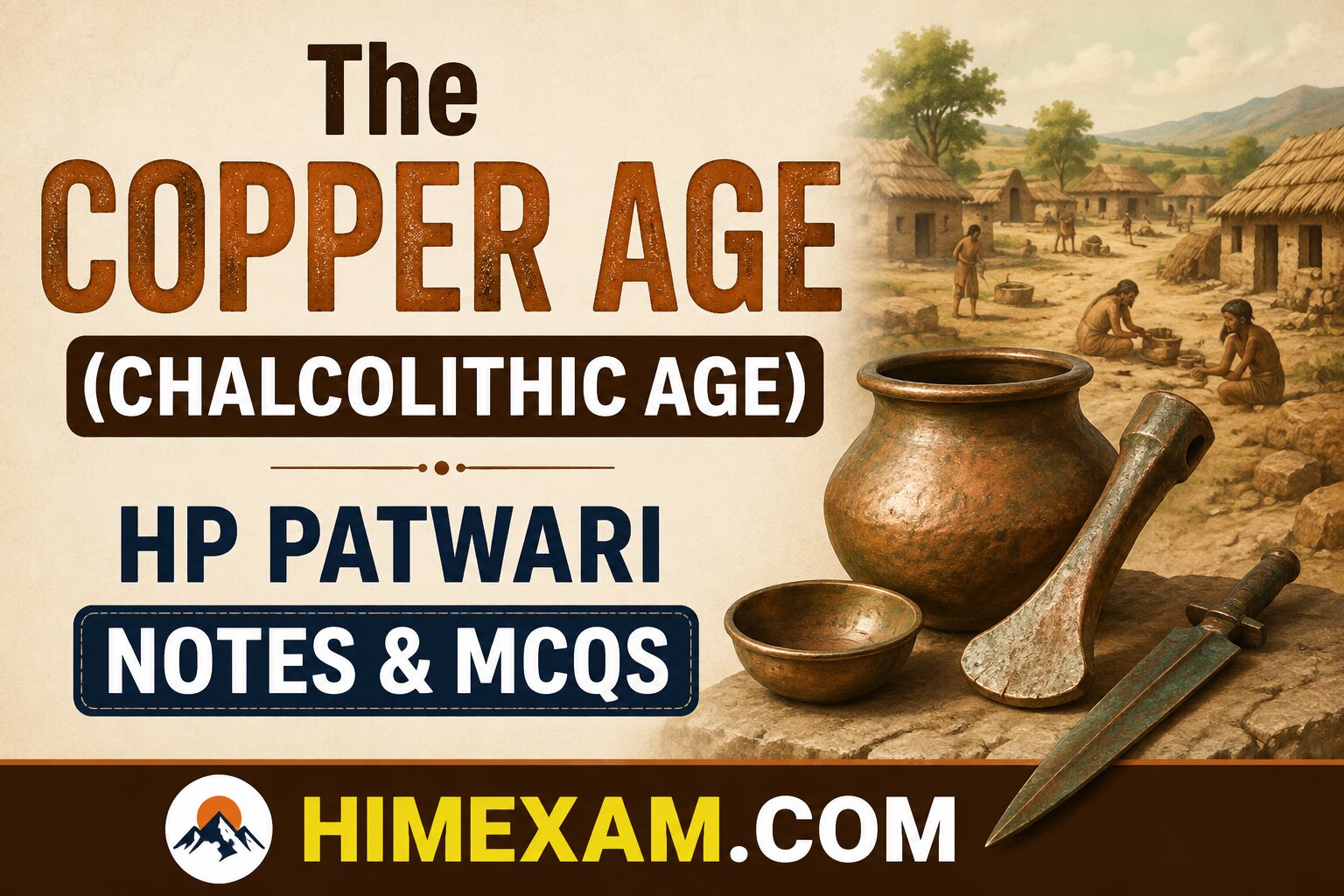


The Copper Age (Chalcolithic Age) | HP Patwari Notes & MCQs
Prepare for the HP Patwari Exam with complete bilingual (Hindi & English) notes on The Copper Age (Chalcolithic Age). . The article also includes 20+ important bilingual MCQs based on the latest exam pattern to help you strengthen your History and General Knowledge preparation.


Join HP Patwari Exam Test Series(15 CBT Test With Answer Key):- CLICK HERE
The Copper Age (Chalcolithic Age) | HP Patwari Notes & MCQs
The Copper Age (ताम्रपाषाण काल / Chalcolithic Age) ||HP Patwari Exam
1. Introduction (परिचय)
The Copper Age (Chalcolithic Age) is the period when humans started using copper along with stone tools. It lies between the Neolithic Age and the Iron Age.
ताम्रपाषाण काल वह काल है जब मनुष्य ने पत्थर के औजारों के साथ–साथ तांबे के औजारों का उपयोग करना शुरू किया। यह नवपाषाण काल और लौह काल के बीच का संक्रमण काल है।
Important Facts
- Meaning of Chalcolithic: Chalcos (Copper) + Lithos (Stone)
- हिन्दी: Chalcos = तांबा, Lithos = पत्थर
2. Time Period (समय अवधि)
|
English |
हिन्दी |
|
Around 3000 BC – 700 BC |
लगभग 3000 ई.पू. – 700 ई.पू. |
Different regions entered the Copper Age at different times.
3. Main Features (मुख्य विशेषताएँ)
- Copper tools were used.
- Stone tools continued to be used.
- Agriculture expanded.
- Animal domestication increased.
- Pottery became advanced.
- Permanent villages developed.
- Trade expanded.
- Wheel was widely used.
- तांबे के औजारों का प्रयोग।
- पत्थर के औजार भी प्रचलित रहे।
- कृषि का विस्तार।
- पशुपालन में वृद्धि।
- मिट्टी के बर्तनों का विकास।
- स्थायी गाँवों का विकास।
- व्यापार में वृद्धि।
- पहिए का व्यापक उपयोग।
4. Discovery of Copper (तांबे की खोज)
Copper was the first metal widely used by humans.
तांबा मनुष्य द्वारा व्यापक रूप से उपयोग की जाने वाली पहली धातु था।
Important Copper Sources
- Rajasthan
- Madhya Pradesh
- Bihar
5. Major Chalcolithic Cultures (प्रमुख ताम्रपाषाण संस्कृतियाँ)
(A) Ahar Culture (आहड़ संस्कृति)
|
English |
हिन्दी |
|
Rajasthan |
राजस्थान |
|
Udaipur |
उदयपुर |
|
Black and Red Ware Pottery |
काले एवं लाल मृद्भांड |
|
Copper tools |
तांबे के औजार |
(B) Kayatha Culture (कायथा संस्कृति)
Location:
- Madhya Pradesh
Features
- Copper tools
- Agriculture
- Pottery
(C) Malwa Culture (मालवा संस्कृति)
Location
- Madhya Pradesh
- Maharashtra
Features
- Painted pottery
- Agriculture
- Bullock carts
(D) Jorwe Culture (जोरवे संस्कृति)
Location
- Maharashtra
Features
- Large villages
- Farming
- Storage houses
(E) Savalda Culture (सावलदा संस्कृति)
Location
- Maharashtra
Oldest Chalcolithic culture of Maharashtra.
6. Important Sites (महत्वपूर्ण स्थल)
|
Site |
State |
|
Ahar |
Rajasthan |
|
Balathal |
Rajasthan |
|
Gilund |
Rajasthan |
|
Kayatha |
Madhya Pradesh |
|
Eran |
Madhya Pradesh |
|
Navdatoli |
Madhya Pradesh |
|
Daimabad |
Maharashtra |
|
Jorwe |
Maharashtra |
|
Inamgaon |
Maharashtra |
7. Houses (आवास)
- Mud houses
- Bamboo walls
- Thatched roofs
- Circular and rectangular houses
- मिट्टी के घर
- बांस की दीवारें
- फूस की छत
- गोल तथा आयताकार मकान
8. Economy (अर्थव्यवस्था)
Main occupations
- Agriculture
- Animal husbandry
- Hunting
- Fishing
- Trade
- Craftsmanship
9. Crops (फसलें)
Main Crops
- Wheat
- Barley
- Rice
- Millet
- Lentils
- Gram
- Peas
10. Domesticated Animals (पालतू पशु)
- Cow
- Buffalo
- Sheep
- Goat
- Pig
- Dog
11. Pottery (मृद्भांड)
Most famous pottery
- Black and Red Ware (BRW)
Other varieties
- Painted pottery
- Red pottery
- Burnished pottery
12. Tools (औजार)
Made of
- Copper
- Stone
- Bone
Common tools
- Axe
- Chisel
- Knife
- Spear
- Arrowhead
- Fish hook
13. Ornaments (आभूषण)
Made from
- Copper
- Gold
- Silver
- Shell
- Beads
- Semi-precious stones
14. Food (भोजन)
People consumed
- Wheat
- Rice
- Barley
- Meat
- Fish
- Fruits
- Milk
15. Burial Practice (दफनाने की प्रथा)
- Burials inside villages
- Pot burials in some regions
- Grave goods were kept with the dead.
16. Religion (धर्म)
People worshipped
- Mother Goddess
- Nature
- Animals
- Fertility symbols
17. Trade (व्यापार)
Trade occurred through
- Barter system
- Copper
- Beads
- Pottery
- Agricultural products
18. Important Chalcolithic Sites and Rivers
|
Site |
River |
|
Ahar |
Ahar River |
|
Kayatha |
Chambal Region |
|
Navdatoli |
Narmada |
|
Inamgaon |
Ghod River |
|
Daimabad |
Pravara River |
19. Difference between Neolithic and Chalcolithic
|
Neolithic |
Chalcolithic |
|
Stone tools |
Copper + Stone tools |
|
Farming started |
Farming expanded |
|
Simple pottery |
Advanced pottery |
|
Small villages |
Larger villages |
|
Limited trade |
Developed trade |
20. Difference between Chalcolithic and Harappan
|
Chalcolithic |
Harappan |
|
Mostly rural |
Urban Civilization |
|
Small settlements |
Planned cities |
|
Limited drainage |
Advanced drainage |
|
Copper dominant |
Bronze dominant |
|
Local trade |
International trade |
21. Important Facts for HP Patwari Exam (One-Liners)
- Copper Age = Chalcolithic Age (ताम्रपाषाण काल)
- First metal widely used = Copper (तांबा)
- Chalcolithic = Copper + Stone tools
- Most famous pottery = Black and Red Ware (BRW)
- Oldest Chalcolithic culture of Maharashtra = Savalda
- Jorwe Culture = Maharashtra
- Kayatha Culture = Madhya Pradesh
- Ahar Culture = Rajasthan
- Malwa Culture = Madhya Pradesh
- Inamgaon = Jorwe Culture
- Navdatoli = Narmada River
- Daimabad = Largest Chalcolithic site in Maharashtra
- Economy = Agriculture + Animal Husbandry
- Trade system = Barter (वस्तु विनिमय)
- Main metal = Copper
- Mother Goddess worship was common.
- Black and Red Ware pottery is the hallmark of many Chalcolithic cultures.
- The Chalcolithic Age bridges the Neolithic and Iron Ages.
HP Patwari Exam Quick Revision
✅ Copper + Stone tools were used.
✅ Time Period: 3000–700 BC (approx.)
✅ First widely used metal: Copper
✅ Famous Pottery: Black and Red Ware (BRW)
✅ Major Cultures: Ahar, Kayatha, Malwa, Jorwe, Savalda
✅ Main Occupation: Agriculture & Animal Husbandry
✅ Trade System: Barter
✅ Mother Goddess worship was common.
✅ Largest Chalcolithic site in Maharashtra: Daimabad
✅ Jorwe Culture belongs to Maharashtra.
The Copper Age (Chalcolithic Age) – Important MCQs
Question 1:
The Chalcolithic Age is also known as:
ताम्रपाषाण काल को किस अन्य नाम से जाना जाता है?
(a) Stone Age / पाषाण काल
(b) Bronze Age / कांस्य काल
(c) Copper Age / ताम्र युग ✅
(d) Iron Age / लौह काल
Answer: (c) Copper Age / ताम्र युग
Question 2:
The word ‘Chalcolithic’ is derived from:
‘Chalcolithic’ शब्द किस भाषा से लिया गया है?
(a) Latin / लैटिन
(b) Sanskrit / संस्कृत
(c) Greek / ग्रीक ✅
(d) Persian / फ़ारसी
Answer: (c) Greek / ग्रीक
Question 3:
‘Chalcos’ means:
‘Chalcos’ का अर्थ है—
(a) Stone / पत्थर
(b) Iron / लोहा
(c) Gold / सोना
(d) Copper / तांबा ✅
Answer: (d) Copper / तांबा
Question 4:
The Copper Age lies between:
ताम्रपाषाण काल किसके बीच का संक्रमण काल है?
(a) Paleolithic and Mesolithic
(b) Mesolithic and Neolithic
(c) Neolithic and Iron Age ✅
(d) Iron Age and Historical Age
Answer: (c) Neolithic and Iron Age
Question 5:
The first metal widely used by humans was:
मनुष्य द्वारा व्यापक रूप से उपयोग की जाने वाली पहली धातु कौन–सी थी?
(a) Iron / लोहा
(b) Bronze / कांस्य
(c) Gold / सोना
(d) Copper / तांबा ✅
Answer: (d) Copper / तांबा
Question 6:
Which pottery is most closely associated with the Chalcolithic cultures?
ताम्रपाषाण संस्कृतियों से सबसे अधिक संबंधित मृद्भांड कौन–सा है?
(a) Northern Black Polished Ware
(b) Painted Grey Ware
(c) Black and Red Ware ✅
(d) Ochre Coloured Pottery
Answer: (c) Black and Red Ware
Question 7:
Ahar Culture is located in:
आहड़ संस्कृति किस राज्य में स्थित है?
(a) Gujarat / गुजरात
(b) Rajasthan / राजस्थान ✅
(c) Maharashtra / महाराष्ट्र
(d) Uttar Pradesh / उत्तर प्रदेश
Answer: (b) Rajasthan / राजस्थान
Question 8:
Kayatha Culture belongs to:
कायथा संस्कृति किस राज्य से संबंधित है?
(a) Bihar
(b) Rajasthan
(c) Madhya Pradesh ✅
(d) Odisha
Answer: (c) Madhya Pradesh
Question 9:
Jorwe Culture developed mainly in:
जोरवे संस्कृति मुख्यतः कहाँ विकसित हुई?
(a) Gujarat
(b) Maharashtra ✅
(c) Rajasthan
(d) Haryana
Answer: (b) Maharashtra
Question 10:
Malwa Culture is associated with:
मालवा संस्कृति किस राज्य से संबंधित है?
(a) Punjab
(b) Madhya Pradesh ✅
(c) Haryana
(d) Uttar Pradesh
Answer: (b) Madhya Pradesh
Question 11:
The oldest Chalcolithic culture of Maharashtra is:
महाराष्ट्र की सबसे प्राचीन ताम्रपाषाण संस्कृति कौन–सी है?
(a) Jorwe
(b) Daimabad
(c) Savalda ✅
(d) Malwa
Answer: (c) Savalda
Question 12:
Which site is located on the Narmada River?
नर्मदा नदी के किनारे स्थित स्थल कौन–सा है?
(a) Ahar
(b) Daimabad
(c) Navdatoli ✅
(d) Jorwe
Answer: (c) Navdatoli
Question 13:
The largest Chalcolithic site in Maharashtra is:
महाराष्ट्र का सबसे बड़ा ताम्रपाषाण स्थल कौन–सा है?
(a) Inamgaon
(b) Nevasa
(c) Daimabad ✅
(d) Jorwe
Answer: (c) Daimabad
Question 14:
The main occupation of Chalcolithic people was:
ताम्रपाषाण काल के लोगों का मुख्य व्यवसाय क्या था?
(a) Hunting only
(b) Fishing only
(c) Agriculture and Animal Husbandry ✅
(d) Trade only
Answer: (c) Agriculture and Animal Husbandry
Question 15:
Trade during the Chalcolithic Age was mainly based on:
ताम्रपाषाण काल में व्यापार मुख्यतः किस पर आधारित था?
(a) Coins
(b) Currency
(c) Credit System
(d) Barter System ✅
Answer: (d) Barter System
Question 16:
Which animal was domesticated during the Chalcolithic Age?
ताम्रपाषाण काल में निम्नलिखित में से कौन–सा पशु पालतू बनाया गया था?
(a) Cow / गाय ✅
(b) Tiger / बाघ
(c) Lion / शेर
(d) Elephant / हाथी
Answer: (a) Cow / गाय
Question 17:
People of the Chalcolithic Age worshipped mainly:
ताम्रपाषाण काल के लोग मुख्यतः किसकी पूजा करते थे?
(a) Sun only
(b) Fire only
(c) Mother Goddess ✅
(d) Kings
Answer: (c) Mother Goddess
Question 18:
The houses of Chalcolithic people were mainly made of:
ताम्रपाषाण काल के लोगों के घर मुख्यतः किससे बने होते थे?
(a) Stone only
(b) Bricks only
(c) Mud and Bamboo ✅
(d) Cement
Answer: (c) Mud and Bamboo
Question 19:
Which crop was cultivated during the Chalcolithic Age?
ताम्रपाषाण काल में कौन–सी फसल उगाई जाती थी?
(a) Wheat / गेहूँ ✅
(b) Coffee / कॉफी
(c) Tea / चाय
(d) Rubber / रबर
Answer: (a) Wheat / गेहूँ
Question 20:
Which pair is correctly matched?
निम्नलिखित में से कौन–सा युग्म सही सुमेलित है?
(a) Ahar – Maharashtra
(b) Jorwe – Rajasthan
(c) Kayatha – Gujarat
(d) Ahar – Rajasthan ✅
Answer: (d) Ahar – Rajasthan
Question 21:
Which of the following is a feature of the Chalcolithic Age?
निम्नलिखित में से कौन–सी ताम्रपाषाण काल की विशेषता है?
(a) Iron tools only
(b) No agriculture
(c) Nomadic life only
(d) Use of both copper and stone tools ✅
Answer: (d) Use of both copper and stone tools
Question 22:
Which culture is associated with Inamgaon?
इनामगाँव किस संस्कृति से संबंधित है?
(a) Malwa Culture
(b) Ahar Culture
(c) Kayatha Culture
(d) Jorwe Culture ✅
Answer: (d) Jorwe Culture
Question 23:
Which river is associated with Daimabad?
दैमाबाद किस नदी के किनारे स्थित है?
(a) Godavari
(b) Chambal
(c) Narmada
(d) Pravara River ✅
Answer: (d) Pravara River
Question 24:
Which one of the following was NOT a commonly used material for tools in the Chalcolithic Age?
ताम्रपाषाण काल में औजार बनाने के लिए निम्नलिखित में से किसका सामान्यतः उपयोग नहीं किया जाता था?
(a) Copper / तांबा
(b) Stone / पत्थर
(c) Bone / हड्डी
(d) Iron / लोहा ✅
Answer: (d) Iron / लोहा
Question 25:
Which statement about the Chalcolithic Age is correct?
ताम्रपाषाण काल के संबंध में कौन–सा कथन सही है?
(a) Only iron tools were used.
(b) Agriculture had completely disappeared.
(c) Coins were widely used for trade.
(d) Copper and stone tools were used together. ✅
Answer: (d) Copper and stone tools were used together.
हमारे बारे में – Himexam.com
Himexam.com हिमाचल प्रदेश व अखिल भारतीय प्रतियोगी परीक्षाओं के लिए एक विश्वसनीय पोर्टल है। यहाँ आपको नवीनतम HP Govt Jobs, All India Jobs, HP GK, करेंट अफेयर्स, वन लाइनर प्रश्न, जिलेवार GK और पिछले वर्षों के प्रश्न पत्र की जानकारी एक ही जगह मिलती है। हमारी कोशिश है कि हर अभ्यर्थी को सही और समय पर अध्ययन सामग्री मिले।
 WhatsApp
 Facebook
 Telegram
 Instagram