
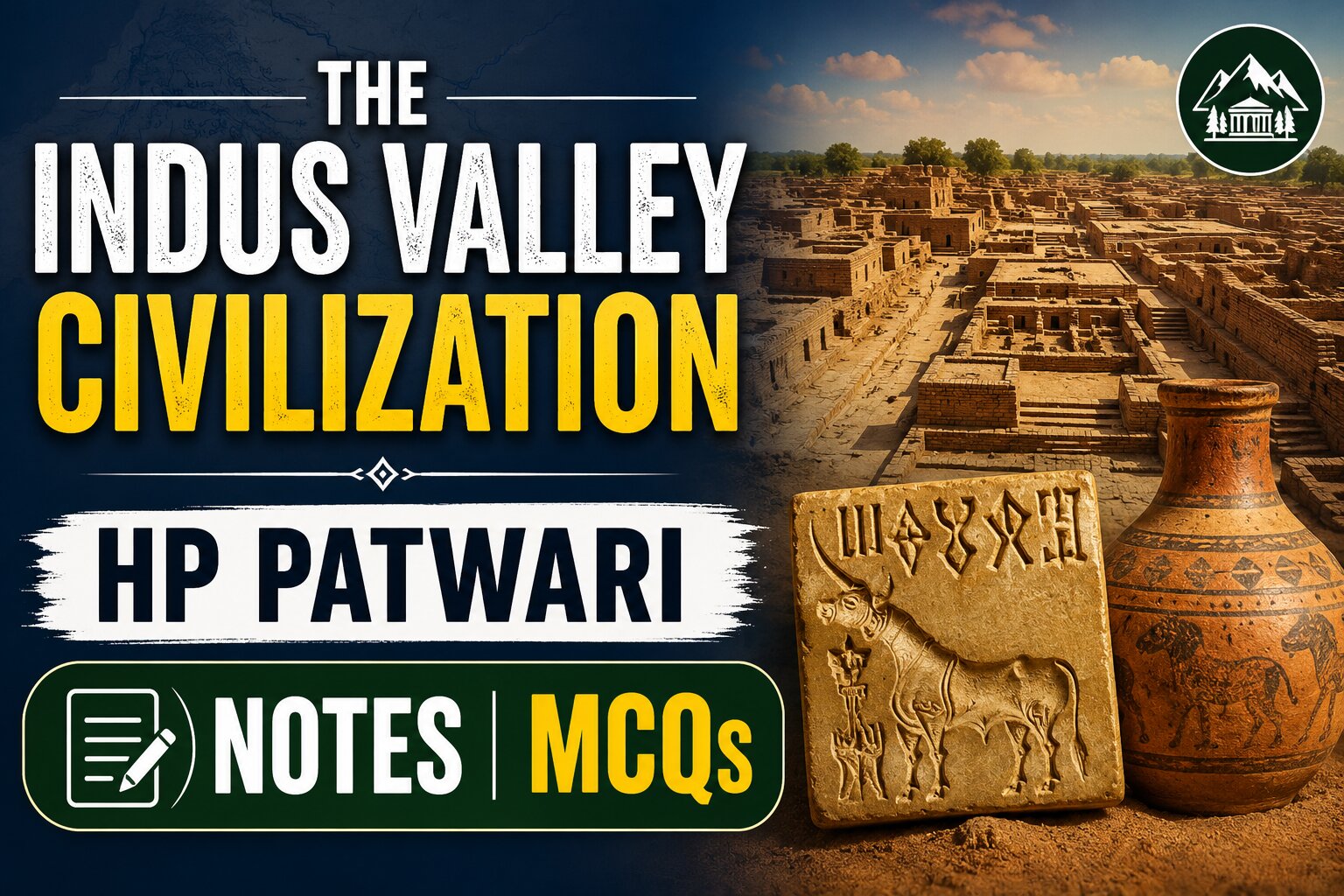


The Indus Valley Civilization | HP Patwari Notes & MCQs
Prepare for the HP Patwari Exam with complete bilingual (Hindi & English) notes on The Indus Valley Civilization. . The article also includes 20+ important bilingual MCQs based on the latest exam pattern to help you strengthen your History and General Knowledge preparation.


Join HP Patwari Exam Test Series(15 CBT Test With Answer Key):- CLICK HERE
The Indus Valley Civilization | HP Patwari Notes & MCQs
The Indus Valley Civilization / सिंधु घाटी सभ्यता||HP PATWARI EXAM
HP Patwari Exam – Complete Bilingual Notes | Easy to Advanced Level
The Indus Valley Civilization (IVC), also called the Harappan Civilization, was one of the earliest urban civilizations of the Indian subcontinent. Its Mature Harappan phase is generally dated to c. 2600–1900 BCE. The civilization is especially famous for planned cities, drainage systems, standardized weights and bricks, craft specialization, seals and long-distance trade.
1. Basic Introduction / मूल परिचय
|
Point |
English |
हिंदी |
|
Other name |
Harappan Civilization |
हड़प्पा सभ्यता |
|
Major phase |
Mature Harappan: c. 2600–1900 BCE |
परिपक्व हड़प्पा काल: लगभग 2600–1900 ई.पू. |
|
Nature |
Bronze Age urban civilization |
कांस्य युगीन नगरीय सभ्यता |
|
First major site identified |
Harappa |
हड़प्पा |
|
River system |
Indus and its tributaries, along with adjoining regions |
सिंधु एवं उसकी सहायक नदियाँ तथा आसपास के क्षेत्र |
|
Script |
Undeciphered |
अपठित/अभी तक पूर्णतः पढ़ी नहीं जा सकी |
|
Economy |
Agriculture + animal husbandry + crafts + trade |
कृषि + पशुपालन + शिल्प + व्यापार |
|
Famous features |
Town planning, drainage, seals, weights, crafts |
नगर योजना, जल निकासी, मुहरें, बाट, शिल्प |
The National Museum identifies Harappa, Mohenjo-daro, Dholavira, Kalibangan, Lothal and Rakhigarhi among the major Harappan centres and classifies the civilization as Bronze Age because of its copper-based alloys.
2. Principal Archaeological Sites / प्रमुख पुरातात्त्विक स्थल
This section is very important for HP Patwari.
Important Sites at a Glance
|
Site |
Present location |
Important evidence / विशेषता |
|
Harappa |
Punjab, Pakistan |
Granary-like structures, cemetery, seals, standardized bricks |
|
Mohenjo-daro |
Sindh, Pakistan |
Great Bath, drainage, bronze Dancing Girl, Priest-King, major public buildings |
|
Dholavira |
Kutch, Gujarat |
Reservoirs, sophisticated water management, city divisions, large signboard, stone architecture |
|
Lothal |
Gujarat |
Maritime-trade installation traditionally identified as a dockyard, bead industry, warehouse-like structures |
|
Kalibangan |
Rajasthan |
Ploughed field, fire-altars, distinctive settlement planning |
|
Rakhigarhi |
Haryana |
One of the largest Harappan settlements; extensive urban remains |
|
Chanhudaro |
Sindh, Pakistan |
Major craft-production centre; bead-making; notably lacks a large citadel |
|
Banawali |
Haryana |
Fortified settlement, Harappan town planning |
|
Surkotada |
Gujarat |
Fortified settlement; horse-related remains have been reported and debated |
|
Ropar/Rupnagar |
Punjab, India |
Harappan settlement in the Sutlej region |
|
Alamgirpur |
Uttar Pradesh |
Easternmost commonly cited Harappan site |
|
Sutkagendor |
Balochistan, Pakistan |
Western frontier; trade-related settlement |
|
Manda |
Jammu region |
Northern extent of the Harappan cultural zone |
Must Remember
Mohenjo-daro → Great Bath
Lothal → Maritime trade / dockyard traditionally identified
Dholavira → Water management + reservoirs
Kalibangan → Ploughed field + fire-altars
Chanhudaro → Craft centre + no major citadel
Rakhigarhi → One of the largest Harappan sites
Harappa → Cemetery + important urban remains
3. Mohenjo-daro / मोहनजोदड़ो
Mohenjo-daro means “Mound of the Dead” in Sindhi.
Major Features
- Located in Sindh, Pakistan.
- One of the largest Harappan urban centres.
- Famous for the Great Bath.
- Extensive drainage system.
- Planned streets and houses.
- Numerous wells.
- Bronze Dancing Girl.
- Famous stone “Priest-King” sculpture.
- Seals and terracotta objects.
Great Bath / महान स्नानागार
The Great Bath is one of the most famous structures of the Harappan civilization.
Features:
- Large rectangular tank.
- Carefully constructed with bricks.
- Waterproofing was used.
- Steps descended into the tank.
- Surrounding rooms and drainage arrangements existed.
Its exact function cannot be established with certainty, but ritual bathing is the commonly accepted interpretation.
Exam Fact
Great Bath → Mohenjo-daro
4. Dholavira / धोलावीरा
Located in Kutch, Gujarat, Dholavira is one of the most important Harappan sites in India.
Special Features
- Sophisticated water-management system
- Large reservoirs
- Channels and water-storage structures
- Stone used extensively in construction
- Large inscription/signboard
- Planned settlement
- Distinctive division of the settlement
Unlike the frequently cited two-part division at many Harappan cities, Dholavira is especially noted for its three-part urban organization, conventionally described as:
- Citadel
- Middle Town
- Lower Town
Dholavira was inscribed as a UNESCO World Heritage Site in 2021.
HP Patwari Trick
Dholavira = D for Dams/Drainage/Water
5. Lothal / लोथल
Located in Gujarat, Lothal was an important centre of craft production and trade.
Important Findings
- Bead-making industry
- Shell working
- Metalworking
- Seals
- Weights
- Warehouse-like structures
- Fire-related structures
- Maritime-trade installation traditionally identified as a dockyard
Important Caution
In competitive-exam textbooks:
Lothal = Dockyard
Modern archaeological discussions have debated the precise function of the large basin, but “dockyard” remains the standard examination association.
Trade Importance
Its location provided access to routes connecting the Harappan world with the Arabian Sea and wider western Asian trading networks.
6. Kalibangan / कालीबंगा
Located in Rajasthan, on the Ghaggar region.
Most Important Findings
1. Ploughed field
Evidence of a ploughed agricultural field was discovered here.
This is one of the most important agricultural archaeological discoveries associated with the Harappan civilization.
2. Fire-altars
Structures interpreted as fire-altars were found at Kalibangan.
3. Planned settlement
The site had fortified and planned settlement areas.
Exam Trick
Kalibangan → K = Khet + Kund/ritual fire structures
7. Rakhigarhi / राखीगढ़ी
Located in Haryana.
It is one of the largest known Harappan settlements, and archaeological investigations have revealed extensive evidence of urban life, houses, streets, drainage and craft activity.
Important
Rakhigarhi → Haryana → Major/very large Harappan urban centre
Do not confuse it with Ropar/Rupnagar, which is in Punjab.
8. Chanhudaro / चन्हूदड़ो
Located in Sindh, Pakistan.
Famous for:
- Bead-making
- Craft production
- Shell working
- Small-scale manufacturing
- Seals and ornaments
Special Fact
Chanhudaro is generally noted as a Harappan settlement without a large citadel.
This is a frequently asked examination fact.
9. Urban Planning / नगर नियोजन
Urban planning is one of the greatest achievements of the Harappans.
Harappan cities show systematic planning rather than random settlement growth. Archaeological evidence includes planned streets, drainage, standardized construction materials and differentiated settlement areas.
A. Grid Pattern / जालीनुमा योजना
Many Harappan cities had streets arranged in an approximately grid-like pattern, with major roads intersecting smaller streets.
Simple understanding:
Main road → smaller streets → residential blocks
This indicates:
- Planning before construction
- Organized urban administration
- Standardized construction
- Civic management
10. Citadel and Lower Town / दुर्ग एवं निचला नगर
Many major Harappan settlements are conventionally described as having two broad sections:
1. Citadel / दुर्ग क्षेत्र
- Generally elevated.
- Contained important public structures.
- Often fortified or raised.
2. Lower Town / निचला नगर
- Larger residential area.
- Houses and neighbourhoods.
- Extensive street and drainage network.
Important Exception
Dholavira had a distinctive three-part organization, unlike the simple two-part model often used for Harappa and Mohenjo-daro.
11. Houses / मकान
Harappan houses show considerable standardization.
Features
- Baked bricks were widely used.
- Houses often had courtyards.
- Bathrooms were common.
- Many houses were connected to drains.
- Private wells existed at some sites.
- Houses were generally organized around streets and lanes.
- Doorways often opened into side lanes rather than directly onto major streets.
Important
Harappan houses demonstrate concern for sanitation and privacy.
12. Drainage System / जल निकासी व्यवस्था
This is one of the most important features for exams.
Features
- Covered drains
- Brick-lined drains
- Household wastewater connections
- Inspection/cleaning arrangements at some locations
- Connection between household drains and larger street drains
Why important?
It demonstrates:
Urban planning + sanitation + civic management
The standardized use of baked bricks and sophisticated drainage are among the defining characteristics of Harappan urbanism.
13. Bricks / ईंटें
Harappans used both:
- Sun-dried bricks
- Baked/burnt bricks
A commonly cited standardized brick proportion is approximately:
1 : 2 : 4
This standardization facilitated uniform construction.
14. Water Management / जल प्रबंधन
The Harappans demonstrated impressive water-management technology.
Dholavira is especially famous for:
- Reservoirs
- Water channels
- Storage structures
- Rainwater/seasonal water management
- Efficient use of limited water resources
Exam Formula
Dholavira = Water Management
15. Agriculture / कृषि
Agriculture was a major economic activity.
Major crops
- Wheat
- Barley
- Peas
- Sesame
- Dates
- Various pulses
- Cotton
Cotton
The Harappans are associated with some of the earliest archaeological evidence for cotton textile production.
Kalibangan
Evidence of a ploughed field is particularly important.
16. Animal Husbandry / पशुपालन
Animals known from Harappan archaeological evidence include:
- Cattle
- Buffalo
- Sheep
- Goat
- Pig
- Dog
- Camel
- Elephant
The humped bull appears frequently in Harappan art and seals.
Important caution
The importance and domestication status of particular animals can vary by site and evidence. Therefore, avoid statements such as “every animal represented on seals was domesticated.”
17. Internal Trade / आंतरिक व्यापार
The Harappan civilization had extensive exchange networks within its own cultural zone.
Goods moved between regions included:
- Beads
- Shell products
- Metals
- Stone
- Pottery
- Agricultural products
- Semi-precious stones
- Ornaments
- Timber and other raw materials
Why do historians know this?
Because archaeologists find:
- Raw materials far from their natural sources
- Finished goods at distant settlements
- Standardized weights
- Seals
- Craft-production centres
This suggests a well-connected economic network.
18. External Trade / बाहरी व्यापार
The Harappans maintained long-distance contacts with regions outside the Indian subcontinent.
Major external connections
- Mesopotamia
- Persian Gulf region
- Oman region
- Afghanistan
- Central Asian areas
Mesopotamian records refer to a region called Meluhha, which is widely associated by scholars with the Indus/Harappan cultural sphere, although exact identification and the nature of the relationship remain subjects of scholarly discussion.
Important Trade Materials
From Afghanistan / northern-western regions:
- Lapis lazuli
- Other stones
From Gujarat:
- Carnelian
- Shell
- Other craft materials
From coastal regions:
- Shells
- Marine products
From Oman/Magan-related networks:
- Copper and other materials were part of wider exchange networks.
19. Evidence of Trade / व्यापार के प्रमाण
The following are important evidence:
1. Seals / मुहरें
Used in administration, identification, marking goods and possibly commercial transactions.
2. Standardized Weights / मानकीकृत बाट
Suggest regulated exchange and measurement.
3. Foreign Objects
Objects/materials originating outside the Harappan heartland indicate long-distance exchange.
4. Harappan Objects Outside the Civilization
Harappan-style seals and goods have been found in regions connected with Mesopotamian trade.
5. Maritime Connections
Lothal and other Gujarat settlements demonstrate the importance of coastal trade.
Harappan economic organization included standardized weights, seals and specialized production, all of which are important evidence for organized exchange.
20. Industries and Crafts / उद्योग एवं शिल्प
The Harappans were highly skilled craft producers.
Major Industries
A. Bead-making / मनका निर्माण
Important materials:
- Carnelian
- Agate
- Faience
- Steatite
- Shell
- Semi-precious stones
Important centres:
Chanhudaro and Lothal
B. Metallurgy / धातुकर्म
Harappans worked with:
- Copper
- Bronze
- Gold
- Silver
- Lead
Important
The Harappans were a Bronze Age civilization.
Bronze is essentially an alloy mainly involving copper and tin, although alloy compositions varied.
21. Pottery / मृद्भांड
Harappan pottery was generally:
- Wheel-made
- Well-fired
- Often red in colour
- Decorated with black designs
Common designs
- Geometrical patterns
- Plants
- Animals
- Birds
- Fish motifs
Pottery provides important evidence for identifying Harappan cultural phases.
22. Shell Industry / शंख उद्योग
Coastal settlements had specialized shell-working industries.
Shell was used for:
- Bangles
- Ornaments
- Decorative objects
- Tools and other items
Lothal and coastal Gujarat are particularly important in this context.
23. Faience / फैयेंस
Harappans produced faience, a glazed composition used to make:
- Beads
- Bangles
- Small decorative objects
- Amulets
Its blue-green appearance made it attractive for ornaments.
24. Textile Industry / वस्त्र उद्योग
Cotton was cultivated and used for textiles.
Important
The Harappans are associated with some of the earliest known evidence of cotton use/textile production.
Wool and other fibres were also available through animal husbandry and textile practices.
25. Ivory and Bone Craft / हाथीदांत एवं अस्थि शिल्प
Craft workers used:
- Ivory
- Bone
- Horn
- Shell
for:
- Combs
- Decorative items
- Pins
- Small tools
- Ornaments
26. Seals / मुहरें
Seals are among the most characteristic Harappan artefacts.
Common material
Steatite was widely used.
Common motif
The most famous is the:
Unicorn
Other animals represented include:
- Bull
- Elephant
- Rhinoceros
- Tiger
- Buffalo
- Goat-like animals
Uses/Functions
Seals may have served:
- Identification
- Administrative purposes
- Marking goods
- Trade-related functions
- Symbolic/religious purposes
Their exact functions cannot always be established with certainty.
27. Harappan Script / हड़प्पा लिपि
The Harappan script is:
- Still undeciphered
- Found on seals, pottery, tablets and other objects.
- Often written in very short inscriptions.
- Signs include pictorial/symbolic forms.
Important Exam Fact
Indus script has NOT been conclusively deciphered.
Therefore:
❌ Do not say that the Harappan language is definitely known.
❌ Do not claim a particular language family as proven.
28. Artistic Achievements / कलात्मक उपलब्धियाँ
Harappan art demonstrates advanced skills in:
- Sculpture
- Bronze casting
- Terracotta modelling
- Seal carving
- Pottery decoration
- Jewellery
- Bead-making
A. Dancing Girl / नर्तकी
Found at Mohenjo-daro.
Made of:
Bronze
Technique:
Associated with the lost-wax (cire perdue) casting technique.
This is one of the best-known examples of Harappan metal artistry. The National Museum specifically identifies the Dancing Girl as a bronze figurine demonstrating Harappan advances in metallurgy and art. (National Museum India)
Exam Answer:
Dancing Girl → Mohenjo-daro → Bronze
29. Priest-King / पुजारी–राजा
A famous steatite/stone male sculpture was found at Mohenjo-daro.
It is traditionally called:
“Priest-King”
Important caution:
“Priest-King” is a modern archaeological label, not proof that the individual was actually a king or priest.
This distinction is important for higher-level questions.
30. Terracotta Figurines / टेराकोटा मूर्तियाँ
Harappan sites have yielded:
- Human figurines
- Animal figurines
- Toys
- Carts
- Whistles
- Dolls
Female figurines are often interpreted traditionally as mother-goddess figures, but their exact religious meaning is not certain.
31. Jewellery / आभूषण
Harappan jewellery was highly developed.
Materials included:
- Gold
- Silver
- Copper
- Shell
- Faience
- Carnelian
- Agate
- Semi-precious stones
- Ivory
Jewellery included:
- Necklaces
- Bangles
- Rings
- Beads
- Earrings
- Pendants
The famous Dancing Girl is shown wearing several ornaments.
32. Social Stratification / सामाजिक स्तरीकरण
This is an advanced and important topic.
Archaeological evidence suggests that Harappan society was socially differentiated, but we do not possess written texts that clearly explain its class structure.
Evidence of differentiation includes:
- Variation in house size
- Differences in access to certain goods
- Craft specialization
- Different burial practices
- Presence of public structures
- Differences in wealth and ornaments
However, we should not automatically equate these differences with a rigid caste system.
33. Houses and Social Differences / मकान और सामाजिक अंतर
Some houses were relatively large while others were smaller.
This may indicate:
- Different economic status
- Different household sizes
- Different occupations
- Social differentiation
But archaeological evidence does not allow us to reconstruct a precise hierarchy like a later caste system.
34. Craft Specialists / शिल्प विशेषज्ञ
Harappan urban society had specialized workers such as:
- Potters
- Bead-makers
- Metalworkers
- Shell workers
- Stone workers
- Carpenters
- Builders
- Traders
Meaning:
Urbanization → occupational specialization
This specialization was essential for sustaining large cities.
35. Social Organization / सामाजिक संगठन
The existence of:
- Standardized bricks
- Standardized weights
- Similar urban planning principles
- Large public structures
- Long-distance trade
- Complex drainage systems
suggests the presence of strong organizational mechanisms.
But there is no deciphered Harappan political text identifying a king, dynasty or government system.
Important:
Do not state with certainty that Harappan cities were ruled by kings.
The political structure remains debated.
36. Religion – Exam-Level Overview / धर्म – परीक्षा स्तर
Although your main topic is urbanism, trade, crafts and society, these facts are often mixed into Patwari questions.
Important archaeological evidence:
- Female figurines
- Animal motifs
- Sacred-looking trees
- Seals
- Fire-altars at some sites
- Great Bath
Pashupati Seal
A famous seal from Mohenjo-daro depicts a horned seated figure surrounded by animals.
It has traditionally been called the:
Pashupati seal
But identifying the figure specifically with the later Hindu deity Shiva is an interpretation, not an established fact.
37. Burial Practices / अंतिम संस्कार
Harappan cemeteries provide evidence about social practices.
Some graves contained:
- Pottery
- Ornaments
- Personal objects
This may indicate beliefs concerning death and the afterlife, but the exact religious beliefs remain uncertain.
Archaeological evidence is therefore more reliable than speculative religious reconstructions. (S3WaaS)
38. Standardized Weights and Measures / मानकीकृत बाट एवं माप
One of the most impressive economic features was the use of standardized weights.
Importance
Standard weights helped:
- Measure commodities
- Facilitate trade
- Standardize transactions
- Maintain economic consistency
Exam Connection
Weights + Seals + Standardized Bricks = Harappan standardization
39. Transport / परिवहन
Transport probably involved:
Land:
- Bullock carts
- Pack animals
Water:
- Boats
- River transport
- Coastal maritime transport
The importance of Gujarat settlements and the Arabian Sea indicates that maritime networks were significant.
40. Why is the Indus Civilization called an Urban Civilization?
इसे नगरीय सभ्यता क्यों कहा जाता है?
Because of:
✔ Planned cities
✔ Grid-like streets
✔ Citadel and lower-town organization
✔ Large public buildings
✔ Drainage systems
✔ Wells
✔ Specialized crafts
✔ Standardized bricks
✔ Standardized weights
✔ Long-distance trade
✔ Occupational specialization
This combination distinguishes the Mature Harappan phase as a major urban tradition. (Testbook)
41. High-Yield Site → Finding Table
|
Archaeological fact |
Site |
|
Great Bath |
Mohenjo-daro |
|
Dancing Girl |
Mohenjo-daro |
|
Priest-King |
Mohenjo-daro |
|
Dockyard – traditional exam association |
Lothal |
|
Bead industry |
Lothal / Chanhudaro |
|
Ploughed field |
Kalibangan |
|
Fire-altars |
Kalibangan |
|
Advanced reservoirs |
Dholavira |
|
Water management |
Dholavira |
|
Large signboard |
Dholavira |
|
Three-part city organization |
Dholavira |
|
Major large settlement |
Rakhigarhi |
|
Important cemetery |
Harappa |
|
Craft centre without major citadel |
Chanhudaro |
|
Eastern extent – commonly cited |
Alamgirpur |
|
Northern extent – commonly cited |
Manda |
|
Western frontier – commonly cited |
Sutkagendor |
42. Most Important One-Liners for HP Patwari
Remember These 30 Facts
- Indus Valley Civilization = Harappan Civilization.
- Mature Harappan phase = approximately 2600–1900 BCE.
- It was a Bronze Age civilization.
- Harappa gave the civilization its archaeological name.
- Mohenjo-daro = Great Bath.
- Mohenjo-daro = Dancing Girl.
- Dancing Girl is made of bronze.
- Lothal = maritime trade/dockyard in conventional exam literature.
- Dholavira = advanced water management.
- Kalibangan = ploughed field.
- Kalibangan = fire-altars.
- Chanhudaro = important craft centre.
- Chanhudaro is notable for lacking a major citadel.
- Rakhigarhi = one of the largest Harappan settlements.
- Harappan cities had sophisticated drainage systems.
- Harappan streets were generally planned/grid-like.
- Baked bricks were widely used.
- Standard brick ratio is commonly given as 1:2:4.
- Standardized weights indicate organized exchange.
- Steatite was widely used for seals.
- Unicorn is the most famous Harappan seal motif.
- Harappan script remains undeciphered.
- Cotton was cultivated and used.
- Harappans practiced bead-making, metallurgy, pottery and shell-working.
- Trade existed with Mesopotamia and Persian Gulf networks.
- Mesopotamian sources mention Meluhha, commonly associated with the Harappan sphere.
- Social differentiation existed, but the exact social hierarchy is uncertain.
- There is no deciphered text proving a Harappan king/dynasty.
- The Great Bath’s exact function is not conclusively known; ritual bathing is the common interpretation.
- Harappan urbanism is especially famous for planning + drainage + standardization + crafts + trade.
43. Easy Memory Tricks / आसान ट्रिक्स
🏛️ Major Sites
M-L-D-K-R-C
M = Mohenjo-daro → Great Bath
L = Lothal → Dockyard/Maritime trade
D = Dholavira → Water
K = Kalibangan → Khet (Ploughed field)
R = Rakhigarhi → Really large settlement
C = Chanhudaro → Crafts
🎨 Art
Dancing Girl → Bronze → Mohenjo-daro
Remember:
“Girl = Bronze = Mohenjo-daro”
💧 Water
“Dholavira = Water City”
Reservoirs + channels + water conservation.
🌾 Agriculture
“Kalibangan = Khet”
Ploughed field.
🚢 Trade
“Lothal = Lothal Port”
For exam purposes, remember the traditional association with a dockyard/maritime trade.
44. Advanced Concept: Why Were Harappan Cities So Standardized?
The repeated use of:
- Similar brick proportions
- Standardized weights
- Similar seal traditions
- Planned streets
- Drainage arrangements
- Common craft technologies
suggests that Harappan communities shared strong cultural and technological conventions across a very large geographical area.
However, this does not automatically prove a single centralized empire. The political organization of the civilization remains debated.
45. Advanced Concept: Was Harappan Society Highly Unequal?
The answer is:
Social differences existed, but the exact degree and structure are uncertain.
Evidence:
For differentiation:
- Different house sizes
- Different burial goods
- Craft specialization
- Access to luxury materials
Against simplistic assumptions:
- No deciphered texts describing classes
- No confirmed royal tombs comparable to some other ancient civilizations
- No conclusive evidence of a rigid caste system
Therefore, in an exam:
Harappan society was socially differentiated, but its exact hierarchy remains uncertain.
46. Advanced Concept: Harappan Trade Network
Think of the economy as:
Village → Town → City → Regional network → Overseas trade
Example:
Raw material
↓
Craft centre
↓
Finished product
↓
Trader/merchant
↓
Another settlement
↓
Foreign market
This explains why archaeological evidence of raw materials, finished crafts, seals and standardized weights occurs across widely separated settlements.
47. HP Patwari Exam: Most Important Comparisons
|
Question |
Correct answer |
|
Great Bath? |
Mohenjo-daro |
|
Dancing Girl? |
Mohenjo-daro |
|
Bronze Dancing Girl? |
Mohenjo-daro |
|
Ploughed field? |
Kalibangan |
|
Fire-altars? |
Kalibangan |
|
Water reservoirs? |
Dholavira |
|
Advanced water management? |
Dholavira |
|
Dockyard/traditional association? |
Lothal |
|
Bead-making? |
Lothal/Chanhudaro |
|
Major craft centre without large citadel? |
Chanhudaro |
|
One of largest Harappan sites? |
Rakhigarhi |
|
Famous cemetery? |
Harappa |
|
Famous unicorn seal? |
Harappan civilization |
|
Script status? |
Undeciphered |
|
Bronze Age? |
Harappan civilization |
|
Standardized weights? |
Harappan civilization |
|
Standardized brick proportion? |
1:2:4 |
|
Major external trading contact? |
Mesopotamia |
|
Mesopotamian name associated with Harappan region? |
Meluhha |
48. Final Revision Box / अंतिम पुनरावृत्ति
INDUS VALLEY CIVILIZATION = 8 KEY WORDS
🏙️ Urban Planning
Grid pattern + Citadel + Lower Town
🚿 Sanitation
Covered drains + Bathrooms + Wells
⚖️ Standardization
Weights + Bricks
🛠️ Crafts
Beads + Pottery + Metal + Shell + Faience
🚢 Trade
Internal + Mesopotamia + Persian Gulf + Maritime
🎨 Art
Seals + Dancing Girl + Terracotta + Jewellery
💧 Water
Dholavira + Reservoirs
👥 Society
Occupational specialization + social differentiation, but exact hierarchy uncertain
⭐ HP Patwari “Must-Remember” Chain
Mohenjo-daro → Great Bath → Dancing Girl
Lothal → Dockyard → Maritime Trade → Beads
Dholavira → Reservoirs → Water Management → Three-part city
Kalibangan → Ploughed Field → Fire-altars
Chanhudaro → Crafts → Beads → No major citadel
Rakhigarhi → Haryana → Very large Harappan settlement
Harappa → Cemetery → Major Harappan site
Harappan Civilization → Bronze Age → Urban Planning → Drainage → Standardized Weights → Seals → Trade
The Indus Valley Civilization / सिंधु घाटी सभ्यता
HP Patwari Exam – Important Bilingual MCQs
Question: The Indus Valley Civilization is also known as which of the following?
प्रश्न: सिंधु घाटी सभ्यता को निम्नलिखित में से किस नाम से भी जाना जाता है?
(A) Vedic Civilization / वैदिक सभ्यता
(B) Harappan Civilization / हड़प्पा सभ्यता
(C) Mauryan Civilization / मौर्य सभ्यता
(D) Painted Grey Ware Culture / चित्रित धूसर मृद्भांड संस्कृति
Answer: (B) Harappan Civilization / हड़प्पा सभ्यता
Question: The Mature Harappan phase is generally dated to which period?
प्रश्न: परिपक्व हड़प्पा काल सामान्यतः किस अवधि का माना जाता है?
(A) 4000–3000 BCE / 4000–3000 ई.पू.
(B) 2600–1900 BCE / 2600–1900 ई.पू.
(C) 1500–1000 BCE / 1500–1000 ई.पू.
(D) 1000–600 BCE / 1000–600 ई.पू.
Answer: (B) 2600–1900 BCE / 2600–1900 ई.पू.
Question: The Harappan Civilization is generally classified as a ______ civilization.
प्रश्न: हड़प्पा सभ्यता को सामान्यतः किस प्रकार की सभ्यता माना जाता है?
(A) Stone Age / पाषाण युगीन
(B) Iron Age / लौह युगीन
(C) Bronze Age / कांस्य युगीन
(D) Medieval / मध्यकालीन
Answer: (C) Bronze Age / कांस्य युगीन
Question: Which archaeological site gave its name to the Harappan Civilization?
प्रश्न: किस पुरातात्त्विक स्थल के नाम पर हड़प्पा सभ्यता का नाम पड़ा?
(A) Lothal / लोथल
(B) Harappa / हड़प्पा
(C) Dholavira / धोलावीरा
(D) Kalibangan / कालीबंगा
Answer: (B) Harappa / हड़प्पा
Question: The Great Bath was discovered at which Harappan site?
प्रश्न: महान स्नानागार किस हड़प्पाई स्थल से प्राप्त हुआ है?
(A) Harappa / हड़प्पा
(B) Lothal / लोथल
(C) Mohenjo-daro / मोहनजोदड़ो
(D) Kalibangan / कालीबंगा
Answer: (C) Mohenjo-daro / मोहनजोदड़ो
Question: Mohenjo-daro is located in present-day which province of Pakistan?
प्रश्न: मोहनजोदड़ो वर्तमान पाकिस्तान के किस प्रांत में स्थित है?
(A) Punjab / पंजाब
(B) Sindh / सिंध
(C) Balochistan / बलूचिस्तान
(D) Khyber Pakhtunkhwa / खैबर पख्तूनख्वा
Answer: (B) Sindh / सिंध
Question: The famous bronze Dancing Girl was found at which site?
प्रश्न: प्रसिद्ध कांस्य नर्तकी की मूर्ति किस स्थल से प्राप्त हुई थी?
(A) Harappa / हड़प्पा
(B) Dholavira / धोलावीरा
(C) Mohenjo-daro / मोहनजोदड़ो
(D) Lothal / लोथल
Answer: (C) Mohenjo-daro / मोहनजोदड़ो
Question: The Dancing Girl of Mohenjo-daro is made of which material?
प्रश्न: मोहनजोदड़ो की नर्तकी किस धातु से बनी है?
(A) Iron / लोहा
(B) Copper / तांबा
(C) Bronze / कांस्य
(D) Gold / सोना
Answer: (C) Bronze / कांस्य
Question: The famous “Priest-King” sculpture was found at which site?
प्रश्न: प्रसिद्ध “पुजारी–राजा” की मूर्ति किस स्थल से प्राप्त हुई?
(A) Mohenjo-daro / मोहनजोदड़ो
(B) Harappa / हड़प्पा
(C) Lothal / लोथल
(D) Rakhigarhi / राखीगढ़ी
Answer: (A) Mohenjo-daro / मोहनजोदड़ो
Question: Which Harappan site is famous for its sophisticated water-management system and reservoirs?
प्रश्न: कौन–सा हड़प्पाई स्थल अपनी उन्नत जल–प्रबंधन प्रणाली और जलाशयों के लिए प्रसिद्ध है?
(A) Kalibangan / कालीबंगा
(B) Dholavira / धोलावीरा
(C) Harappa / हड़प्पा
(D) Chanhudaro / चन्हूदड़ो
Answer: (B) Dholavira / धोलावीरा
Question: Dholavira is located in which present-day Indian state?
प्रश्न: धोलावीरा वर्तमान भारत के किस राज्य में स्थित है?
(A) Rajasthan / राजस्थान
(B) Haryana / हरियाणा
(C) Gujarat / गुजरात
(D) Punjab / पंजाब
Answer: (C) Gujarat / गुजरात
Question: Which Harappan site is particularly associated with evidence of a ploughed field?
प्रश्न: किस हड़प्पाई स्थल से जुते हुए खेत के प्रमाण मिले हैं?
(A) Lothal / लोथल
(B) Kalibangan / कालीबंगा
(C) Harappa / हड़प्पा
(D) Dholavira / धोलावीरा
Answer: (B) Kalibangan / कालीबंगा
Question: Fire-altars have been particularly associated with which Harappan site?
प्रश्न: अग्निवेदियों के प्रमाण विशेष रूप से किस हड़प्पाई स्थल से जुड़े हैं?
(A) Kalibangan / कालीबंगा
(B) Rakhigarhi / राखीगढ़ी
(C) Lothal / लोथल
(D) Harappa / हड़प्पा
Answer: (A) Kalibangan / कालीबंगा
Question: Lothal is located in which state?
प्रश्न: लोथल किस राज्य में स्थित है?
(A) Gujarat / गुजरात
(B) Haryana / हरियाणा
(C) Rajasthan / राजस्थान
(D) Punjab / पंजाब
Answer: (A) Gujarat / गुजरात
Question: Lothal is traditionally associated in competitive-exam literature with which structure?
प्रश्न: प्रतियोगी परीक्षाओं में लोथल को पारंपरिक रूप से किस संरचना से जोड़ा जाता है?
(A) Great Bath / महान स्नानागार
(B) Dockyard / गोदी
(C) Granary / अन्नागार
(D) Palace / राजमहल
Answer: (B) Dockyard / गोदी
Question: Which Harappan site was an important centre of bead-making and craft production?
प्रश्न: कौन–सा हड़प्पाई स्थल मनका निर्माण एवं शिल्प उत्पादन के महत्वपूर्ण केंद्र के रूप में जाना जाता है?
(A) Chanhudaro / चन्हूदड़ो
(B) Manda / मांडा
(C) Alamgirpur / आलमगीरपुर
(D) Ropar / रोपड़
Answer: (A) Chanhudaro / चन्हूदड़ो
Question: Chanhudaro is particularly notable because it lacked which major feature?
प्रश्न: चन्हूदड़ो विशेष रूप से किस प्रमुख विशेषता के अभाव के लिए जाना जाता है?
(A) Drainage / जल निकासी
(B) Pottery / मृद्भांड
(C) A major citadel / प्रमुख दुर्ग
(D) Bead industry / मनका उद्योग
Answer: (C) A major citadel / प्रमुख दुर्ग
Question: Rakhigarhi is located in which state?
प्रश्न: राखीगढ़ी किस राज्य में स्थित है?
(A) Gujarat / गुजरात
(B) Haryana / हरियाणा
(C) Rajasthan / राजस्थान
(D) Uttar Pradesh / उत्तर प्रदेश
Answer: (B) Haryana / हरियाणा
Question: Rakhigarhi is important because it is regarded as:
प्रश्न: राखीगढ़ी महत्वपूर्ण है क्योंकि इसे किस रूप में माना जाता है?
(A) A major/one of the largest Harappan settlements / एक प्रमुख/सबसे बड़े हड़प्पाई स्थलों में से एक
(B) A Buddhist centre / एक बौद्ध केंद्र
(C) A Mauryan capital / मौर्य राजधानी
(D) A Gupta centre / गुप्त केंद्र
Answer: (A) A major/one of the largest Harappan settlements / एक प्रमुख/सबसे बड़े हड़प्पाई स्थलों में से एक
Question: Which feature is one of the most remarkable characteristics of Harappan urban planning?
प्रश्न: हड़प्पाई नगर नियोजन की सबसे उल्लेखनीय विशेषताओं में से एक क्या थी?
(A) Random streets / अनियमित सड़कें
(B) Grid-like street planning / जालीनुमा सड़क योजना
(C) Circular cities / वृत्ताकार नगर
(D) Mountain fortresses / पर्वतीय दुर्ग
Answer: (B) Grid-like street planning / जालीनुमा सड़क योजना
Question: Which Harappan feature provides strong evidence of concern for sanitation?
प्रश्न: हड़प्पाई सभ्यता की कौन–सी विशेषता स्वच्छता के प्रति विशेष ध्यान का प्रमाण देती है?
(A) Painted pottery / चित्रित मृद्भांड
(B) Drainage system / जल निकासी प्रणाली
(C) Gold ornaments / स्वर्ण आभूषण
(D) Seals / मुहरें
Answer: (B) Drainage system / जल निकासी प्रणाली
Question: Harappan houses commonly had which of the following features?
प्रश्न: हड़प्पाई घरों में सामान्यतः निम्नलिखित में से कौन–सी विशेषता पाई जाती थी?
(A) Courtyards and bathing areas / आंगन और स्नान क्षेत्र
(B) Large domes / बड़े गुंबद
(C) Stone temples / पत्थर के मंदिर
(D) Iron gates / लोहे के द्वार
Answer: (A) Courtyards and bathing areas / आंगन और स्नान क्षेत्र
Question: Which type of bricks was widely used in Harappan urban construction?
प्रश्न: हड़प्पाई नगरीय निर्माण में किस प्रकार की ईंटों का व्यापक उपयोग हुआ?
(A) Only marble blocks / केवल संगमरमर के खंड
(B) Baked bricks / पकी हुई ईंटें
(C) Only stone blocks / केवल पत्थर के खंड
(D) Iron bricks / लोहे की ईंटें
Answer: (B) Baked bricks / पकी हुई ईंटें
Question: The commonly cited standard proportion of Harappan bricks was:
प्रश्न: हड़प्पाई ईंटों का सामान्यतः उद्धृत मानक अनुपात क्या था?
(A) 1:1:1
(B) 1:2:3
(C) 1:2:4
(D) 2:3:5
Answer: (C) 1:2:4
Question: Which of the following was an important feature of the Harappan economy?
प्रश्न: निम्नलिखित में से कौन–सी हड़प्पाई अर्थव्यवस्था की महत्वपूर्ण विशेषता थी?
(A) Only hunting / केवल शिकार
(B) Agriculture, crafts and trade / कृषि, शिल्प और व्यापार
(C) Only pastoralism / केवल पशुपालन
(D) Only fishing / केवल मछली पकड़ना
Answer: (B) Agriculture, crafts and trade / कृषि, शिल्प और व्यापार
Question: Which crop is particularly associated with the Harappan Civilization and is among the earliest known textile crops?
प्रश्न: कौन–सी फसल हड़प्पा सभ्यता से विशेष रूप से जुड़ी है और प्रारंभिक वस्त्र फसलों में से एक मानी जाती है?
(A) Cotton / कपास
(B) Tea / चाय
(C) Coffee / कॉफी
(D) Tobacco / तंबाकू
Answer: (A) Cotton / कपास
Question: Which of the following was an important craft of the Harappans?
प्रश्न: निम्नलिखित में से कौन–सा हड़प्पावासियों का महत्वपूर्ण शिल्प था?
(A) Bead-making / मनका निर्माण
(B) Paper-making / कागज निर्माण
(C) Silk printing / रेशम छपाई
(D) Steel-making / इस्पात निर्माण
Answer: (A) Bead-making / मनका निर्माण
Question: Which material was widely used for making Harappan seals?
प्रश्न: हड़प्पाई मुहरों के निर्माण में किस पदार्थ का व्यापक उपयोग हुआ?
(A) Steatite / सेलखड़ी
(B) Iron / लोहा
(C) Granite only / केवल ग्रेनाइट
(D) Glass only / केवल कांच
Answer: (A) Steatite / सेलखड़ी
Question: Which animal motif is particularly famous on Harappan seals?
प्रश्न: हड़प्पाई मुहरों पर कौन–सा पशु–चिह्न विशेष रूप से प्रसिद्ध है?
(A) Unicorn / एक–सींग वाला पशु
(B) Horse only / केवल घोड़ा
(C) Lion only / केवल सिंह
(D) Deer only / केवल हिरण
Answer: (A) Unicorn / एक–सींग वाला पशु
Question: What is the present status of the Harappan script?
प्रश्न: हड़प्पाई लिपि की वर्तमान स्थिति क्या है?
(A) Completely deciphered / पूरी तरह पढ़ ली गई है
(B) Partially translated with certainty / निश्चित रूप से आंशिक अनुवादित
(C) Undeciphered / अपठित
(D) Written only in Sanskrit / केवल संस्कृत में लिखी गई
Answer: (C) Undeciphered / अपठित
Question: Harappan seals and weights provide important evidence of:
प्रश्न: हड़प्पाई मुहरें और बाट किसका महत्वपूर्ण प्रमाण प्रदान करते हैं?
(A) Organized exchange and trade / संगठित विनिमय और व्यापार
(B) Iron warfare / लौह युद्ध
(C) Buddhist monasteries / बौद्ध मठ
(D) Coin-based economy / सिक्का आधारित अर्थव्यवस्था
Answer: (A) Organized exchange and trade / संगठित विनिमय और व्यापार
Question: Which region is mentioned in Mesopotamian records and is commonly associated with the Harappan cultural sphere?
प्रश्न: मेसोपोटामियाई अभिलेखों में किस क्षेत्र का उल्लेख मिलता है, जिसे सामान्यतः हड़प्पाई सांस्कृतिक क्षेत्र से जोड़ा जाता है?
(A) Magadha / मगध
(B) Meluhha / मेलुहा
(C) Kalinga / कलिंग
(D) Avanti / अवंति
Answer: (B) Meluhha / मेलुहा
Question: The Harappans had external trade contacts with which ancient civilization?
प्रश्न: हड़प्पावासियों के किस प्राचीन सभ्यता के साथ बाहरी व्यापारिक संबंध थे?
(A) Mesopotamia / मेसोपोटामिया
(B) Rome / रोम
(C) Greece of Alexander / सिकंदर का यूनान
(D) Gupta India / गुप्तकालीन भारत
Answer: (A) Mesopotamia / मेसोपोटामिया
Question: Which of the following was an important raw material used in Harappan bead-making?
प्रश्न: निम्नलिखित में से कौन–सा हड़प्पाई मनका निर्माण में प्रयुक्त महत्वपूर्ण कच्चा माल था?
(A) Carnelian / कार्नेलियन
(B) Coal / कोयला
(C) Steel / इस्पात
(D) Aluminium / एल्युमिनियम
Answer: (A) Carnelian / कार्नेलियन
Question: Which metal was NOT known to the Harappans?
प्रश्न: निम्नलिखित में से किस धातु का ज्ञान हड़प्पावासियों को नहीं था?
(A) Copper / तांबा
(B) Bronze / कांस्य
(C) Gold / सोना
(D) Iron / लोहा
Answer: (D) Iron / लोहा
Question: The Harappan Civilization is called a Bronze Age civilization mainly because of its extensive use of:
प्रश्न: हड़प्पा सभ्यता को कांस्य युगीन सभ्यता मुख्यतः किसके व्यापक उपयोग के कारण कहा जाता है?
(A) Bronze / कांस्य
(B) Iron / लोहा
(C) Steel / इस्पात
(D) Aluminium / एल्युमिनियम
Answer: (A) Bronze / कांस्य
Question: Which of the following best reflects social differentiation in Harappan society?
प्रश्न: निम्नलिखित में से कौन–सा हड़प्पाई समाज में सामाजिक विभेदीकरण को सबसे अच्छी तरह दर्शाता है?
(A) Variation in house sizes and access to goods / घरों के आकार और वस्तुओं तक पहुँच में अंतर
(B) Written caste laws / लिखित जाति कानून
(C) Clearly identified royal dynasty / स्पष्ट रूप से पहचाना गया राजवंश
(D) Feudal land grants / सामंती भूमि अनुदान
Answer: (A) Variation in house sizes and access to goods / घरों के आकार और वस्तुओं तक पहुँच में अंतर
Question: Which statement about Harappan political organization is most appropriate?
प्रश्न: हड़प्पाई राजनीतिक संगठन के बारे में कौन–सा कथन सबसे उपयुक्त है?
(A) A single emperor is conclusively proven / एकल सम्राट का निश्चित प्रमाण है
(B) A clear dynasty list has been deciphered / स्पष्ट राजवंश सूची पढ़ ली गई है
(C) Political structure remains debated / राजनीतिक संरचना अभी भी बहस का विषय है
(D) There was definitely no administration / निश्चित रूप से कोई प्रशासन नहीं था
Answer: (C) Political structure remains debated / राजनीतिक संरचना अभी भी बहस का विषय है
Question: Which Harappan site is especially famous for water reservoirs and sophisticated water conservation?
प्रश्न: कौन–सा हड़प्पाई स्थल जलाशयों और उन्नत जल संरक्षण के लिए विशेष रूप से प्रसिद्ध है?
(A) Dholavira / धोलावीरा
(B) Harappa / हड़प्पा
(C) Chanhudaro / चन्हूदड़ो
(D) Alamgirpur / आलमगीरपुर
Answer: (A) Dholavira / धोलावीरा
Question: Which site is associated with a distinctive three-part urban organization?
प्रश्न: कौन–सा स्थल विशिष्ट त्रि–भागीय नगर संगठन से संबंधित है?
(A) Mohenjo-daro / मोहनजोदड़ो
(B) Dholavira / धोलावीरा
(C) Harappa / हड़प्पा
(D) Kalibangan / कालीबंगा
Answer: (B) Dholavira / धोलावीरा
Question: The Great Bath at Mohenjo-daro is generally interpreted as being associated with:
प्रश्न: मोहनजोदड़ो के महान स्नानागार को सामान्यतः किससे संबंधित माना जाता है?
(A) Ritual bathing / अनुष्ठानिक स्नान
(B) Grain storage / अनाज भंडारण
(C) Horse training / घोड़ा प्रशिक्षण
(D) Royal residence / राजकीय निवास
Answer: (A) Ritual bathing / अनुष्ठानिक स्नान
Question: Which of the following statements about the Great Bath is correct?
प्रश्न: महान स्नानागार के बारे में कौन–सा कथन सही है?
(A) It was found at Lothal / यह लोथल में मिला था
(B) It was found at Mohenjo-daro / यह मोहनजोदड़ो में मिला था
(C) It was made of iron / यह लोहे से बना था
(D) It was a grain warehouse / यह अन्नागार था
Answer: (B) It was found at Mohenjo-daro / यह मोहनजोदड़ो में मिला था
Question: Which Harappan site is famous for a large inscription/signboard?
प्रश्न: कौन–सा हड़प्पाई स्थल बड़े अभिलेख/साइनबोर्ड के लिए प्रसिद्ध है?
(A) Dholavira / धोलावीरा
(B) Harappa / हड़प्पा
(C) Kalibangan / कालीबंगा
(D) Ropar / रोपड़
Answer: (A) Dholavira / धोलावीरा
Question: Which of the following is correctly matched?
प्रश्न: निम्नलिखित में से कौन–सा सही सुमेलित है?
(A) Kalibangan — Ploughed field / कालीबंगा — जुता हुआ खेत
(B) Mohenjo-daro — Reservoir system / मोहनजोदड़ो — जलाशय प्रणाली
(C) Dholavira — Dancing Girl / धोलावीरा — नर्तकी
(D) Lothal — Great Bath / लोथल — महान स्नानागार
Answer: (A) Kalibangan — Ploughed field / कालीबंगा — जुता हुआ खेत
Question: Which of the following pairs is correctly matched?
प्रश्न: निम्नलिखित में से कौन–सा युग्म सही सुमेलित है?
(A) Lothal — Maritime trade / लोथल — समुद्री व्यापार
(B) Dholavira — Dancing Girl / धोलावीरा — नर्तकी
(C) Kalibangan — Great Bath / कालीबंगा — महान स्नानागार
(D) Chanhudaro — Large reservoirs / चन्हूदड़ो — बड़े जलाशय
Answer: (A) Lothal — Maritime trade / लोथल — समुद्री व्यापार
Question: Which of the following is NOT a characteristic feature of Harappan urbanism?
प्रश्न: निम्नलिखित में से कौन–सी हड़प्पाई नगरीय सभ्यता की विशेषता नहीं है?
(A) Planned streets / नियोजित सड़कें
(B) Drainage system / जल निकासी प्रणाली
(C) Standardized bricks / मानकीकृत ईंटें
(D) Extensive use of iron / लोहे का व्यापक उपयोग
Answer: (D) Extensive use of iron / लोहे का व्यापक उपयोग
Question: Which of the following best explains the importance of standardized weights in Harappan society?
प्रश्न: हड़प्पाई समाज में मानकीकृत बाटों के महत्व को सबसे अच्छी तरह कौन–सा विकल्प समझाता है?
(A) They facilitated measurement and exchange / उन्होंने माप और विनिमय को सुगम बनाया
(B) They were used only as toys / उनका उपयोग केवल खिलौनों के रूप में होता था
(C) They were religious idols / वे धार्मिक मूर्तियाँ थीं
(D) They were weapons / वे हथियार थे
Answer: (A) They facilitated measurement and exchange / उन्होंने माप और विनिमय को सुगम बनाया
Question: Which craft was particularly developed at Lothal and Chanhudaro?
प्रश्न: लोथल और चन्हूदड़ो में कौन–सा शिल्प विशेष रूप से विकसित था?
(A) Bead-making / मनका निर्माण
(B) Iron smelting / लौह गलाना
(C) Paper-making / कागज निर्माण
(D) Silk weaving only / केवल रेशम बुनाई
Answer: (A) Bead-making / मनका निर्माण
Question: Which of the following materials was used by Harappans for ornaments?
प्रश्न: हड़प्पावासी निम्नलिखित में से किस पदार्थ का उपयोग आभूषणों के लिए करते थे?
(A) Gold / सोना
(B) Silver / चांदी
(C) Shell / शंख
(D) All of the above / उपर्युक्त सभी
Answer: (D) All of the above / उपर्युक्त सभी
Question: Which of the following is an important characteristic of Harappan social organization?
प्रश्न: निम्नलिखित में से कौन–सी हड़प्पाई सामाजिक संगठन की महत्वपूर्ण विशेषता है?
(A) Occupational specialization / पेशागत विशेषज्ञता
(B) Complete social equality proven by texts / ग्रंथों द्वारा सिद्ध पूर्ण सामाजिक समानता
(C) Feudalism / सामंतवाद
(D) Modern caste system / आधुनिक जाति व्यवस्था
Answer: (A) Occupational specialization / पेशागत विशेषज्ञता
Question: Which statement about Harappan social stratification is most accurate?
प्रश्न: हड़प्पाई सामाजिक स्तरीकरण के बारे में कौन–सा कथन सबसे सटीक है?
(A) No social differences existed / कोई सामाजिक अंतर नहीं था
(B) A rigid caste system is fully proven / कठोर जाति व्यवस्था पूर्णतः सिद्ध है
(C) Social differentiation existed, but its exact structure is uncertain / सामाजिक विभेदीकरण था, लेकिन इसकी सटीक संरचना अनिश्चित है
(D) Society was definitely ruled by priests / समाज निश्चित रूप से पुरोहितों द्वारा शासित था
Answer: (C) Social differentiation existed, but its exact structure is uncertain / सामाजिक विभेदीकरण था, लेकिन इसकी सटीक संरचना अनिश्चित है
Question: Which of the following is NOT a safe conclusion from the term “Priest-King”?
प्रश्न: “पुजारी–राजा” शब्द से निम्नलिखित में से कौन–सा निष्कर्ष निकालना उचित नहीं है?
(A) It is a modern archaeological label / यह आधुनिक पुरातात्त्विक नामकरण है
(B) The sculpture was found at Mohenjo-daro / मूर्ति मोहनजोदड़ो से मिली
(C) The person is conclusively proven to have been a king / व्यक्ति का राजा होना निश्चित रूप से सिद्ध है
(D) It is an important Harappan sculpture / यह एक महत्वपूर्ण हड़प्पाई मूर्ति है
Answer: (C) The person is conclusively proven to have been a king / व्यक्ति का राजा होना निश्चित रूप से सिद्ध है
Question: Which of the following statements about the Harappan script is correct?
प्रश्न: हड़प्पाई लिपि के बारे में निम्नलिखित में से कौन–सा कथन सही है?
(A) It has been conclusively deciphered / इसे निश्चित रूप से पढ़ लिया गया है
(B) It remains undeciphered / यह अभी भी अपठित है
(C) It was written only in Brahmi / यह केवल ब्राह्मी में लिखी गई थी
(D) It was written only in Sanskrit / यह केवल संस्कृत में लिखी गई थी
Answer: (B) It remains undeciphered / यह अभी भी अपठित है
Question: Which combination best represents Harappan economic life?
प्रश्न: कौन–सा संयोजन हड़प्पाई आर्थिक जीवन को सबसे अच्छी तरह दर्शाता है?
(A) Agriculture + Crafts + Trade / कृषि + शिल्प + व्यापार
(B) Hunting only / केवल शिकार
(C) Warfare only / केवल युद्ध
(D) Temple economy only / केवल मंदिर आधारित अर्थव्यवस्था
Answer: (A) Agriculture + Crafts + Trade / कृषि + शिल्प + व्यापार
Question: Which of the following was an important external trading region connected with the Harappans?
प्रश्न: निम्नलिखित में से कौन–सा हड़प्पावासियों से जुड़ा महत्वपूर्ण बाहरी व्यापारिक क्षेत्र था?
(A) Mesopotamia / मेसोपोटामिया
(B) Japan / जापान
(C) Western Europe / पश्चिमी यूरोप
(D) South America / दक्षिण अमेरिका
Answer: (A) Mesopotamia / मेसोपोटामिया
Question: Which site is associated with the eastern extent of the Harappan cultural zone in commonly used archaeological lists?
प्रश्न: सामान्यतः प्रयुक्त पुरातात्त्विक सूचियों में कौन–सा स्थल हड़प्पाई सांस्कृतिक क्षेत्र के पूर्वी विस्तार से जुड़ा है?
(A) Alamgirpur / आलमगीरपुर
(B) Sutkagendor / सुत्कागेंडोर
(C) Dholavira / धोलावीरा
(D) Mohenjo-daro / मोहनजोदड़ो
Answer: (A) Alamgirpur / आलमगीरपुर
Question: Which site is commonly cited as a northern Harappan outpost/extent?
प्रश्न: किस स्थल को सामान्यतः हड़प्पाई सभ्यता के उत्तरी विस्तार/चौकी के रूप में उद्धृत किया जाता है?
(A) Manda / मांडा
(B) Lothal / लोथल
(C) Kalibangan / कालीबंगा
(D) Alamgirpur / आलमगीरपुर
Answer: (A) Manda / मांडा
Question: Which site is commonly cited as a western frontier settlement of the Harappan Civilization?
प्रश्न: किस स्थल को सामान्यतः हड़प्पा सभ्यता की पश्चिमी सीमा के स्थल के रूप में उद्धृत किया जाता है?
(A) Sutkagendor / सुत्कागेंडोर
(B) Rakhigarhi / राखीगढ़ी
(C) Alamgirpur / आलमगीरपुर
(D) Kalibangan / कालीबंगा
Answer: (A) Sutkagendor / सुत्कागेंडोर
Question: Which of the following combinations is completely correct?
प्रश्न: निम्नलिखित में से कौन–सा संयोजन पूर्णतः सही है?
(A) Mohenjo-daro—Great Bath; Kalibangan—Ploughed field; Dholavira—Water management / मोहनजोदड़ो—महान स्नानागार; कालीबंगा—जुता हुआ खेत; धोलावीरा—जल प्रबंधन
(B) Lothal—Great Bath; Dholavira—Dancing Girl; Harappa—Dockyard / लोथल—महान स्नानागार; धोलावीरा—नर्तकी; हड़प्पा—गोदी
(C) Kalibangan—Dockyard; Mohenjo-daro—Reservoirs; Lothal—Fire-altars / कालीबंगा—गोदी; मोहनजोदड़ो—जलाशय; लोथल—अग्निवेदियाँ
(D) Chanhudaro—Great Bath; Harappa—Dancing Girl; Dholavira—Ploughed field / चन्हूदड़ो—महान स्नानागार; हड़प्पा—नर्तकी; धोलावीरा—जुता हुआ खेत
Answer: (A) Mohenjo-daro—Great Bath; Kalibangan—Ploughed field; Dholavira—Water management / मोहनजोदड़ो—महान स्नानागार; कालीबंगा—जुता हुआ खेत; धोलावीरा—जल प्रबंधन
हमारे बारे में – Himexam.com
Himexam.com हिमाचल प्रदेश व अखिल भारतीय प्रतियोगी परीक्षाओं के लिए एक विश्वसनीय पोर्टल है। यहाँ आपको नवीनतम HP Govt Jobs, All India Jobs, HP GK, करेंट अफेयर्स, वन लाइनर प्रश्न, जिलेवार GK और पिछले वर्षों के प्रश्न पत्र की जानकारी एक ही जगह मिलती है। हमारी कोशिश है कि हर अभ्यर्थी को सही और समय पर अध्ययन सामग्री मिले।
 WhatsApp
 Facebook
 Telegram
 Instagram