
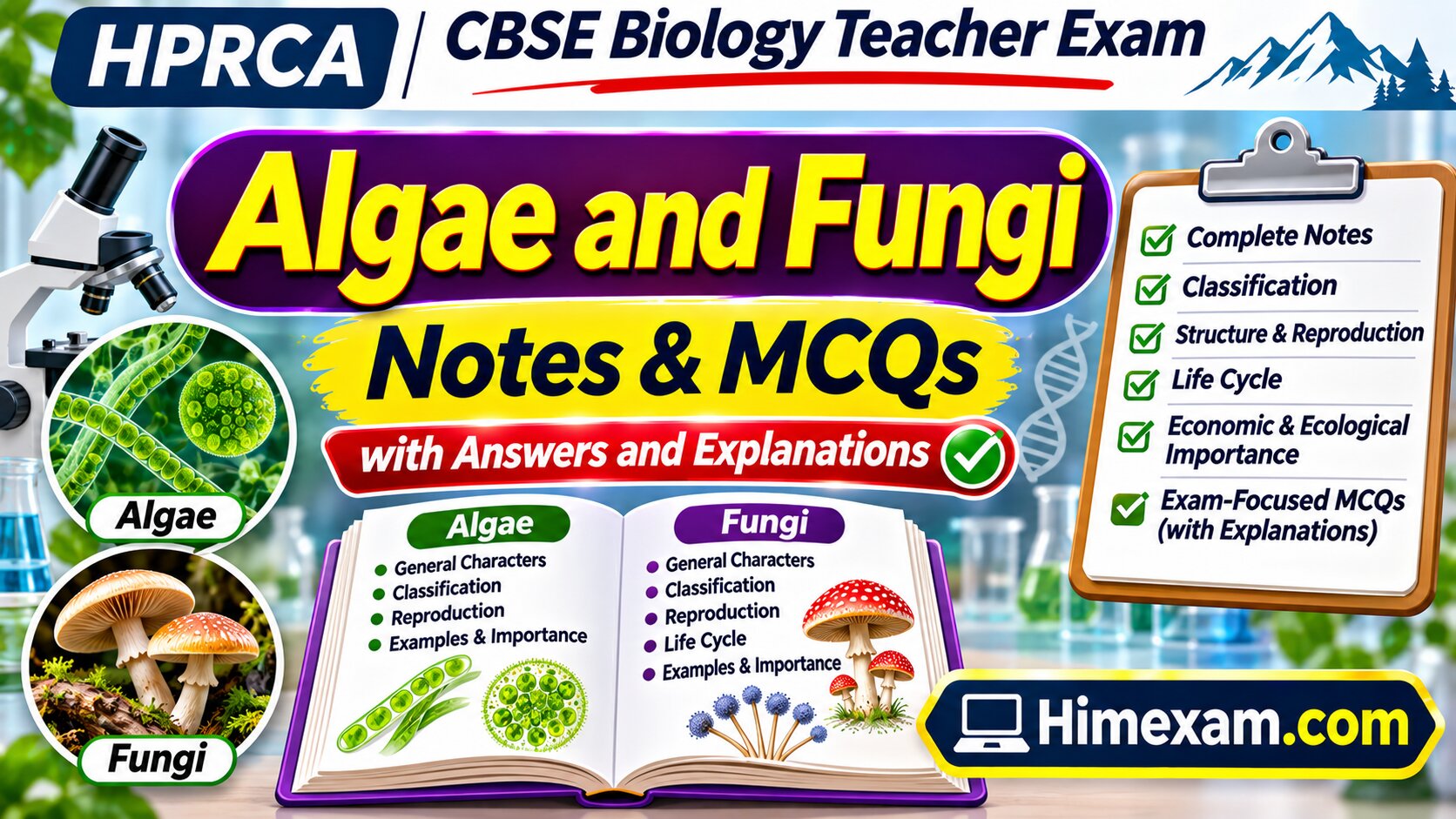


Algae and Fungi Notes & MCQs with Answers and Explanations for HPRCA CBSE Biology Teacher Exam
Algae and Fungi: Complete Study Notes
Topic: Algae and Fungi – General Characteristics, Classification, Range of Thallus Organization, Economic Importance, Symbiotic Associations (Lichens and Mycorrhiza), Edible and Poisonous Mushrooms.


PART A: ALGAE
1. Introduction to Algae
Algae are predominantly aquatic, photosynthetic organisms that contain chlorophyll and other photosynthetic pigments. They may be unicellular, colonial, filamentous or large multicellular forms.
They are commonly found in freshwater, marine water, moist soil, rocks, tree trunks and other damp habitats. Some algae also occur in unusual environments such as snow, hot springs and symbiotic associations with other organisms.
1.1 General Characteristics of Algae
- Habitat: Most algae are aquatic, occurring in freshwater and marine environments. Some are terrestrial or grow in moist habitats.
- Body organization: Their plant body is called a thallus. It is not differentiated into true roots, stems and leaves.
- Photosynthesis: Most algae are photoautotrophic and contain chlorophyll a.
- Pigments: They possess different combinations of chlorophylls, carotenoids, xanthophylls and phycobilins.
- Cell wall: It is commonly composed of cellulose and other polysaccharides. Its exact composition varies among groups.
- Nutrition: Most algae prepare their own food through photosynthesis. Some species show mixotrophic or heterotrophic nutrition.
- Reproduction: They reproduce by vegetative, asexual and sexual methods.
- Sexual reproduction: It may be isogamous, anisogamous or oogamous.
- Reserve food: The stored food differs among algal groups.
- Organization: They range from microscopic unicellular organisms to giant seaweeds.
1.2 Habitat-Based Distribution of Algae
| Type | Habitat | Examples |
|---|---|---|
| Freshwater algae | Ponds, lakes and rivers | Spirogyra, Chlamydomonas, Volvox |
| Marine algae | Seas and oceans | Sargassum, Laminaria, Fucus |
| Terrestrial algae | Moist soil and damp surfaces | Trentepohlia |
| Epiphytic algae | Growing on other plants | Some species of Trentepohlia |
| Symbiotic algae | Living in association with other organisms | Chlorella in certain symbioses |
| Thermophilic algae | Hot springs | Some cyanobacteria and eukaryotic algae |
| Psychrophilic algae | Snow and ice | Chlamydomonas nivalis |
2. Classification of Algae
Algae are traditionally classified on the basis of their photosynthetic pigments, reserve food materials, cell wall composition, flagella, cellular organization and reproductive features.
In traditional botanical classification, three important groups are Chlorophyceae, Phaeophyceae and Rhodophyceae. Other major algal lineages include diatoms, dinoflagellates and euglenoids.
2.1 Major Traditional Classes of Algae
Three classical groups commonly emphasized in introductory plant biology.
A. Chlorophyceae (Green Algae)
Chlorophyceae are commonly known as green algae because chlorophyll a and chlorophyll b are their principal photosynthetic pigments.
General Characteristics:- They are mostly freshwater organisms, although marine and terrestrial species also occur.
- They possess chlorophyll a and b.
- Carotenoids are also present.
- The cell wall is generally composed of cellulose and other polysaccharides.
- Food is primarily stored as starch, commonly associated with pyrenoids in many members.
- Motile cells generally possess equal or similar flagella, often two or four.
- Thallus organization ranges from unicellular to colonial and filamentous forms.
- Sexual reproduction may be isogamous, anisogamous or oogamous.
| Alga | Important Characteristics |
|---|---|
| Chlamydomonas | Unicellular, motile, biflagellate green alga. |
| Volvox | Motile colonial green alga with differentiated reproductive and somatic cells. |
| Chlorella | Unicellular, non-motile green alga. |
| Spirogyra | Unbranched filamentous alga with spiral chloroplasts. |
| Ulothrix | Unbranched filamentous alga with a basal holdfast cell. |
| Ulva | Sheet-like multicellular green alga, commonly called sea lettuce. |
| Oedogonium | Filamentous green alga characterized by cap cells. |
| Chara | Complex freshwater green alga with whorled branchlets. |
- Principal pigments: Chlorophyll a and b.
- Reserve food: Starch.
- Cell wall: Mainly cellulose.
- Example of spiral chloroplast: Spirogyra.
- Example of colonial organization: Volvox.
- Example of sheet-like thallus: Ulva.
B. Phaeophyceae (Brown Algae)
Phaeophyceae are commonly called brown algae. They are predominantly marine and include several large seaweeds.
General Characteristics:- Most members are marine and are especially common in cold and temperate coastal waters.
- They contain chlorophyll a, chlorophyll c and carotenoids.
- The characteristic brown colour is due mainly to fucoxanthin.
- The cell wall contains cellulose and alginates.
- Food is stored mainly as laminarin and mannitol.
- Motile reproductive cells generally possess two unequal, laterally inserted flagella.
- The thallus may be differentiated into holdfast, stipe and blade-like frond.
- Reproduction occurs through vegetative, asexual and sexual methods.
| Example | Important Feature |
|---|---|
| Ectocarpus | Branched filamentous brown alga. |
| Dictyota | Commonly shows dichotomous branching. |
| Laminaria | Large kelp with a differentiated thallus. |
| Fucus | Brown alga with conceptacles and oogamous reproduction. |
| Sargassum | Brown seaweed with air bladders in many species. |
| Macrocystis | Giant kelp; among the largest algae. |
| Turbinaria | Marine brown seaweed. |
Holdfast anchors the alga; it is not a true root.
- Characteristic pigment: Fucoxanthin.
- Major reserve foods: Laminarin and mannitol.
- Cell wall: Cellulose and alginates.
- Predominantly marine.
- Motile cells: Two unequal lateral flagella.
- Example of giant kelp: Macrocystis.
C. Rhodophyceae (Red Algae)
Rhodophyceae are known as red algae because they contain red-coloured phycobilin pigments, particularly phycoerythrin.
General Characteristics:- Most red algae are marine, although some freshwater species occur.
- They contain chlorophyll a and d in most traditionally described members.
- They contain phycobilin pigments, particularly phycoerythrin and phycocyanin.
- Phycoerythrin gives many species their characteristic red appearance.
- Reserve food is stored as floridean starch.
- The cell wall commonly contains cellulose, agar or carrageenan in different groups.
- Flagellated stages are completely absent.
- Sexual reproduction is generally oogamous.
- Life cycles may be complex and often involve three phases.
| Example | Importance / Feature |
|---|---|
| Polysiphonia | Branched red alga with a characteristic polysiphonous organization. |
| Porphyra | Edible marine red alga; commonly used as nori. |
| Gelidium | Important commercial source of agar. |
| Gracilaria | Important source of agar. |
| Chondrus | Source of carrageenan. |
| Corallina | Calcareous red alga with calcium carbonate deposits. |
- Characteristic pigment: Phycoerythrin.
- Reserve food: Floridean starch.
- Flagellated stages: Absent.
- Important agar sources: Gelidium and Gracilaria.
- Important carrageenan source: Chondrus.
- Example of red alga: Polysiphonia.
2.2 Comparison of Major Algal Classes
| Characteristics | Chlorophyceae | Phaeophyceae | Rhodophyceae |
|---|---|---|---|
| Common name | Green algae | Brown algae | Red algae |
| Main pigments | Chlorophyll a, b | Chlorophyll a, c, fucoxanthin | Chlorophyll a, usually d, phycobilins |
| Reserve food | Starch | Laminarin and mannitol | Floridean starch |
| Habitat | Mostly freshwater | Mostly marine | Mostly marine |
| Cell wall | Mainly cellulose | Cellulose and alginates | Cellulose and other polysaccharides |
| Flagella | Usually equal in motile stages | Usually two unequal lateral flagella | Absent |
| Sexual reproduction | Iso-, aniso- and oogamy | Iso-, aniso- and oogamy | Generally oogamous |
| Examples | Spirogyra, Volvox | Fucus, Laminaria | Gelidium, Polysiphonia |
2.3 Other Important Algal Groups
In modern biological classification, many organisms historically grouped under algae belong to distinct evolutionary lineages. The following groups are also important for graduation-level examinations.
1. Bacillariophyceae (Diatoms)
- Diatoms are microscopic, photosynthetic organisms found in freshwater and marine environments.
- Their cell walls contain silica and are called frustules.
- A frustule consists of two overlapping halves called epitheca and hypotheca.
- They are important components of phytoplankton.
- They contribute significantly to global aquatic primary production.
- Accumulated fossil diatom shells form diatomaceous earth.
The two silica valves fit together like the two parts of a box.
2. Dinophyceae (Dinoflagellates)
- Mostly unicellular, aquatic and frequently marine organisms.
- They generally possess two flagella arranged in different orientations.
- Many species have cellulose plates forming an armour-like covering called the theca.
- They contain chlorophyll a and c and various carotenoids.
- Some species cause red tides or harmful algal blooms.
- Examples: Ceratium, Noctiluca and Gonyaulax.
3. Euglenophyceae (Euglenoids)
- Commonly found in freshwater, particularly stagnant water rich in organic matter.
- They have a flexible protein-rich covering called a pellicle rather than a typical cellulose cell wall.
- They possess chlorophyll a and b.
- Many species are photosynthetic in light and can obtain nutrients heterotrophically under suitable conditions.
- They commonly possess one emergent flagellum and a second shorter flagellum.
- Example: Euglena.
4. Cyanobacteria (Blue-Green Algae)
- Cyanobacteria are photosynthetic prokaryotes, not true eukaryotic algae.
- They contain chlorophyll a and phycobilin pigments.
- They do not possess a membrane-bound nucleus or chloroplasts.
- Many species can fix atmospheric nitrogen.
- Examples: Nostoc, Anabaena and Oscillatoria.
- Some species possess specialized nitrogen-fixing cells called heterocysts.
3. Range of Thallus Organization in Algae
The algal plant body is called a thallus because it is not differentiated into true roots, stems and leaves. Algae show a remarkable range of structural organization, from a single cell to large and complex multicellular seaweeds.
3.1 Unicellular Organization
The entire organism consists of a single cell. It may be motile or non-motile.
| Type | Description | Example |
|---|---|---|
| Motile unicellular | Possesses flagella and moves in water. | Chlamydomonas |
| Non-motile unicellular | Does not possess locomotory flagella. | Chlorella |
3.2 Colonial Organization
Several cells remain associated to form a colony. The cells may be embedded in a common gelatinous matrix or arranged in a definite pattern.
- Motile colonies: Volvox.
- Non-motile colonies: Hydrodictyon and Scenedesmus.
- Colonial forms: Gonium and Pandorina.
3.3 Palmelloid Organization
In this type, non-motile cells remain embedded in a common gelatinous matrix. The cells are not organized into a typical motile colony.
Example: Palmella.
3.4 Dendroid Organization
The cells form a branched, tree-like arrangement, usually attached to a substratum.
Example: Ecballocystis is commonly cited in traditional descriptions of dendroid organization.
3.5 Filamentous Organization
Cells divide repeatedly in one plane and remain attached end to end, forming filaments. Filaments may be unbranched or branched.
| Type | Description | Example |
|---|---|---|
| Unbranched filament | Cells arranged in a single linear row. | Spirogyra, Ulothrix |
| Branched filament | Filaments develop lateral branches. | Cladophora, Ectocarpus |
3.6 Heterotrichous Organization
This is a more advanced filamentous organization in which the thallus is differentiated into two systems:
- Prostrate system: Grows horizontally along the substratum and helps in attachment.
- Erect system: Grows vertically and projects above the substratum.
Examples: Stigeoclonium, Fritschiella and Coleochaete.
3.7 Siphonaceous or Coenocytic Organization
The thallus is large and tubular but lacks regular cross walls. It contains a continuous mass of cytoplasm with many nuclei.
- The body is generally multinucleate.
- Regular septa are generally absent, except in certain reproductive or damaged regions.
- The thallus is coenocytic.
- Examples: Vaucheria, Caulerpa and Codium.
3.8 Siphonocladous Organization
The thallus consists of large multinucleate cells separated by cross walls. It differs from a completely aseptate siphonaceous thallus.
Examples: Cladophora and Valonia.
3.9 Parenchymatous Organization
Cells divide in more than one plane and form tissue-like structures. The thallus may become sheet-like or highly differentiated.
- Ulva: Sheet-like or two-cell-layered thallus in many species.
- Laminaria: Differentiated into holdfast, stipe and blade.
- Fucus: Complex parenchymatous thallus.
- Sargassum: Large, differentiated marine thallus.
↓
This is a comparison of structural complexity, not a universal evolutionary sequence.
3.10 Summary Table of Thallus Organization
| Organization | Example |
|---|---|
| Unicellular motile | Chlamydomonas |
| Unicellular non-motile | Chlorella |
| Colonial motile | Volvox |
| Colonial non-motile | Hydrodictyon |
| Palmelloid | Palmella |
| Dendroid | Ecballocystis |
| Unbranched filamentous | Spirogyra |
| Branched filamentous | Cladophora |
| Heterotrichous | Stigeoclonium |
| Siphonaceous / Coenocytic | Vaucheria, Caulerpa |
| Siphonocladous | Cladophora, Valonia |
| Parenchymatous | Ulva, Fucus |
4. Reproduction in Algae
Algae reproduce through three major methods: vegetative, asexual and sexual reproduction.
4.1 Vegetative Reproduction
Vegetative reproduction takes place through the fragmentation or division of the thallus.
- Cell division: Common in unicellular forms such as Chlorella.
- Fragmentation: The thallus breaks into smaller pieces, and each piece develops into a new individual.
- Examples: Spirogyra and other filamentous algae.
4.2 Asexual Reproduction
Asexual reproduction commonly occurs through spores formed without the fusion of gametes.
| Spore Type | Characteristics |
|---|---|
| Zoospores | Motile, flagellated spores. |
| Autospores | Non-motile spores resembling the parent cell. |
| Aplanospores | Non-motile asexual spores. |
| Hypnospores | Thick-walled resting spores in certain algae. |
| Monospores | Non-motile spores common in some red algae. |
| Tetraspores | Four spores produced by meiosis in the tetrasporangia of many red algae. |
4.3 Sexual Reproduction
Sexual reproduction involves the fusion of two gametes to form a zygote.
Types of Sexual Reproduction:1. Isogamy
Fusion occurs between two morphologically similar gametes. They may be motile or non-motile.
Examples: Ulothrix and certain species of Chlamydomonas.
2. Anisogamy
Fusion occurs between two gametes that differ in size or form.
Example: Eudorina and certain species of Chlamydomonas.
3. Oogamy
Fusion takes place between a large, non-motile female gamete (egg) and a smaller male gamete, which is commonly motile in many algal examples.
Examples: Volvox, Fucus and Oedogonium.
5. Life Cycles in Algae
Algae exhibit different types of life cycles depending on the duration and dominance of haploid and diploid generations.
5.1 Haplontic Life Cycle
- The main vegetative plant body is haploid (n).
- Gametes are produced by mitosis.
- Fertilization forms a diploid zygote (2n).
- The zygote undergoes meiosis to produce haploid cells.
- The zygote is generally the only diploid stage.
- Examples: Chlamydomonas, Volvox and Spirogyra in their commonly described life cycles.
5.2 Diplontic Life Cycle
- The main vegetative plant body is diploid (2n).
- Meiosis produces haploid gametes.
- Fertilization restores the diploid chromosome number.
- The haploid phase is restricted to gametes.
- Example: Fucus.
5.3 Haplodiplontic Life Cycle
- Both haploid and diploid multicellular phases are present.
- The haploid generation is called the gametophyte.
- The diploid generation is called the sporophyte.
- Both generations may be similar or different in appearance.
- Examples: Ulva, Ectocarpus and Laminaria.
| Life Cycle | Dominant Phase | Examples |
|---|---|---|
| Haplontic | Haploid | Spirogyra, Chlamydomonas |
| Diplontic | Diploid | Fucus |
| Haplodiplontic | Both phases multicellular | Ulva, Ectocarpus, Laminaria |
6. Economic Importance of Algae
Algae have significant ecological, nutritional, industrial, pharmaceutical and agricultural importance. They are also important in aquatic ecosystems as primary producers.
6.1 Food and Nutrition
- Porphyra: Used as an edible seaweed, especially in nori production.
- Ulva: Commonly consumed as sea lettuce.
- Laminaria: Used as food in several coastal regions.
- Chlorella: Investigated and cultivated as a protein-rich food supplement.
- Arthrospira (Spirulina): Commercially cultivated as a nutrient-rich biomass.
6.2 Industrial Importance
| Product | Source | Uses |
|---|---|---|
| Agar | Gelidium and Gracilaria | Culture media, food industry and biotechnology. |
| Alginate | Brown algae such as Laminaria and Macrocystis | Food thickening, textile printing, pharmaceuticals and dental materials. |
| Carrageenan | Red algae such as Chondrus and Kappaphycus | Food stabilizer and thickening agent. |
| Diatomaceous earth | Accumulated fossil diatom frustules | Filtration, abrasives and insulation. |
6.3 Agricultural Importance
- Seaweed extracts are used as biostimulants in agriculture.
- Some cyanobacteria fix atmospheric nitrogen and improve soil fertility.
- Anabaena forms a nitrogen-fixing association with Azolla.
- Algae contribute organic matter to aquatic and terrestrial ecosystems.
- Some algal biomass is used as an organic soil amendment.
6.4 Environmental Importance
- Algae form the base of many aquatic food chains.
- They release oxygen during photosynthesis.
- They absorb carbon dioxide and contribute to global carbon cycling.
- They are used in certain wastewater treatment and bioremediation systems.
- Diatoms are important indicators in environmental monitoring.
6.5 Pharmaceutical and Research Importance
- Algal compounds are investigated for antioxidant, antimicrobial and other biological activities.
- Agar is extensively used in microbiological research.
- Algal cultures are used in photosynthesis and cell biology research.
- Microalgae are investigated for biofuel production.
- Gelidium and Gracilaria – Agar.
- Laminaria and Macrocystis – Alginate.
- Chondrus and Kappaphycus – Carrageenan.
- Diatoms – Diatomaceous earth.
- Porphyra – Edible seaweed.
- Arthrospira – Commercial protein-rich biomass.
PART B: FUNGI
7. Introduction to Fungi
Fungi are eukaryotic, non-photosynthetic, spore-producing organisms that obtain nutrients through absorption. They form a separate kingdom, Kingdom Fungi, in modern biological classification.
They include yeasts, moulds, mushrooms, rusts, smuts and many other organisms. Fungi are found in soil, water, decaying organic matter, living organisms and diverse environmental conditions.
7.1 General Characteristics of Fungi
- Eukaryotic organization: Fungal cells possess a true nucleus and membrane-bound organelles.
- Absence of chlorophyll: Fungi lack chlorophyll and do not perform oxygenic photosynthesis.
- Nutrition: They are heterotrophic and absorb dissolved nutrients from their surroundings.
- Cell wall: The fungal cell wall is primarily composed of chitin and glucans.
- Cell membrane: Ergosterol is the principal sterol in most fungal cell membranes.
- Body organization: Most fungi consist of thread-like structures called hyphae.
- Mycelium: A network of hyphae is called mycelium.
- Yeasts: Some fungi are unicellular and reproduce commonly by budding or fission.
- Reserve food: Glycogen and lipids are the principal stored food materials.
- Reproduction: Fungi reproduce by vegetative, asexual and sexual methods.
- Habitat: Most fungi grow in moist environments rich in organic matter.
- Nutrition types: They may be saprotrophic, parasitic, mutualistic or occasionally predatory.
8. Structure of Fungi
8.1 Hyphae
Hyphae are long, thread-like tubular structures that form the basic structural units of most multicellular fungi.
They may be branched or unbranched and may contain one or many nuclei depending on the fungal group.
8.2 Mycelium
A mass or network of interconnected hyphae is called mycelium. It forms the vegetative body of most filamentous fungi.
- Vegetative mycelium: Absorbs nutrients from the substrate.
- Aerial mycelium: Extends above the substrate and may bear reproductive structures.
8.3 Types of Hyphae
| Type | Characteristics | Examples |
|---|---|---|
| Aseptate / Coenocytic | Generally lack regular septa and contain many nuclei in a continuous cytoplasm. | Rhizopus, Mucor |
| Septate | Divided into compartments by cross walls called septa. | Aspergillus, Penicillium |
| Dolipore septate | Specialized septal pores with barrel-shaped swellings. | Many Basidiomycota |
Hyphae collectively form the mycelial network.
8.4 Specialized Structures in Fungi
| Structure | Function |
|---|---|
| Rhizoids | Attachment and absorption of nutrients. |
| Stolons | Horizontal hyphae spreading across the substrate. |
| Sporangiophore | Specialized hypha supporting a sporangium. |
| Conidiophore | Specialized hypha bearing conidia. |
| Haustoria | Structures that absorb nutrients from host cells in many parasitic fungi. |
| Appressorium | Specialized attachment and penetration structure in many plant pathogens. |
| Sclerotium | Compact, hardened resting structure that helps survival. |
| Rhizomorph | Rope-like aggregation of fungal hyphae. |
| Fruiting body | Reproductive structure that produces spores. |
9. Classification of Fungi
Fungi have traditionally been classified using their reproductive structures, particularly the nature of their sexual spores, asexual spores and hyphal organization.
Traditional textbooks often describe four major groups: Phycomycetes, Ascomycetes, Basidiomycetes and Deuteromycetes. Modern fungal classification recognizes several distinct evolutionary phyla and does not treat Deuteromycetes as a natural taxonomic group.
9.1 Traditional Classification of Fungi
A. Phycomycetes (Traditional Group)
Phycomycetes is a historical textbook category that includes certain fungi with generally aseptate, coenocytic hyphae. Many organisms formerly placed here are now classified into different modern phyla.
General Characteristics:- Mycelium is generally aseptate and coenocytic.
- They commonly grow in soil, decaying organic matter and aquatic habitats.
- Asexual reproduction commonly occurs through sporangiospores or zoospores.
- Sexual reproduction may involve gametangial fusion or other forms of sexual reproduction, depending on the organism.
- Examples include Rhizopus, Mucor, Albugo and certain water moulds in older textbook treatments.
| Example | Important Feature |
|---|---|
| Rhizopus | Common bread mould; forms sporangia. |
| Mucor | Common saprotrophic mould. |
| Albugo | Plant pathogen causing white rust. |
| Pilobolus | Coprophilous fungus known for forcefully discharging its sporangium. |
B. Ascomycetes (Sac Fungi)
Ascomycetes are known as sac fungi because their sexual spores, called ascospores, are produced inside sac-like structures known as asci.
General Characteristics:- They may be unicellular or multicellular.
- Yeasts represent unicellular forms, whereas many other ascomycetes are filamentous.
- Hyphae are generally branched and septate.
- Asexual reproduction commonly occurs through conidia.
- Sexual spores are called ascospores.
- Ascospores are produced inside asci.
- Asci are frequently organized into fruiting bodies called ascocarps or ascomata.
| Example | Importance |
|---|---|
| Saccharomyces cerevisiae | Baker’s yeast; fermentation. |
| Penicillium | Antibiotic discovery and industrial applications. |
| Aspergillus | Industrial enzymes, organic acids and some pathogenic species. |
| Neurospora | Important model organism in genetics. |
| Morchella | Edible morel mushroom. |
| Tuber | Truffle; edible underground fungus. |
| Claviceps | Ergot fungus of cereals. |
Types of Ascocarps
| Type | Characteristics |
|---|---|
| Cleistothecium / Chasmothecium | Closed ascocarp without a preformed opening. |
| Perithecium | Flask-shaped ascocarp with an opening called an ostiole. |
| Apothecium | Open, cup-shaped or disc-shaped ascocarp. |
C. Basidiomycetes (Club Fungi)
Basidiomycetes are called club fungi because their sexual spores are generally produced externally on club-shaped structures called basidia.
General Characteristics:- They are mostly terrestrial.
- They include mushrooms, puffballs, bracket fungi, rusts and smuts.
- Hyphae are generally septate.
- The dikaryotic phase is usually prolonged and prominent.
- Two compatible nuclei remain in the same cell after plasmogamy.
- Karyogamy occurs in the basidium.
- Meiosis generally produces four haploid basidiospores externally on the basidium.
- Basidia are commonly arranged in a fertile layer called the hymenium.
- Fruiting bodies in many species are called basidiocarps.
| Example | Importance |
|---|---|
| Agaricus | Common cultivated button mushroom. |
| Puccinia | Causes rust diseases in plants. |
| Ustilago | Causes smut diseases. |
| Amanita | Includes poisonous and edible species. |
| Coprinus | Ink-cap mushrooms. |
| Polyporus | Bracket fungi. |
| Ganoderma | Bracket fungus with medicinal research interest. |
D. Deuteromycetes (Fungi Imperfecti)
Deuteromycetes is a traditional artificial group used for fungi in which a sexual stage was not known or had not been observed at the time of classification.
General Characteristics:- Sexual reproduction was unknown in the traditionally described members.
- They reproduce mainly through asexual spores, particularly conidia.
- Mycelium is generally septate and branched.
- Many are saprotrophs, while others are plant or animal pathogens.
- When sexual stages were discovered, many species were reassigned to Ascomycota or Basidiomycota.
- Alternaria – plant pathogen.
- Colletotrichum – causes anthracnose diseases.
- Trichoderma – useful in biological control.
- Cercospora – causes leaf spot diseases.
9.2 Modern Major Groups of Fungi
Modern fungal systematics recognizes evolutionary lineages based on molecular phylogeny, morphology, life cycles and other characteristics.
| Modern Group | Important Characteristics | Examples |
|---|---|---|
| Chytridiomycota | Produce motile zoospores with a single posterior flagellum. | Allomyces, Batrachochytrium |
| Blastocladiomycota | Many possess motile zoospores and show varied life cycles. | Allomyces is now placed here in modern classification. |
| Mucoromycota | Includes many coenocytic moulds. | Rhizopus, Mucor |
| Glomeromycota | Includes important arbuscular mycorrhizal fungi. | Rhizophagus, Funneliformis |
| Ascomycota | Sexual spores produced in asci. | Penicillium, Aspergillus, Saccharomyces |
| Basidiomycota | Sexual spores produced on basidia. | Agaricus, Puccinia, Ustilago |
| Chytrid-related early-diverging lineages | Various aquatic and terrestrial fungi with diverse reproductive structures. | Several early-diverging fungal lineages |
10. Reproduction in Fungi
Fungi reproduce through vegetative, asexual and sexual methods.
10.1 Vegetative Reproduction
- Fragmentation: A fragment of mycelium grows into a new fungal individual.
- Budding: A small outgrowth develops on the parent cell and separates to form a new cell.
- Fission: A unicellular fungal cell divides into two daughter cells.
10.2 Asexual Reproduction
Asexual reproduction occurs through spores that are produced without sexual fusion.
| Spore | Description | Example |
|---|---|---|
| Sporangiospores | Produced inside a sporangium. | Rhizopus, Mucor |
| Conidia | Produced externally on conidiophores or specialized hyphae. | Aspergillus, Penicillium |
| Arthrospores | Formed by fragmentation of hyphae into individual cells. | Some yeasts and fungi |
| Chlamydospores | Thick-walled resting cells formed from hyphal cells. | Some species of Candida and other fungi |
| Blastospores | Produced by budding. | Saccharomyces |
10.3 Sexual Reproduction
Sexual reproduction in fungi generally involves three important stages.
Plasmogamy: Fusion of the cytoplasm of two compatible cells.
Karyogamy: Fusion of two nuclei to form a diploid nucleus.
Meiosis: Reduction division that restores the haploid chromosome number.
Methods of Sexual Reproduction
- Gametangial copulation: Fusion of the entire contents of two gametangia.
- Gametangial contact: Male and female gametangia come into contact and nuclei are transferred.
- Spermatization: Non-motile male cells called spermatia are transferred to receptive female structures.
- Somatogamy: Fusion of compatible vegetative hyphae or cells.
10.4 Dikaryotic Stage
In many fungi, particularly Basidiomycota and several Ascomycota, plasmogamy is not immediately followed by karyogamy.
As a result, cells contain two genetically distinct haploid nuclei, represented as n + n. This condition is called the dikaryotic state.
- n = Haploid condition.
- 2n = Diploid condition.
- n + n = Dikaryotic condition, containing two separate haploid nuclei.
- Dikaryotic condition is not the same as a diploid nucleus.
11. Economic Importance of Fungi
Fungi play important roles in food production, agriculture, medicine, industry, biotechnology and environmental processes. Some are beneficial, while others cause diseases and food spoilage.
11.1 Food Industry
- Saccharomyces cerevisiae: Used in bread-making and alcoholic fermentation.
- Agaricus bisporus: Common button mushroom used as food.
- Pleurotus species: Oyster mushrooms used as edible mushrooms.
- Morchella species: Morels, highly valued edible mushrooms.
- Penicillium roqueforti: Used in the production of certain blue cheeses.
- Penicillium camemberti: Used in the production of Camembert-type cheeses.
- Aspergillus oryzae: Used in the production of several fermented foods.
11.2 Medical Importance
| Fungus | Product / Importance |
|---|---|
| Penicillium rubens (historically called P. chrysogenum in industrial literature) | Source of penicillin. |
| Acremonium chrysogenum | Source of cephalosporin C. |
| Aspergillus terreus | Industrial production of lovastatin. |
| Claviceps purpurea | Produces ergot alkaloids. |
| Aspergillus niger | Important industrial source of citric acid. |
11.3 Industrial Importance
- Fungi are used in the production of industrial enzymes such as amylases, cellulases and proteases.
- Aspergillus niger is widely used for commercial citric acid production.
- Yeasts are used for ethanol production.
- Fungal enzymes are used in food processing, textile industries and detergents.
- Fungal biomass and metabolites are used in biotechnology.
11.4 Agricultural Importance
- Mycorrhizal fungi improve plant nutrient uptake.
- Trichoderma species are used as biological control agents against certain plant pathogens.
- Some fungi decompose organic matter and recycle nutrients.
- Entomopathogenic fungi such as Beauveria bassiana are used in biological pest management.
11.5 Ecological Importance
- Fungi act as major decomposers in terrestrial ecosystems.
- They recycle carbon, nitrogen, phosphorus and other nutrients.
- They form mutualistic relationships with plants through mycorrhiza.
- Lichens contribute to ecological succession and soil formation.
- Some fungi help in the decomposition of complex organic substances such as lignin and cellulose.
11.6 Harmful Effects of Fungi
- They cause plant diseases such as rust, smut, powdery mildew and wilt.
- They cause human diseases such as ringworm, candidiasis and aspergillosis.
- They cause food spoilage and deterioration of stored materials.
- Some produce toxic secondary metabolites called mycotoxins.
- Some mushrooms contain dangerous toxins that may cause organ failure or death.
12. Symbiotic Associations: Lichens
Lichens are composite organisms formed through a close association between a fungus and a photosynthetic partner. The photosynthetic partner may be a green alga or a cyanobacterium.
The fungal partner is called the mycobiont, while the photosynthetic partner is called the photobiont or phycobiont.
12.1 Components of Lichens
- Mycobiont: Usually an ascomycete, although some lichens involve basidiomycete fungi.
- Photobiont: A green alga or cyanobacterium.
- Fungal partner: Provides structural support, protection, water retention and mineral acquisition.
- Photosynthetic partner: Produces carbohydrates through photosynthesis.
- Cyanobacterial partner: In certain lichens, also fixes atmospheric nitrogen.
↓
Fungal structure and protection + photosynthetic carbon supply.
12.2 Types of Lichens
1. Crustose Lichens
- They form a thin crust closely attached to the substratum.
- They are difficult to remove without damaging the substratum.
- Examples: Lecanora and Graphis.
2. Foliose Lichens
- They have a flat, leaf-like and lobed thallus.
- They are generally attached to the substratum by root-like structures called rhizines.
- Examples: Parmelia and Xanthoria.
3. Fruticose Lichens
- They possess a shrubby, branched or hanging thallus.
- They may grow erect or hang from branches.
- Examples: Usnea and Ramalina.
Crust-like | Leaf-like | Shrubby or hanging
12.3 Internal Structure of Lichens
In many foliose lichens, the thallus shows distinct layers.
| Layer | Description / Function |
|---|---|
| Upper cortex | Compact fungal hyphae forming the protective upper layer. |
| Algal layer | Contains the photosynthetic partner. |
| Medulla | Loosely arranged fungal hyphae with air spaces. |
| Lower cortex | Compact lower fungal layer in many foliose lichens. |
| Rhizines | Attachment structures arising from the lower surface in many foliose lichens. |
12.4 Reproduction in Lichens
- Fragmentation: A fragment of the thallus develops into a new lichen.
- Soredia: Small powdery propagules containing fungal hyphae and photobiont cells.
- Isidia: Small outgrowths of the thallus containing both partners.
- Fungal sexual reproduction: The fungal partner may produce sexual spores, which must establish a new association with a suitable photobiont.
12.5 Economic and Ecological Importance of Lichens
- Bioindicators: Many lichens are sensitive to air pollution, especially sulfur dioxide, and are used in environmental monitoring.
- Soil formation: They contribute to weathering of rocks and early soil development.
- Primary succession: They are important pioneer organisms on bare rocks and other exposed surfaces.
- Dyes: Some lichens are used in the production of natural dyes.
- Litmus: Certain lichens have historically been used to produce litmus, an acid-base indicator.
- Perfumes: Oakmoss lichens such as Evernia prunastri are used in perfumery.
- Food: Some lichens are eaten by animals and humans after suitable processing.
- Secondary metabolites: Lichens produce substances such as usnic acid.
- Usnea – beard lichen.
- Parmelia – foliose lichen.
- Graphis – script lichen.
- Cladonia – reindeer lichen group.
- Roccella – traditionally used in dye production.
13. Mycorrhiza
Mycorrhiza refers to a mutualistic association between certain fungi and the roots of plants. The fungal partner receives carbohydrates and other organic compounds from the plant, while the plant benefits from improved acquisition of water and mineral nutrients, especially phosphorus.
Mycorrhizal associations are widespread and play an important role in plant growth, nutrient cycling and ecosystem functioning.
13.1 Functions of Mycorrhiza
- Improves phosphorus absorption from the soil.
- Enhances uptake of certain micronutrients.
- Increases the effective absorptive area of the root system.
- May improve plant tolerance to drought and certain environmental stresses.
- Can help protect plants against some root pathogens.
- Improves plant establishment in nutrient-poor soils.
- Contributes to soil structure and nutrient cycling.
13.2 Types of Mycorrhiza
A. Ectomycorrhiza
In ectomycorrhiza, fungal hyphae form a sheath or mantle around the root surface. The hyphae also penetrate between the root cortical cells, forming a network called the Hartig net.
Characteristics:- Fungal mantle is present around the root.
- Hartig net develops between root cortical cells.
- Fungal hyphae generally do not enter the living cortical cells.
- Common in many forest trees.
B. Endomycorrhiza
In endomycorrhiza, fungal structures develop within root cortical cells or tissues. The most widespread type is arbuscular mycorrhiza.
Characteristics:- Fungal hyphae penetrate root cortical tissues.
- In arbuscular mycorrhiza, branched structures called arbuscules develop inside cortical cells.
- Vesicles may occur in many species.
- Arbuscules are major sites of nutrient exchange.
- Many arbuscular mycorrhizal fungi belong to Glomeromycota.
C. Ectendomycorrhiza
This type combines features of ectomycorrhiza and endomycorrhiza. Fungal hyphae may form an external sheath and also penetrate certain root cells.
13.3 Important Structures in Mycorrhiza
| Structure | Function |
|---|---|
| Fungal mantle | Forms an external covering around roots in ectomycorrhiza. |
| Hartig net | Network of hyphae between root cells in ectomycorrhiza. |
| Arbuscules | Branched structures involved in nutrient exchange in arbuscular mycorrhiza. |
| Vesicles | Storage structures in some arbuscular mycorrhizal fungi. |
| External hyphae | Extend into soil to acquire nutrients and water. |
↓
13.4 Ectomycorrhiza vs Endomycorrhiza
| Feature | Ectomycorrhiza | Endomycorrhiza |
|---|---|---|
| External mantle | Usually present | Generally absent |
| Hartig net | Present | Absent |
| Intracellular structures | Generally absent in living cortical cells | Present in arbuscular forms |
| Arbuscules | Absent | Present in arbuscular mycorrhiza |
| Common host plants | Many forest trees | A wide variety of plants, including crops |
| Important fungi | Boletus, Amanita and other ectomycorrhizal fungi | Rhizophagus, Funneliformis |
14. Edible Mushrooms
Mushrooms are the reproductive fruiting bodies of certain fungi, particularly many members of Basidiomycota. Some edible mushrooms are also members of Ascomycota.
Edible mushrooms are valued as food because they provide proteins, dietary fibre, vitamins, minerals and various bioactive compounds.
14.1 Structure of a Typical Mushroom
A typical mushroom such as Agaricus possesses a cap, stalk, gills and underground mycelium.
| Part | Description |
|---|---|
| Pileus | The cap-like upper portion of the mushroom. |
| Stipe | The stalk that supports the pileus. |
| Gills (Lamellae) | Plates present on the lower surface of the cap; bear the hymenium. |
| Hymenium | Fertile layer containing basidia and developing spores. |
| Basidia | Club-shaped cells producing basidiospores. |
| Annulus | Ring-like structure left by the partial veil in some mushrooms. |
| Volva | Cup-like structure at the base, derived from the universal veil in species that possess it. |
| Mycelium | Underground network of fungal hyphae. |
Simplified educational representation of a gilled mushroom.
14.2 Important Edible Mushrooms
| Mushroom | Scientific Name | Important Feature |
|---|---|---|
| Button mushroom | Agaricus bisporus | Widely cultivated edible mushroom. |
| Oyster mushroom | Pleurotus ostreatus | Grows on dead wood and agricultural residues. |
| Paddy straw mushroom | Volvariella volvacea | Commonly cultivated in tropical regions. |
| Shiitake | Lentinula edodes | Popular edible mushroom cultivated on wood-based substrates. |
| Morel | Morchella esculenta | Highly valued edible ascomycete. |
| Chanterelle | Cantharellus cibarius | Wild edible mushroom. |
| Enoki | Flammulina filiformis | Edible mushroom with slender fruiting bodies. |
| Milky mushroom | Calocybe indica | Popular tropical cultivated mushroom. |
| King oyster | Pleurotus eryngii | Large edible oyster mushroom. |
| Truffle | Tuber species | Edible underground fungus. |
14.3 Nutritional Importance of Edible Mushrooms
- They are generally low in calories and fat.
- They contain dietary fibre.
- They provide varying amounts of proteins and essential amino acids.
- They contain B-group vitamins.
- They provide minerals such as potassium, phosphorus and selenium, depending on the species and growing conditions.
- Some mushrooms contain vitamin D2, particularly after exposure to ultraviolet light.
- They contain biologically active polysaccharides and other compounds.
14.4 Mushroom Cultivation
Mushroom cultivation is an important agricultural activity because mushrooms can be grown on various organic substrates and agricultural wastes.
Basic Steps:- Substrate selection: Select a suitable substrate such as wheat straw, paddy straw or compost, depending on the species.
- Substrate preparation: Prepare and condition the growing material through appropriate treatment.
- Spawning: Introduce mushroom spawn containing actively growing mycelium.
- Incubation: Maintain suitable environmental conditions for mycelial growth.
- Fruiting: Provide appropriate humidity, temperature, fresh air and light requirements according to the species.
- Harvesting: Harvest mushrooms at the appropriate developmental stage.
- Post-harvest handling: Clean, grade, package and store appropriately.
- Button mushroom – Agaricus bisporus.
- Oyster mushroom – Pleurotus ostreatus.
- Paddy straw mushroom – Volvariella volvacea.
- Milky mushroom – Calocybe indica.
- Morel – Morchella esculenta.
15. Poisonous Mushrooms
Not all mushrooms are safe for consumption. Some species contain toxic chemical compounds that can cause gastrointestinal illness, neurological disturbances, liver damage, kidney failure and even death.
Poisonous mushrooms may resemble edible species, making identification difficult without expert knowledge.
15.1 Important Poisonous Mushrooms
| Mushroom | Toxin | Major Effects |
|---|---|---|
| Amanita phalloides | Amatoxins | Severe liver damage and potentially fatal liver failure. |
| Amanita virosa | Amatoxins | Severe liver toxicity. |
| Amanita muscaria | Ibotenic acid and muscimol | Neurological symptoms and altered consciousness. |
| Amanita pantherina | Ibotenic acid and muscimol | Neurological and gastrointestinal symptoms. |
| Galerina marginata | Amatoxins | Potentially fatal liver injury. |
| Cortinarius orellanus | Orellanine | Delayed and potentially severe kidney damage. |
| Gyromitra esculenta | Gyromitrin | Can cause seizures and liver toxicity. |
| Inocybe species | Muscarine | Excessive salivation, sweating and other cholinergic symptoms. |
| Clitocybe rivulosa | Muscarine | Cholinergic poisoning. |
| Omphalotus olearius | Illudin compounds | Severe gastrointestinal symptoms. |
15.2 Important Mushroom Toxins
| Toxin | Associated Mushroom | Major Target / Effect |
|---|---|---|
| Amatoxins | Amanita phalloides | Inhibit RNA polymerase II, causing severe cellular and liver injury. |
| Muscarine | Inocybe species | Muscarinic receptor stimulation. |
| Muscimol | Amanita muscaria | Acts primarily on GABA-A receptors. |
| Orellanine | Cortinarius orellanus | Kidney toxicity. |
| Gyromitrin | Gyromitra esculenta | Can produce monomethylhydrazine and cause neurological and hepatic toxicity. |
| Illudin | Omphalotus species | Gastrointestinal toxicity. |
15.3 Symptoms of Mushroom Poisoning
- Nausea and vomiting.
- Abdominal pain and diarrhoea.
- Excessive sweating and salivation.
- Confusion, hallucinations or seizures.
- Jaundice and liver dysfunction.
- Kidney damage and reduced urine output.
15.4 Edible vs Poisonous Mushrooms
| Feature | Edible Mushrooms | Poisonous Mushrooms |
|---|---|---|
| Consumption | Suitable for consumption when correctly identified and properly prepared. | May cause serious poisoning. |
| Toxic compounds | Do not contain dangerous toxins at normal edible serving levels. | May contain amatoxins, muscarine or other toxins. |
| Examples | Agaricus bisporus, Pleurotus ostreatus | Amanita phalloides, Galerina marginata |
| Identification | Requires correct species identification. | Some species resemble edible mushrooms. |
16. Important Differences: Algae vs Fungi
| Feature | Algae | Fungi |
|---|---|---|
| Cell organization | Mostly eukaryotic; cyanobacteria are prokaryotic organisms traditionally called algae. | Eukaryotic. |
| Nutrition | Mostly photosynthetic. | Heterotrophic by absorption. |
| Chlorophyll | Present in photosynthetic algae. | Absent. |
| Cell wall | Variable; commonly cellulose in many eukaryotic algae. | Generally chitin and glucans. |
| Reserve food | Varies with group. | Glycogen and lipids. |
| Body organization | Unicellular to multicellular thallus. | Mostly hyphae forming mycelium; yeasts are unicellular. |
| Habitat | Mostly aquatic. | Mostly terrestrial, although many occur in aquatic habitats. |
| Nutrition method | Primarily autotrophic. | Saprotrophic, parasitic or mutualistic. |
| Reproduction | Vegetative, asexual and sexual. | Vegetative, asexual and sexual. |
| Examples | Chlamydomonas, Spirogyra, Fucus | Rhizopus, Agaricus, Penicillium |
17. Important One-Liner Facts for Examination
- Green algae contain chlorophyll a and b.
- Brown algae contain fucoxanthin.
- Red algae contain phycoerythrin.
- Floridean starch is the reserve food of red algae.
- Laminarin and mannitol are reserve foods of brown algae.
- Starch is the major reserve food in green algae.
- Spirogyra has spiral chloroplasts.
- Volvox is a colonial green alga.
- Chlamydomonas is a unicellular motile green alga.
- Ulva is commonly known as sea lettuce.
- Macrocystis is a giant kelp.
- Gelidium and Gracilaria are important sources of agar.
- Chondrus is an important source of carrageenan.
- Alginates are obtained from brown algae.
- Diatom cell walls are composed of silica.
- Diatomaceous earth is formed from accumulated diatom remains.
- Dinoflagellates commonly possess two flagella.
- Cyanobacteria are prokaryotic organisms.
- Fungal cell walls generally contain chitin.
- Ergosterol is the principal sterol of most fungal cell membranes.
- Glycogen is an important reserve food in fungi.
- A network of hyphae is called mycelium.
- Rhizopus is a common bread mould.
- Ascomycetes are called sac fungi.
- Basidiomycetes are called club fungi.
- Ascospores are produced inside asci.
- Basidiospores are generally produced externally on basidia.
- Penicillium is associated with the discovery of penicillin.
- Saccharomyces cerevisiae is used in baking and fermentation.
- Aspergillus niger is used in citric acid production.
- Trichoderma is used in biological control.
- Mycorrhiza is an association between fungi and plant roots.
- Arbuscules are characteristic structures of arbuscular mycorrhiza.
- Hartig net is found in ectomycorrhiza.
- Lichens consist of a fungal partner and a photosynthetic partner.
- The fungal component of lichen is called mycobiont.
- The photosynthetic component is called photobiont.
- Usnea is a fruticose lichen.
- Parmelia is a foliose lichen.
- Crustose lichens form a crust-like thallus.
- Amanita phalloides is known as the death cap.
- Amatoxins inhibit RNA polymerase II.
- Orellanine is associated with kidney toxicity.
- Muscarine causes cholinergic symptoms.
- Agaricus bisporus is the common button mushroom.
- Pleurotus ostreatus is the oyster mushroom.
18. Important Scientific Terms
| Term | Meaning |
|---|---|
| Thallus | Plant body not differentiated into true roots, stems and leaves. |
| Pyrenoid | Protein-rich structure associated with starch formation in many algae. |
| Fucoxanthin | Brown-coloured xanthophyll pigment. |
| Phycoerythrin | Red phycobilin pigment. |
| Floridean starch | Reserve carbohydrate of red algae. |
| Frustule | Siliceous cell wall of diatoms. |
| Hypha | Thread-like fungal filament. |
| Mycelium | Network of fungal hyphae. |
| Conidium | Asexual fungal spore formed externally. |
| Ascus | Sac-like structure containing ascospores. |
| Basidium | Structure that produces basidiospores. |
| Dikaryon | Cell containing two separate compatible haploid nuclei. |
| Mycobiont | Fungal component of a lichen. |
| Photobiont | Photosynthetic component of a lichen. |
| Mycorrhiza | Mutualistic association between fungi and plant roots. |
| Arbuscule | Branched fungal structure inside root cortical cells. |
| Hartig net | Intercellular hyphal network of ectomycorrhiza. |
| Mycotoxin | Toxic secondary metabolite produced by certain fungi. |
| Basidiocarp | Sexual fruiting body of many basidiomycetes. |
| Ascocarp | Sexual fruiting body of many ascomycetes. |
19. Quick Revision: Important Examples and Their Significance
| Organism | Remember For |
|---|---|
| Chlamydomonas | Unicellular green alga |
| Volvox | Colonial green alga |
| Spirogyra | Spiral chloroplast |
| Ulva | Sea lettuce |
| Fucus | Diplontic life cycle |
| Macrocystis | Giant kelp |
| Gelidium | Agar |
| Gracilaria | Agar |
| Chondrus | Carrageenan |
| Porphyra | Edible red seaweed |
| Nostoc | Cyanobacterium |
| Rhizopus | Bread mould |
| Saccharomyces | Baker’s yeast |
| Penicillium | Penicillin |
| Aspergillus niger | Citric acid production |
| Morchella | Edible morel |
| Agaricus bisporus | Button mushroom |
| Pleurotus ostreatus | Oyster mushroom |
| Puccinia | Rust disease |
| Ustilago | Smut disease |
| Amanita phalloides | Death cap mushroom |
| Trichoderma | Biological control |
| Usnea | Fruticose lichen |
| Parmelia | Foliose lichen |
| Gelidium | Commercial agar source |
| Rhizophagus | Arbuscular mycorrhizal fungus |
Algae and Fungi: 60 Important MCQs with Answers and Explanations
Section A: Algae – General Characteristics and Classification
Section B: Thallus Organization, Reproduction and Life Cycles
Which of the following combinations is correct?
Section C: Fungi – General Characteristics and Classification
Section D: Fungal Reproduction, Economic Importance and Applications
Which statements are correct?
Section E: Lichens and Mycorrhiza
Which of the following combinations is correct?
Section F: Edible and Poisonous Mushrooms
Which of the following combinations is correct?
Important Last-Minute Revision Points
- Green algae – Chlorophyll a and b; starch.
- Brown algae – Fucoxanthin; laminarin and mannitol.
- Red algae – Phycoerythrin; floridean starch.
- Diatoms – Siliceous frustules.
- Rhodophyceae – No flagellated stages.
- Fungi – Chitin-containing cell walls; glycogen storage.
- Ascomycetes – Ascospores inside asci.
- Basidiomycetes – Basidiospores on basidia.
- Plasmogamy – Cytoplasmic fusion.
- Karyogamy – Nuclear fusion.
- Dikaryotic condition – n + n.
- Lichens – Mycobiont + photobiont.
- Mycorrhiza – Fungi + plant roots.
- Hartig net – Ectomycorrhiza.
- Arbuscules – Arbuscular mycorrhiza.
- Amanita phalloides – Amatoxins.
- Cortinarius orellanus – Orellanine.
- Inocybe – Muscarine poisoning.
- Agaricus bisporus – Button mushroom.
- Pleurotus ostreatus – Oyster mushroom.
हमारे बारे में – Himexam.com
Himexam.com हिमाचल प्रदेश व अखिल भारतीय प्रतियोगी परीक्षाओं के लिए एक विश्वसनीय पोर्टल है। यहाँ आपको नवीनतम HP Govt Jobs, All India Jobs, HP GK, करेंट अफेयर्स, वन लाइनर प्रश्न, जिलेवार GK और पिछले वर्षों के प्रश्न पत्र की जानकारी एक ही जगह मिलती है। हमारी कोशिश है कि हर अभ्यर्थी को सही और समय पर अध्ययन सामग्री मिले।
📚 महत्वपूर्ण लिंक
 WhatsApp
 Facebook
 Telegram
 Instagram

Hello everyone! My name is Gaurav, My aim is to provide quality educational content, free study materials, and exam preparation resources to help students and job aspirants achieve their goals. I believe quality education should be accessible to everyone.